Executive summary. Bangladesh can enter 2036 with stronger public services, more productive firms and greater household security. Reaching that position depends on how it resolves bank losses, raises revenue, secures energy, expands opportunities for women and protects access to export markets. These choices interact with global demand, migration, technology and climate risk. This research examines those interactions across sixty chapters, then asks which outcomes would support or challenge its proposed policies.
The numerical scenarios use the same assumptions as research chapter 15: eleven years of real GDP growth at 3.5, 5.0 or 6.5 percent, the IMF FY25 purchasing-power base, and the UN medium population projection. They yield approximately 13,400, 15,700 or 18,300 international dollars of GDP per person in FY36, expressed at FY25 prices. These are conditional calculations, not predictions or promises of household income.
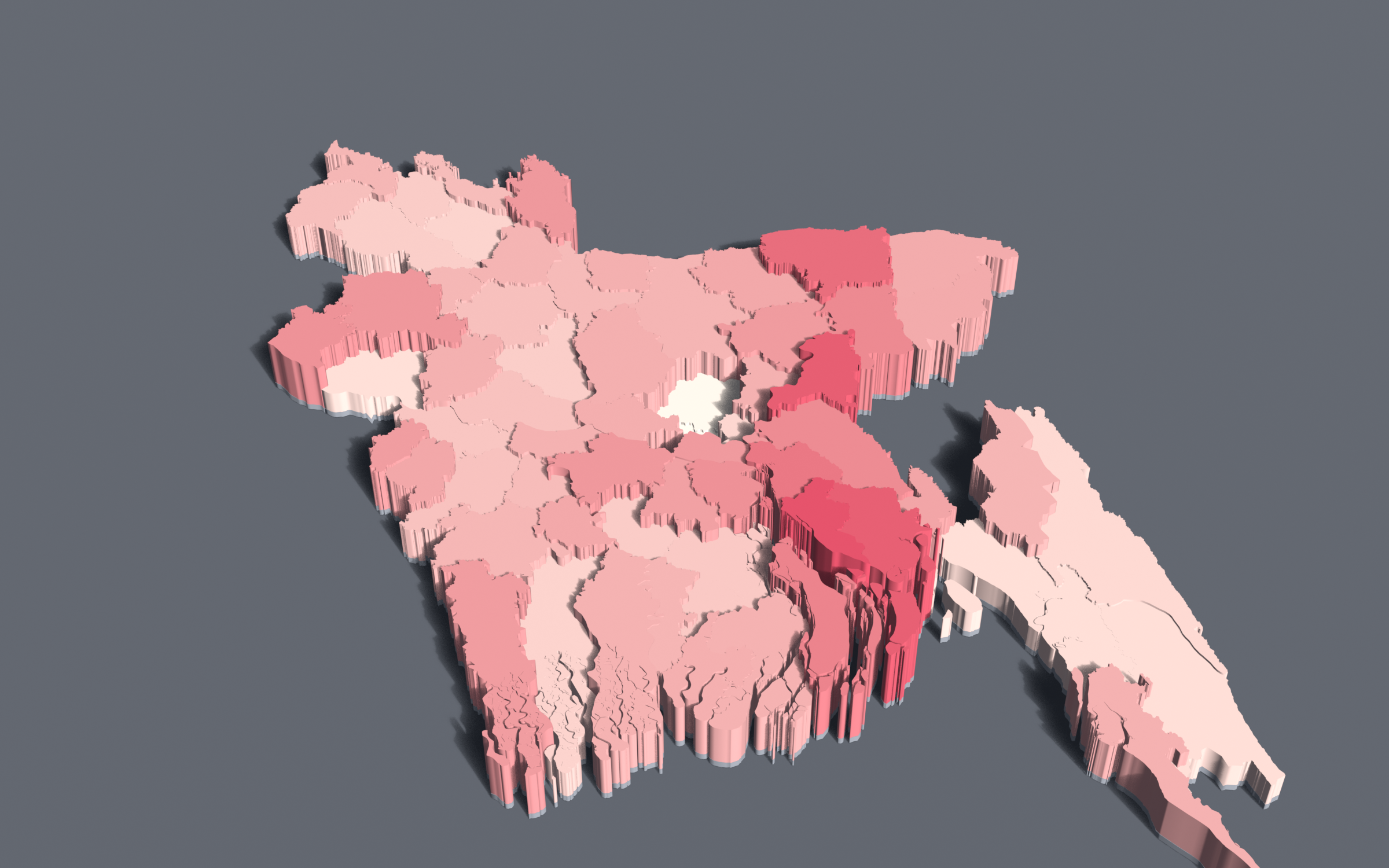
National averages are the wrong unit for this decade: on youth idleness the 64 districts run from 25.4 percent in Dhaka to 42.2 percent in Lakshmipur, and on remittance receipts the top district takes almost a hundred times what the bottom one takes.
Bangladesh graduates from least developed country status on a date that is currently 24 November 2026 and currently under review by the General Assembly. It does so with a per head income that has stopped rising in dollars, a banking system reporting a classified loan ratio more than three times what it reported two years earlier, a gas base two thirds depleted, and a labour force that shed 1.17 million people between 2023 and 2024. It also does so with a labour force projected at about 83 million in 2036 under the participation assumption in chapter 08, a savings rate near 30 percent of GDP, and a payments system that moves 34.7 percent of GDP through mobile money accounts each year.
The central question is how public institutions and private firms can put those resources to better use. A bank resolution programme draws on the same budget needed for schools and adaptation. Trade access depends on labour standards as well as price. Reliable electricity affects both export competitiveness and household costs. Each chapter examines one part of this system, with cross-references where another chapter changes the interpretation.
Five pressures that the chapters examine together
These five indicators locate important pressures on the economy. They have different reference periods and definitions; together they frame the investigation, rather than establish a complete model of growth.
Revenue. Central government tax revenue was 7.64 percent of GDP in the latest year the World Bank series carries, calendar 2021, down from 9.02 percent in 2012. The Finance Division's iBAS++ actuals put FY25 lower again: tax of 376,945 crore BDT, 6.79 percent of GDP, and total revenue of 436,054 crore BDT, 7.85 percent. Interest on sovereign debt took 134,430 crore BDT in the same year, 35.7 percent of every taka of tax collected.
Banks. The classified loan ratio stood at 30.6 percent at end December 2025 on Bangladesh Bank's reclassified definition, which excludes unclassified rescheduled and written off loans. The World Bank series reads 18.96 percent for 2024 and 9.57 percent for 2023. The rise combines changes in classification, recognition and loan performance. The ratio alone cannot separate those effects or measure previously hidden losses.
Exports. Ready made garments were 50.90 billion USD of 58.81 billion USD in goods exports in 2024, 86.6 percent. The share has not fallen below 84.0 percent in any year since 2019. The EU took 52.4 percent of the total and the United States 14.8 percent, so two jurisdictions took 67.2 percent.
Women at work. Female labour force participation on the ILO modelled series was 35.7 percent in 2010, 43.7 percent in 2022, and 38.7 percent in 2024. Translating that change into a number of women requires the matching female population aged 15 and above; it is not a count of jobs lost or created.
Gas. The Petrobangla 2024 census puts gas initially in place at 38,211 billion cubic feet, recoverable at 29,737, cumulative production at 21,082, and remaining reserves at 8,655, which is 29.1 percent of the recoverable base.
The chart brings together dated indicators with different units. Read each against its source and reference period; their joint movement does not identify the cause of slower growth.
Ten essays connect the research
The ten companion essays provide a shorter route through the research, with charts and maps. The sixty research chapters below contain the fuller sector arguments and their sources.
- Growth slowed before the politics did. The growth record, the fiscal squeeze, and an interest bill that already takes a third of every taka of tax.
- The banking system is the largest unbooked liability on the national balance sheet. A classified loan ratio past 30 percent, three years of near double digit inflation, and a taka that lost 30 percent of its dollar value.
- One product, one market, one date. Garments at 86.6 percent of goods exports, the EU at 52.4 percent, the November 2026 graduation clock, and the remittance map.
- A larger labour force needs more productive work. Ten million net new jobs needed by 2036, female participation in retreat, and a youth cohort meeting AI with fewer skills than the one before it.
- The human capital bill is unpaid, and health is where the arrears sit. Education and health spending against the peers, and where the arrears sit.
- Two thirds of the gas is gone and the grid is built for gas. Twenty nine percent of recoverable gas left, capacity payments on idle plants, and night lights that grew 141 percent.
- The delta is not waiting for the policy cycle. Five consecutive years with a quarter of the country under water, falling mortality, rising exposure, and salinity rewriting coastal water.
- Dhaka is a country inside a country. One built-up ridge from Old Dhaka to Gazipur, and an urban share that reaches only 37 percent by 2036 on the last decade's pace.
- The institutions weakened, and so did the numbers that measure them. Every institutional score fell, the statistics with them, and the digital economy is a gender gap with a geography.
- Three growth scenarios for 2036. The assumptions behind three growth paths, their income implications and the policy choices to examine alongside them.
The sixty chapters behind this piece
The sixty research chapters cover the economy, public services, institutions, regions and emerging opportunities. Each distinguishes recorded evidence from interpretation and proposed policy. Source gaps and conflicting definitions are stated where they affect the conclusion. The illustrations are conceptual; the diagrams summarise arguments and do not estimate causal effects.
Foundations: the economy, the state and the scenarios.
- 01 Macro trajectory
- 02 LDC graduation and the trade regime
- 03 External sector
- 04 Public finance
- 05 Monetary policy and prices
- 06 Banking sector
- 07 Capital markets and access to finance
- 08 Employment and demographics
- 09 Human capital
- 10 Energy and infrastructure
- 11 Climate and environment
- 12 Governance and institutions
- 13 Digital economy and AI
- 14 Urbanization, land and regions
- 15 Scenarios 2036
Production and sectors.
- 16 Agriculture and food security
- 17 Ready-made garments
- 18 Manufacturing diversification
- 19 Pharmaceuticals
- 20 Services exports and freelancing
- 21 Remittances and labour migration
- 22 SMEs and the informal economy
- 23 Ports, logistics and shipping
- 24 Transport megaprojects and PPP
- 25 Power sector
- 26 Gas, LNG and fuel security
- 27 Renewables and the energy transition
Environment and resilience.
- 28 Water, rivers and the delta
- 29 Coastal zone and disaster risk
- 30 Air, plastics and urban environment
People.
- 31 Health system
- 32 Education, TVET and skills
- 33 Higher education, research and brain drain
- 34 Poverty, inequality and social protection
- 35 Women in the economy
- 36 Youth, the demographic window and ageing
Money and finance.
- 37 Fintech, mobile money and payments
- 38 Insurance, pensions and long-term savings
- 39 Microfinance and NGOs
- 40 Tax administration and revenue reform
- 41 State-owned enterprises and subsidies
- 42 External debt and sovereign risk
- 43 Exchange rate, reserves and capital account
The world.
- 44 Trade agreements and market access
- 45 Geoeconomics: India, China, the US, Japan and the Gulf
- 46 The Rohingya and border economics
State and institutions.
- 47 Political economy, elections and state capacity
- 48 Justice, corruption and the rule of law
- 49 Local government and regional inequality
- 50 Dhaka: megacity, housing and mobility
- 51 Land records and property rights
- 52 Media, information and civil society
- 53 Statistics and data credibility
Frontier.
- 54 AI adoption, data protection and cybersecurity (open items)
- 55 Startups, venture capital and innovation
- 56 Tourism and aviation
- 57 Blue economy and the maritime domain
- 58 Labour rights, wages and due diligence
- 59 Food inflation and the cost of living
- 60 Diaspora, soft power and the nation brand
From scenarios to decisions
A useful national outlook needs more than a GDP endpoint. Higher output can coexist with rising inequality, unpaid care work, expensive housing or ecological damage. The chapters therefore examine jobs, public services, financial resilience and the distribution of costs alongside growth.
| Question | Evidence to bring together | Outcome to judge | Main research chapters |
|---|---|---|---|
| Can the state fund better services? | Tax collection, exemptions, debt service and spending execution | More reliable services without an unsustainable financing burden | 04, 31, 32, 40, 41, 42 |
| Can savings finance productive firms? | Bank asset quality, credit allocation, capital markets and firm entry | Investment, repayment and viable employment, rather than credit growth alone | 06, 07, 18, 22, 55 |
| Can trade generate better-paid work? | Market access, product capabilities, wages and labour rights | Export earnings and worker welfare, with compliance costs made explicit | 02, 17, 18, 19, 20, 58 |
| Can households use new opportunities? | Education, health, care work, participation and migration costs | Earnings and security across gender, age and region | 08, 09, 21, 31-39 |
| Can energy and cities support growth? | Fuel supply, dispatch, transport use, land records and local revenue | Reliable services at a cost households and the budget can sustain | 10, 14, 24-30, 49-51 |
| Can institutions correct mistakes? | Procurement, justice, information access and statistical revisions | Decisions that can be challenged, evaluated and revised | 12, 47, 48, 52, 53, 54 |
How to read a projection. An observation records a defined quantity at a stated date. An institutional forecast reflects the named institution's information and assumptions at publication. A scenario is this research's conditional calculation. A proposed target is a policy judgement, not an estimate of what will happen. The chapters should not be read as assigning probabilities to their reform and adverse cases.
What the growth arithmetic leaves out. The constant-rate scenarios do not estimate how much growth a particular reform causes. They do not model fiscal feedback, exchange-rate movements, distribution, migration responses or climate damages. The chart interpolates population growth between the two UN endpoints for the intervening years; its annual curve is not the UN's annual population path. A different population assumption changes GDP per person, and a shock to exports, fuel prices or financing can change the ranking of policy options even when the arithmetic ranking of fixed growth rates is unchanged.
How to use the work. Start with the relevant chapter's evidence and proposed choices. Identify the institution responsible, the resources needed and who bears the transition cost. Compare subsequent outcomes with the chapter's dated baseline, keeping definitions consistent. If the expected response does not appear, revisit the mechanism before assuming that the remedy is simply a larger programme. More research is needed wherever a chapter cannot establish the baseline or isolate the effect of a policy.
Sources
- BBS NA 2024: Bangladesh Bureau of Statistics national accounts on the 2015-16 base, via
bdpolicy.dbseriesbbs_gdp_real_growth_rate_pct,bbs_gdp_share_,bbs_gdp_growth_,bbs_investment_gdp_ratio_pct,bbs_private_investment_gdp_ratio_pct,bbs_national_savings_gdp_ratio_pct,bbs_per_capita_gdp_usd. - BBS CPI 2023 and 2024: BBS consumer price index, fiscal year averages and monthly rural and urban series, via
bdpolicy.dbseriesbbs_inflation_national_general,bbs_inflation_rural_general,bbs_inflation_urban_general. - BBS HIES 2022: BBS Household Income and Expenditure Survey 2022, via
bdpolicy.dbseriesbbs_hies_poverty_upper_national,bbs_hies_poverty_lower_national,bbs_hies_gini_national,bbs_hies_gini_urban, andlake/poverty/bbs_hies_divisional_poverty.parquet. - BBS Census 2022: Population and Housing Census 2022, National Report Volume I Tables 3.2.31 and 3.2.32 for internet and mobile phone use, and the district tables in
lake/demographics/bbs_census_district_.parquetandextracted/hdx/unrco-bangladesh/populationa-and-housing-census-dataset/.parquetfor NEET, remittance households, dwellings, slums and locality. - BB AR 2024: Bangladesh Bank Annual Report 2023-24, via
ocr_text/bb/annual_report/ar2023-2024.txt, for the classified loan tables, capital adequacy, profitability, the interest rate corridor, the 8 May 2024 crawling peg at a 117.00 mid rate, and the deposit and advance rate series. - BB Econ 2024 and 2025: Bangladesh Bank Economic Trends, via
bdpolicy.dbseriesbb_m2_money_supply,bb_bank_advances_totalandbb/remittances/economic_trends_october_2025.pdftables IB, XIIB and XVIII. - BB Econ 2026: two different things under one label. The balance of payments figures are Bangladesh Bank's own, from the monthly BoP page at https://www.bb.org.bd/en/index.php/econdata/bop. The exchange rate and M2 snapshots read from the
bdpolicy.dbindicators table (usd_bdt_rate,bb_m2_money_supply) are NOT Bangladesh Bank figures: the taka rate comes from the @fawazahmed0/currency-api dataset served from jsDelivr and M2 from World Bank FM.LBL.BMNY.CN (broad money, LCU). - BB NPL 2026: Bangladesh Bank classified loan ratio for end December 2025 on the reclassified definition,
bdpolicy.dbindicatorbb_npl_ratio, current 30.6 and previous 18.96. - BB RemStat 2025: Bangladesh Bank Statistics Department, Monthly Report on Workers' Remittance Inflows, July 2025, Annex-III country wise and Annex district wise tables for FY2016-17 to FY2025-26,
bb/remittances/monthly_remittance_july_2025.pdf. https://www.bb.org.bd/en/index.php/econdata/wageremitance - WB WDI 2026: World Bank World Development Indicators, API read 2026-09-06 (data last updated 2026-07-13) and
indicators/wb_full_bd.parquetplushdx/wb_combined.csv. Series used include NY.GDP.MKTP.KD.ZG, FP.CPI.TOTL.ZG, GC.TAX.TOTL.GD.ZS, GC.REV.XGRT.GD.ZS, FS.AST.PRVT.GD.ZS, FB.AST.NPER.ZS, SL.TLF., SL.EMP., SL.UEM.NEET., SE.XPD.TOTL.GD.ZS, SE.LPV.PRIM, SH.XPD.GHED.GD.ZS, SP.URB., EN.URB.LCTY*, EN.POP.EL5M.ZS, ER.H2O.INTR.PC, AG.YLD.CREL.KG, IT.NET.USER.ZS, BX.GSR.CCIS.CD. World Bank year N is the fiscal year ending June of year N for the national accounts rows. - WB BDU 2026: World Bank Bangladesh overview page, FY26 to FY28 growth projections and 2025 to 2028 national poverty estimates. https://www.worldbank.org/en/country/bangladesh/overview
- WB WGI 2024: Worldwide Governance Indicators percentile ranks for data year 2024,
governance/wgi_bd.parquet. - WB CPIA 2024: Country Policy and Institutional Assessment,
governance/wb_cpia_bd.parquet, IQ.CPA.PADM.XQ and IQ.CPA.REVN.XQ. - WB HCI 2025: Human Capital Index Plus,
indicators/wb_full_bd.parquet, HD_HCIP_OVRL_TO, HD_HCIP_EDUC_TO, HD_HCIP_HLTH_TO by sex. - WB Findex 2024: Global Findex database,
finance/findex_bd_full.parquet, account ownership, phone ownership and own name SIM by sex. - WB peers 2026: World Bank indicators for India, Indonesia, Pakistan, Thailand and Vietnam,
lake/data_points/source=world_bank_peer/, SE.XPD.TOTL.GD.ZS and SH.XPD.GHED.GD.ZS. - IMF WEO 2026: IMF World Economic Outlook via the DataMapper API, read 2026-09-06, series NGDP_RPCH, PCPIPCH, PPPPC, BCA_NGDPD, GGXWDG_NGDP. https://www.imf.org/external/datamapper/api/v1/
- IMF FAS 2024: IMF Financial Access Survey via
bdpolicy.dbseriesimf_fas_*, deposits to GDP, mobile money accounts and transactions, agents and ATMs. - IMF Art IV 2024: IMF Article IV staff report sovereign credit default swap estimates (Bloomberg quotes) via
finance/bd_sovereign_spreads.parquet. - MoF iBAS 2025: Finance Division iBAS++ FY25 actuals via
bdpolicy.dbseriesmof_actual_tax_revenue,mof_actual_revenue_total,mof_tax_gdp_ratio_actual,mof_revenue_gdp_ratio_actual,mof_sovereign_debt_interest_service,mof_actual_development_expenditure. - MoF Budget 2023: Finance Division consolidated evaluation of the twenty major state owned enterprises,
bdpolicy.dbseriessoe_consolidated_*. - ERD 2023 and 2024: Economic Relations Division external debt and debt service series,
bdpolicy.dbserieserd_debt_service_total_usd_mn,erd_debt_service_interest_usd_mn,erd_debt_service_revenue_pct,erd_foreign_debt_gdp_pct. - ERD STS 2025: Smooth Transition Strategy for LDC graduation, Economic Relations Division, February 2025, via
ocr_text/policies/ldc-graduation-smooth-transition-strategy__2025.txt, sections 2.1.2 and 2.2 for the EU market access mechanics. - UN CDP 2021 and 2026: UN Committee for Development Policy and the LDC Portal, graduation scheduled 24 November 2026 under General Assembly resolution 76/8, the 18 February 2026 extension request and the 21 July 2026 ECOSOC referral. https://www.un.org/ldcportal/content/bangladesh-graduation-status
- WTO 2015 and 2021: WTO TRIPS Council decisions on LDC transition periods, including the early exit clause at graduation. https://www.wto.org/english/tratop_e/trips_e/ldc_e.htm
- UN WPP 2024: UN World Population Prospects 2024 medium variant,
demography/un_wpp2024_bd.parquet, total population, growth rate, median age, fertility and births. - BACI 2024: CEPII BACI mirrored trade data for 2024,
trade/bd_hs6_trade.parquet,trade/bd_bilateral.parquetandtrade/ref_countries.parquet, values in thousand USD, Bangladesh code 50. - BIS 2026: Bank for International Settlements monthly and annual exchange rates,
bdpolicy.dbseriesbis_usd_bdt_monthly_eop(15908) and the annual average series (15913). - ILO 2025: ILOSTAT modelled estimates via
labor/ilo/.parquetandlabor/ilo_peers/.parquet, participation, employment by sector and status, informality and unemployment. - BMET 2023: Bureau of Manpower, Employment and Training overseas employment series via
bdpolicy.dbseriesbmet_overseas_employment_andbmet_workers_. - Petrobangla 2024: Petrobangla Annual Report 2024 Table 18 gas reserve census and the 2024 field production table,
lake/energy/petrobangla_gas_reserves_census_2024.parquetandlake/energy/petrobangla_field_production_capacity_2024.parquet. - BPDB 2023: Bangladesh Power Development Board FY23 panels,
lake/energy/bpdb_power_capacity_generation_panel.parquet,lake/energy/bpdb_financial_performance_2023.parquet,lake/energy/bpdb_per_capita_electricity.parquet. - Power Division 2023: Power Division Annual Report FY2022-23 (Bengali),
ocr_text/power_div/, installed capacity, plant count and transmission expansion. - NWPGCL 2025: North West Power Generation Company audited financial statements FY2024-25,
ocr_text/nwpgcl/audited_financial_statements_2024_2025.txt, capacity and energy payments. - Ember 2025: Ember yearly electricity data for Bangladesh,
climate/ember_yearly_bd.parquet, generation mix, demand and net imports. - EIA 2025: US Energy Information Administration international data,
energy/eia_international_bd.parquet, dry natural gas production, consumption and imports. - BWDB 2023: Bangladesh Water Development Board flood affected area series,
bdpolicy.dbseriesbwdb_flood_affected_area_sq_kmandbwdb_flood_affected_pct, andlake/climate/bwdb_historical_floods_bd.parquet. - FAO 2026: FAO satellite flood monitoring events for Bangladesh,
lake/climate/fao_flood_events_bd.parquet, July 2024 and April 2026 windows. - EMDAT 2026: EM-DAT International Disaster Database via
bdpolicy.dbseriesemdat_disaster_events,emdat_disaster_deaths,emdat_disaster_affected,emdat_disaster_damage. - Germanwatch CRI 2025: Climate Risk Index 2025, Table 5, rank 31 of 174 with score 12.36 for 1993 to 2022. https://www.germanwatch.org/sites/default/files/2025-02/Climate%20Risk%20Index%202025.pdf
- Zenodo 2024: Soil Resource Development Institute coastal salinity survey of 162 sites via
bdpolicy.dbseriescoastal_soil_salinity_*. - WHO GHO 2016 and 2023: WHO Global Health Observatory,
health/who_gho_bd.parquet, GHED_CHEGDP_SHA2011, GHED_GGHE-DGDP_SHA2011, GHED_OOPSCHE_SHA2011, GHED_OOP_pc_US_SHA2011, UHC_INDEX_REPORTED and the FINPROTECTION catastrophic spending indicators. - DHS Program 2022: Bangladesh Demographic and Health Survey stunting series via
bdpolicy.dbseriesbdhs_nutrition_stunting. - BANBEIS 2022 and 2023: Bangladesh Bureau of Educational Information and Statistics,
bdpolicy.dbseriesbanbeis_primary_*andlake/education/banbeis_institutions_students_by_tier.parquet. - VDem 2022: Varieties of Democracy dataset,
governance/vdem_bd.parquet, v2x_polyarchy, v2xel_frefair, v2x_jucon. - Freedom House 2024: Freedom in the World scores,
governance/freedomhouse_bd.parquet. - IBP Open Budget 2023: International Budget Partnership Open Budget Survey,
governance/ibp_open_budget_bd.parquet. - TI CPI 2024: Transparency International Corruption Perceptions Index via
owid/corruption-perception-index.csv. - CAG 2022: Comptroller and Auditor General Annual Activity Report 2022,
ocr_text/cag_deep/annual_activity_report_2022.txt. - BTRC 2023: Bangladesh Telecommunication Regulatory Commission connection, fibre and coverage series via
bdpolicy.dbseriesbtrc_*. - BB FSR 2024: Bangladesh Bank Financial Stability Report internet banking volumes via
bdpolicy.dbseriesbb_fsr_internet_banking_volume, converted from billion to crore BDT. - ICT Division 2020: ICT Division Annual Report 2019-20 (Bengali),
ocr_text/govtwin_min_ict/ictd_annual_report_2019_20_bn.txt, the 5 billion USD 2021 IT export target. - WIPO GII 2024: Global Innovation Index ranks via
indicators/wipo_gii_bd.parquet. - Planning Commission ADP 2025: Programming Division RADP FY2025-26 project table via
bdpolicy.dbadp_projects, allocations in lakh BDT converted to crore. - NEC 2025: National Economic Council approval of the FY2025-26 Annual Development Programme at 230,000 crore BDT, 18 May 2025. https://unb.com.bd/category/Bangladesh/nec-approves-tk-230000-crore-adp-for-fy-25-26/159985
- MinLaw 2026: Deposit Protection Act 2026 (Act 75 of 2026), assent 10 April 2026, ceiling of 200,000 BDT, reported by Bangladesh Sangbad Sangstha news items 319657 and 384747. The gazette text could not be opened.
- bd_gis nightlights: BDPolicyLab bd_gis pipeline, DMSP-OLS and VIIRS-DNB annual composites for Bangladesh,
bd_gis/outputs/nightlights/nightlights_timeseries.csv; only the VIIRS-DNB era from 2014 is compared, because the two sensors are not on one scale. - ILO 2025: ILOSTAT employment by sex and age (EMP_TEMP_SEX_AGE_NB_A, 10 year bands) and unemployment rate by sex and age (UNE_DEAP_SEX_AGE_RT_A), Bangladesh, via
data/labor/ilo/parquet files; youth is the 15 to 24 band. - UNESCO UIS 2023: SDG indicator 4.4.1, proportion of youth and adults who used a basic arithmetic formula in a spreadsheet, series ICTSKILLARSP by age group and sex, 2021 and 2023, via the HDX UNESCO extract
data/hdx/extra/unesco-data-for-bangladesh__sdg_data_bgd.parquet. - Planning Commission RADP FY26: Revised Annual Development Programme 2025-26 project table,
bdpolicy.dbtableadp_projects; the Department of Youth Development AI skills project (cost 4,635.5 lakh, allocation 1,325 lakh, cumulative expenditure 0) and the ICT Division total across 18 projects (228,625 lakh), lakh converted to crore. - WB WDI 2026, digital infrastructure: secure internet servers per million (IT.NET.SECR.P6), fixed broadband subscriptions per 100 (IT.NET.BBND.P2), resident patent applications (IP.PAT.RESD), youth NEET (SL.UEM.NEET.ME.ZS and by sex), working age share (SP.POP.1564.TO.ZS) and dependency ratio (SP.POP.DPND).
- WB WDI 2026, interest rates: deposit interest rate (FR.INR.DPST) and lending interest rate (FR.INR.LEND), calendar year, with CPI inflation (FP.CPI.TOTL.ZG); the real deposit rate in the chart is the difference of the two series.
- BB RemStat 2025, country wise: Monthly Report on Remittance Inflows, July 2025, Annexure-III, FY2024-25 rows for eighteen source countries, million USD, against the FY25 total of 30,328.80 million in BB Economic Trends October 2025 table XVIII.
- WB WDI 2026, digital exports and schooling: computer and information service exports as a share of service exports (BX.GSR.CCIS.ZS) for Bangladesh and the peer set, read from the partitioned lake pull at
data/lake/data_points/source=world_bankandsource=world_bank_peer; gross secondary and tertiary enrolment (SE.SEC.ENRR, SE.TER.ENRR); resident and non-resident patent applications (IP.PAT.RESD, IP.PAT.NRES).
Methods note. This narrative draws on a sixty chapter research manuscript. Source checks, corrections and unresolved evidence gaps are recorded in the chapter references and the accompanying SOURCES_LEDGER.md. These records do not establish independent verification of every inherited claim. Figures that come from lake queries run for this narrative are recorded in the accompanying SOURCES_LEDGER.md, among them the FY2024-25 country wise and district wise remittance tables from the Bangladesh Bank monthly report, the district youth NEET and internet use distributions from the 2022 census tables, the peer country education and health spending series, the VIIRS night light series, the ILO youth employment and unemployment series, the UNESCO youth digital skills series and the FY26 revised development programme project table. Two known conflicts in the underlying data are stated in the text rather than resolved silently: the FY26 development programme total and the census versus World Bank youth NEET measures. Where two vintages of a series exist, the piece uses the current one and says so. Where a threshold is this project's own calibration rather than a published target, it is labelled as such.