Executive finding
Five consecutive years with a quarter of the country under water, falling mortality, rising exposure, and salinity rewriting coastal water.
Bangladesh 2036, chapter 7 of 10. Contents, sources and the five numbers.
The delta is not waiting for the policy cycle
Climate is the one constraint in this piece that does not negotiate.
Flooding is not receding. On Bangladesh Water Development Board records, floods covered 31 percent of the country in 2019, 40.0 percent in 2020, 33 percent in 2021, 27.1 percent in 2022 and 25.7 percent in 2023, five consecutive years above a quarter of the national territory. The 1955 benchmark is 50,500 square kilometres, 34 percent. FAO satellite monitoring put the July 2024 event at 28,726 square kilometres across all 64 districts with 20.67 million people exposed, and the 1 to 15 April 2026 Sylhet event at 747 square kilometres and 477,056 people in four districts.
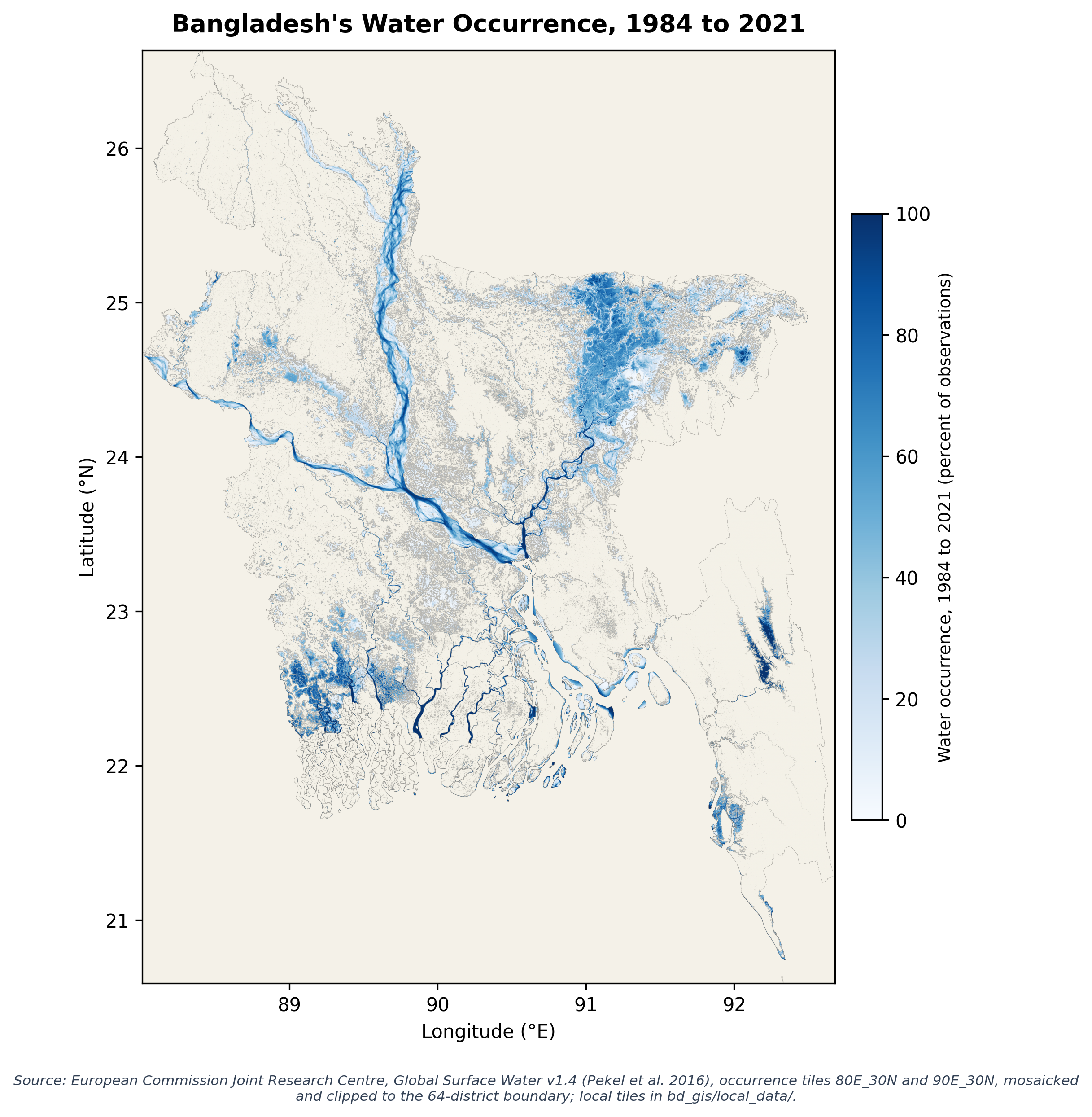
Bangladesh gets a cropping intensity of 198 percent out of 19,875 thousand acres of net cropped area by farming the same ground the water uses, which is why flood control and food supply are one policy and not two.
The human toll has fallen and the exposure has not. EM-DAT records 5,635 deaths in 2007 and an average above 900 a year through the 2000s, against 283 in 2020, 20 in 2023 and 124 in 2024. Early warning and shelters worked. But affected population reached 48.78 million in 2024, the series high, and the single year damage record is 4.60 billion USD in 2004. Germanwatch's Climate Risk Index for 1993 to 2022 ranks Bangladesh 31 of 174 with a score of 12.36, down from rank 7 with a score of 28.33 on the 2000 to 2019 assessment. The improvement is real and it is an improvement in mortality, not in exposure.
The slow variables are worse than the fast ones. Renewable freshwater per head fell from 647 cubic metres in 2017 to 620 in 2022, about 5.5 cubic metres a year, while withdrawals run at 34.2 percent of internal resources. Coastal soil salinity across 162 survey sites averages 1.52 millisiemens per centimetre with 29.6 percent of sites above 2.0. In Satkhira only 7.66 percent of households use surface water and 4.01 percent rainwater; in Bagerhat 21.99 percent use surface water and 16.74 percent rainwater, against a national tube well share of 90.7 percent. Salinity is already rewriting how coastal households get water.
One person in twelve, 8.38 percent of the population, lives below five metres of elevation. That belt is where the soil survey found 29.6 percent of its sites above 2.0 millisiemens per centimetre, and it is where 71.19 percent of Satkhira's households draw from tube wells because the surface water has gone brackish.
Five consecutive years with more than a quarter of the country flooded is the planning assumption, not the tail case.
The money does not match. Water resources, environment and disaster management together carry 13,889.7 crore BDT across 135 projects in the FY26 programme, 6.0 percent of the 230,000 crore approved total, against committed costs of 68,796 crore, roughly five times the annual allocation. The Bangladesh Water Development Board alone carries 10,497 crore of committed cost across 84 projects. Adaptation is being funded on a payment plan.
Previous: Two thirds of the gas is gone and the grid is built for gas
Next: Dhaka is a country inside a country
Bangladesh 2036, the series. Contents and the five numbers · 1 · 2 · 3 · 4 · 5 · 6 · 7 · 8 · 9 · 10
Sources for every figure in this chapter are listed on the contents page and in the series source ledger.
Cite / Reproduce
BDPolicyLab Research. (2026). The delta is not waiting for the policy cycle. Bangladesh Policy Laboratory. https://bdpolicylab.com/publications/2026-09-06-bangladesh-2036-7-the-delta
Method and source
Source: Primary sources cited at point of use in the publicationAs of 6 Sep 2026