Chapter 31 of 60 in the Bangladesh 2036 research base. Contents of the series.
Who pays for a longer life?
Bangladesh has built a broad primary-care network, but households still finance most treatment. Chronic illness exposes the weakness of that arrangement: patients need regular diagnosis, medicine and follow-up, while payment is organised around individual visits. The priority is a funded benefit package that patients can actually use, supported by staff, reliable medicines and accountable purchasing.
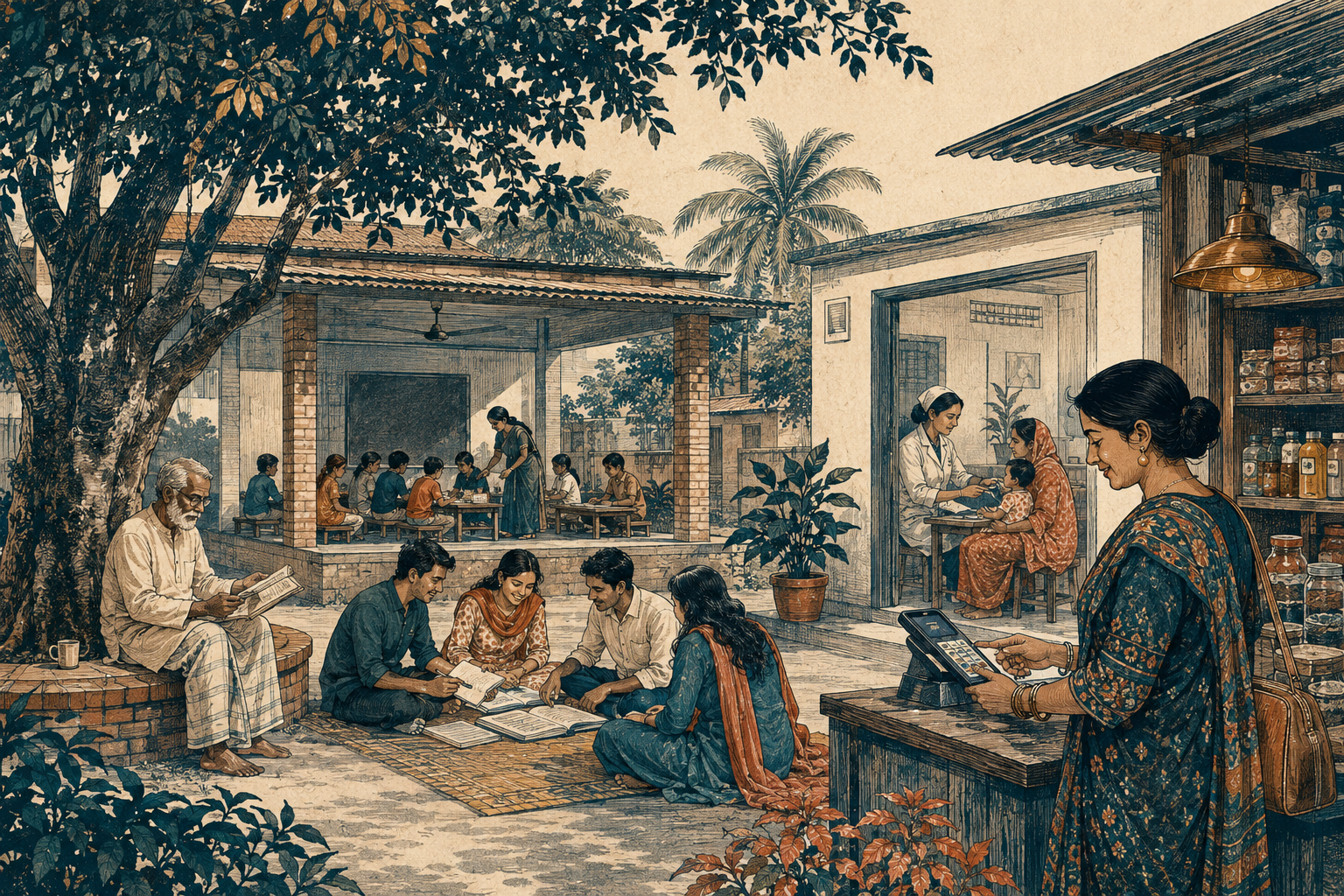
Public spending, household payments and service gaps
The financing record is a twenty three year drift from public to household payment. The national health accounts series that runs from 1997 to 2020 shows the government's share of total health expenditure falling from 36.11 percent in 1997 to 23.12 percent in 2020, while the household out of pocket share rose from 55.85 to 68.53 percent [MOHFW BNHA 2020]. Total health expenditure held between 2.3 and 3.2 percent of GDP for the whole series and stood at 2.8 percent in 2020, 54 USD per person [MOHFW BNHA 2020]. The international series extends the drift: domestic general government health expenditure fell from 0.47 percent of GDP in 2010 to 0.31 percent in 2023, its share of current health expenditure from 20.57 to 14.48 percent, while the out of pocket share climbed from 67.96 to 79.31 percent and out of pocket spending per person rose from 14.01 to 42.40 USD [WB WDI 2026].
Domestic private health expenditure reached 82.02 percent of current health expenditure in 2023 from 70.45 percent in 2010 [WB WDI 2026]. The measured welfare cost is chapter 09's: 24.42 percent of households spent more than a tenth of the household budget on health in 2016, and health payments pushed 6.99 percent of the non poor below the 3.65 USD a day line [WHO GHO 2016].
The capacity record is thin but moving, unevenly across staff grades. Hospital beds reached 0.92 per 1,000 people in 2023 from 0.54 in 2010, physicians 0.72 per 1,000 from 0.35, nurses and midwives 0.66 per 1,000 from 0.18 [WB WDI 2026]. The WHO workforce series shows medical doctors at 7.22 per 10,000 people in 2023, up from 2.38 in 2001, nursing and midwifery personnel at 6.64 per 10,000, up from 1.38 in 2003, pharmacists at 1.10 per 10,000, and a community health worker count of 148,713 in 2020, up from 21,202 in 2004 [WHO GHO 2023, HWF_0001, HWF_0006, HWF_0014, HWF_0024].
The mix is the finding: the WHO country strategy records a doctor to nurse ratio of 1 to 0.6 against a 1 to 3 international standard, and a combined workforce density of 8.3 per 10,000 against the 44.5 SDG benchmark it cites [WHO CCS 2020]; the 2023 series lifts the combined density to 13.86 across the two cited series [WHO GHO 2023, HWF_0001, HWF_0006], still under a third of the benchmark. Diagnostics are scarcer than staff: 0.49 MRI units and 0.30 computed tomography units per million people at the 2021 reading [WHO GHO 2021, DEVICES08, DEVICES09].
The facility pyramid is a public primary tier under a private hospital tier: the 2010 health bulletin counted 39,341 functioning government beds against 42,237 private sector beds and 2,501 registered private hospitals and clinics [DGHS 2010], and the current registered private facility count is not held in the cited reports and could not be confirmed, with the Directorate General of Health Services the resolving source.
The outcome record splits the same way the financing does. What the vertical programmes reached, they reached near universally: the survey series has under five mortality at 31 per 1,000 live births in 2022 from 48 in 2011, neonatal mortality at 20 from 28, stunting at 24.0 percent from 41.0 in 2011, and immunisation coverage above 95 percent [DHS Program 2022] [WB WDI 2026]. What households must buy, the record thins: four or more antenatal care visits covered 38.6 percent of pregnancies in 2022, 51.18 percent urban against 32.40 percent rural and 54.83 percent in the richest wealth quintile against 24.71 percent in the poorest [DHS Program 2022].
Skilled birth attendance rose from 12.0 percent of births in 2001 to 59.0 percent in 2019 [WB WDI 2026]. The universal coverage index reached 54 of 100 in 2023 from 24 in 2000, and its components price the split: 66 for reproductive, maternal and child health and 66 for infectious disease against 46 for non communicable disease [WHO GHO 2023, UHC_INDEX_REPORTED, UHC_SCI_RMNCH, UHC_SCI_INFECT, UHC_SCI_NCD]. The mortality mix has moved on: non communicable diseases were 63.07 percent of deaths in 2021, from 42.45 percent in 2000 and a 70.92 percent peak in 2019 before the pandemic's communicable rebound [WB WDI 2026].
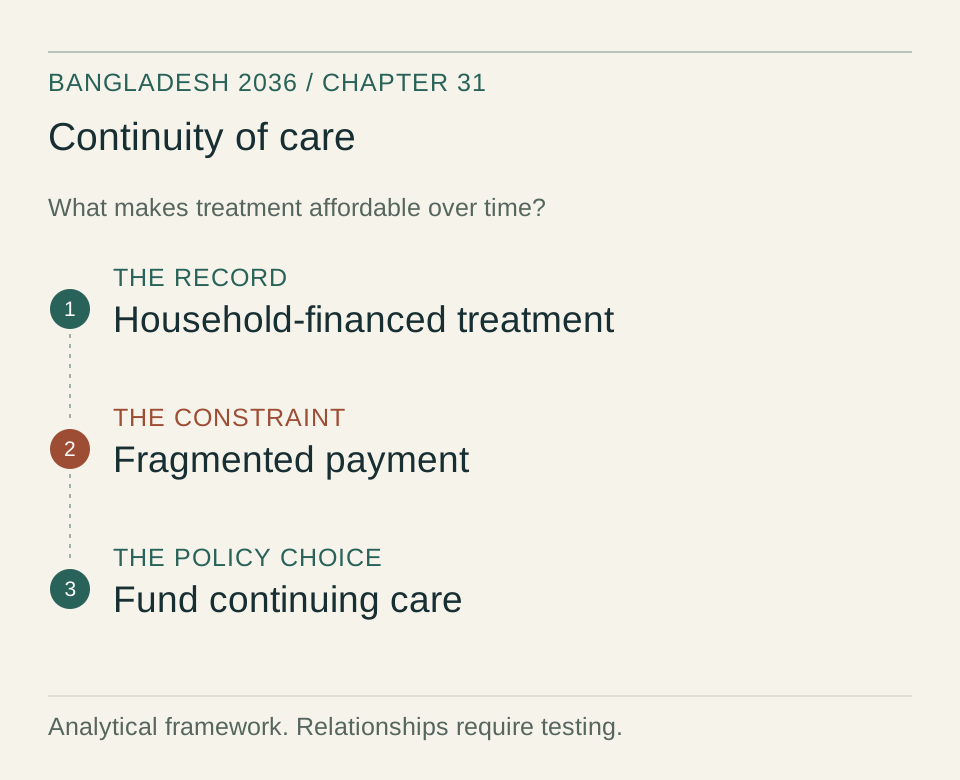
How financing shapes care
The financing mechanism is a budget that buys posts and buildings: the recurrent side pays salaries and facility operating costs, the development side construction and equipment, and the FY26 annual development programme allocates 18,148.14 crore BDT to health across 41 projects, 7.89 percent of the NEC-approved 230,000.00 crore BDT programme (238,695.64 crore with own funds), the share as the programme prints it [Planning Commission ADP 2025, ADP at a glance table]. The revised FY26 programme carries the health sector at 4,734.21 crore BDT across 47 projects, 26.09 percent of the original allocation [Planning Commission ADP 2025, revised FY2025-26 project table].
What the development budget buys is visible in the project list: the two health divisions hold 32 projects, 3,116.88 crore BDT of allocation for the Health Services Division against 21,457.82 crore BDT of committed cost and 1,346.15 crore BDT for the Medical Education and Family Welfare Division against 15,021.55 crore BDT of committed cost, with the largest lines going to hospital construction, 457.89 crore BDT of FY26 allocation for the eight divisional cancer, kidney and cardiac centres against a 3,433.01 crore BDT cost, 373.84 crore BDT for four 500 bed medical college hospitals, and 262.57 crore BDT for the Essential Drugs Company's Manikganj plant [Planning Commission ADP 2025].
The pandemic year exposed the model's cyclicality: government health schemes' expenditure fell from 189,614 million BDT in 2019 to 179,742 million BDT in 2020, a 5.2 percent nominal cut in the pandemic calendar year, while household out of pocket spending rose 11.0 percent from 480,086 to 532,740 million BDT [MOHFW BNHA 2020]. A system financed this way does not smooth shocks; it passes them to the paying household.
The workforce mechanism is medical production without nursing production. The ministry's 2018 achievement review counts 69 private medical colleges and hospitals approved by 2018, of which 29 were approved in the two Awami League terms since 2009, not the 38 that includes the pre-2008 1996-2001 term [DGHS 2018], and the physician series shows the output, a trebling of doctors per 10,000 since 2001 [WHO GHO 2023, HWF_0001]. Nursing and midwifery output lagged for a decade, 1.38 per 10,000 as late as 2003 and 2.60 in 2015, before a jump that lifted nurse density two and a half times between 2015 and 2023 and moved the doctor to nurse ratio from 1 to 0.55 to 1 to 0.92 [WHO GHO 2023, HWF_0006].
The 2010 health bulletin recorded a physician to nurse ratio of 2.07 to 1 [DGHS 2010]; the 2023 series has it at 1.09 to 1 [WB WDI 2026], still below the nurse-to-doctor benchmark cited in the WHO country strategy. Pharmacists, the grade the drug chain below runs on, sit at 1.10 per 10,000 [WHO GHO 2023, HWF_0014]. The community health worker tier is the counterweight: 148,713 workers by the 2020 reading [WHO GHO 2023, HWF_0024], delivering the community clinic programme whose 13,779 clinics each serve about 6,000 people, an average of 40 clients a day, 95 percent of them women and children, with upazila health complexes of 50 beds and district hospitals of 250 beds above them [DGHS 2018] [WHO CCS 2020].
The maternal mechanism is a platform built for pregnancy, left unfinished at the facility birth. Antenatal contact reached 81.9 percent of pregnancies in 2018 from 25.7 percent in 1994 [WB WDI 2026], but the four visit standard that detects the complications killing mothers reaches 38.6 percent, with the urban rural and rich poor gaps quoted above [DHS Program 2022]. The maternal mortality ratio fell 79 percent between 2000 and 2023 on the UNFPA reading [UNFPA 2024]. The instrument of the next stage is midwifery: UNFPA reports 73 percent of public facilities equipped for midwife led services in 2024, up from 60 percent a year earlier, supported midwives delivering over 154,000 newborns in the year, and 518 new midwifery positions created [UNFPA 2024].
The equity ledger returns at every step: under five mortality in the poorest quintile was 59 per 1,000 live births in 2018 against 37 in the richest [WB WDI 2026], and 80.1 percent of the poorest quintile's women reported a problem accessing care in 2018, 65.3 percent naming money and 54.5 percent naming distance, against 49.9, 24.6 and 27.6 percent in the richest [WB WDI 2026].
The drug chain mechanism is a licensed retail market under a thin regulator. The Directorate General of Drug Administration's FY2021-22 report counts 893 licensed production units of which 708 are functional, 295 of them allopathic with 220 functional, and 98 new production approvals in the year [DGDA 2022]. Retail is where the system meets the patient: 202,528 licensed retail drug outlets, 27,081 of them in Dhaka district alone, renewals up from 29,095 in FY18 to 35,530 in FY22, and 54,839 pharmacies inspected in FY22 after a pandemic year low of 36,441 [DGDA 2022].
The counters are the physical form of the 79.31 percent out of pocket share, and chapter 19, which shows the supplying industry is an export side show at 0.2 billion USD, records regulator capacity and price control coverage as not established; this chapter adds the measured licensing floor and the procurement side, where the state's own buyer is a 262.57 crore BDT FY26 line for one new Essential Drugs Company plant against committed costs of 1,905.26 crore BDT [Planning Commission ADP 2025]. The pooling reform waits on paper: the national financing strategy whose 2012 to 2032 target window the WHO strategy records, and the Shasthyo Surokkha Karmasuchi pilot for people below the poverty line, are its recorded instruments [WHO CCS 2020, Health Care Financing Strategy 2012-2032].
The cited reports do not establish the pilot’s current coverage or cost. Those questions require programme records from the Health Economics Unit.
The pandemic record closes the mechanism. The Global Health Security Index scored Bangladesh 35.5 of 100 in both 2019 and 2021, with prevention falling from 30.7 to 26.6, detection from 26.4 to 23.7 and the health system category from 35.6 to 31.3, while rapid response rose from 33.9 to 39.7 and compliance from 33.0 to 47.5 [GHS Index 2021]. The June 2020 capacity count compiled in the Bangladesh Health Watch report was 559 ventilators, intensive care units in 42 government hospitals and fewer than 7,000 isolation beds, with case fatality rates of 1.33 to 1.5 percent reported in the early months [JPGSPH BHW 2021].
Environmental exposures add to the demands on health services. WHO reports separate mortality estimates for ambient and household air pollution; these overlap and must not be added, as chapter 30 explains [WHO GHO 2019]. The groundwater sample discussed in chapter 28 had mean arsenic of 90.02 parts per billion, with 39.09 percent of tested sources above the national standard [Harvard Dataverse 2020, DOI 10.7910/DVN/JPYWDD]. These are sample results, not a national exposure estimate. The waterlogging survey cited in chapter 29 reported illness prevalence of 74.65 percent in waterlogged households against 59.83 percent in the comparison group, and mean out-of-pocket medical costs of 1,197.76 BDT per episode [PLOS Climate 2024]. The comparison establishes an association within that survey, not the independent causal effect of waterlogging.
Five decisions for sustained treatment
The demand arithmetic is set. The UN medium variant projects fertility falling from 2.14 births per woman in 2024 to 1.92 by 2036 and the median age rising from 25.65 to 30.0 years [UN WPP 2024, medium variant], the ageing schedule chapter 08 dates, and the risk factor stock is measured: diabetes prevalence of 13.2 percent of adults aged 20 to 79 in 2024 from 10.5 percent in 2011 [WB WDI 2026], raised blood pressure in 24.58 percent of adults on the 2019 age standardized reading, 29.06 percent among women against 20.24 percent among men [WHO GHO 2019, BP_04], current tobacco use falling from 58.1 percent of adults in 2000 to 32.9 percent in 2022 with the male rate at 50.5 against 15.4 female [WB WDI 2026] [Tobacco indicator definition], and smokeless tobacco use by 27.5 percent of adults in 2018 [WHO GHO 2018, Adult_curr_smokeless].
A chronic caseload needs continuity, detection and drug refills; the current system's unit of care is the paid encounter. The gap between the two is the 46 against 66 non communicable sub index [WHO GHO 2023, UHC_SCI_NCD].
Five decision points define the window, with the responsible institutions identified. The payer decision, led by the Health Services Division with the Health Economics Unit, is whether the pilot scheme's benefit package becomes a funded programme with a measured book; the coverage targets could not be confirmed, with the ministry documents the resolving source [WHO CCS 2020]. The workforce mix decision, led by the nursing and medical education directorates with the private colleges, is whether nursing output holds its 2018 to 2023 pace, which doubles nurse density again by the mid 2030s calculated from the cited figures, or reverts to the pre 2018 crawl [WHO GHO 2023, HWF_0006].
The drug regulator decision, led by the DGDA with the industry, is whether inspection throughput grows with the 202,528 counter retail base or the FY22 renewal and inspection numbers become the ceiling [DGDA 2022]; chapter 19 carries the same regulator as the export certification constraint. The procurement decision, led by the Essential Drugs Company with the health services directorate, is whether public procurement scales as a quality anchor buyer or stays a plant construction line [Planning Commission ADP 2025]. The preparedness decision, led by the ministry with the disease control programmes, is whether the 2021 rapid response gain is budgeted as standing capacity rather than a crisis artefact [GHS Index 2021].
The demand side has its own reading: willingness to vaccinate a daughter against HPV runs at 54.22 percent and self assessed vaccination likelihood at 40.91 percent [Harvard Dataverse 2024, DOI 10.7910/DVN/TNCDQY], the acceptance band any new vaccine or screening programme starts from.
The projections with named authors are demographic, not financial: the UN fertility and median age path above [UN WPP 2024], and the ageing dependency trend chapter 08 records. No stored health financing projection to FY36 exists in the cited reports; the reform scenario in chapter 15 assumes the financing turn, and this chapter's contribution is the size of the base it turns from, a public share of 14.48 percent of current health expenditure [WB WDI 2026].
How to test the argument. The Health Services Division and Health Economics Unit should assess whether funded coverage reduces household payments while improving access to medicines and follow-up. If enrolment rises but those outcomes do not improve, the benefit package or provider arrangements need revision; payment technology alone would not explain the gap.
Risks and opportunities
Risks. First, the medical impoverishment spiral: the out of pocket share is 79.31 percent and rising [WB WDI 2026], the chronic caseload grows with the median age, and each point of the share is an unpooled transfer to providers; monitor the next national health accounts round and the catastrophic spending share [WHO GHO 2016]. Second, the chronic service failure: if the non communicable sub index stays near 46 [WHO GHO 2023, UHC_SCI_NCD] while diabetes prevalence climbs from 13.2 percent [WB WDI 2026], the system accumulates unmanaged disease that presents as the hospital admissions the beds cannot hold at 0.92 per 1,000 [WB WDI 2026]; monitor the sub index and the diabetes series.
Third, a preparedness relapse: the health system category fell to 31.3 between the index editions [GHS Index 2021], the June 2020 capacity counts [JPGSPH BHW 2021] date the starting stock, and a recurrence against that baseline would reprice every scenario in chapter 15; monitor the next GHS edition and the government health expenditure series through the cycle [WB WDI 2026].
Upside. First, the maternal platform completes: antenatal contact has expanded, skilled birth attendance is up from 12.0 percent of births in 2001 to 59.0 in 2019 [WB WDI 2026], the midwife network is scaling [UNFPA 2024], and closing the four visit gap is an outreach and supply task, not a hospital construction task; monitor the ANC4+ series [DHS Program 2022]. Second, the rails dividend: the mobile money and digital identity rails chapters 07 and 13 document are the distribution system a prepayment scheme needs, and payment infrastructure can support contributions and reimbursements, but pooling also requires funding, eligibility rules, provider contracts and protection for people unable to contribute; monitor the pilot's book moving from unconfirmed to measured.
Third, the prevention dividend: age-standardised current tobacco use among adults aged 15 and over fell 25.2 percentage points since 2000 [WB WDI 2026]; taxation and regulation are available prevention instruments, but their contribution to the decline and implementation costs are not estimated here; monitor the smoking and smokeless series [WHO GHO 2018, Adult_curr_smokeless].
Health indicators to follow
The benchmarks below are author-proposed monitoring points, not validated causal cutoffs or official forecasts.
- Government health expenditure share of GDP. Current value 0.31 percent in 2023 [WB WDI 2026]. Proposed benchmark: a print at or above 0.5 percent would indicate the financing turn the reform scenario assumes; a print below 0.35 percent after the FY26 revision may indicate the drift is policy.
- Out of pocket share of current health expenditure. Current value 79.31 percent in 2023 [WB WDI 2026]. Proposed benchmark: a fall below 65 percent, the chapter 09 mark and chapter 19's procurement precondition, would indicate pooling at scale; a print above 85 percent would signal continuing heavy reliance on household payment.
- Non communicable disease component of the universal coverage index. Current value 46 of 100 in 2023 [WHO GHO 2023, UHC_SCI_NCD]. Proposed benchmark: a rise above 55 would indicate the chronic care regime arriving; stagnation near 46 with rising diabetes prevalence may indicate the chapter's service failure risk.
- Four or more antenatal care visits. Current value 38.6 percent in 2022, poorest quintile 24.71 percent [DHS Program 2022]. Proposed benchmark: a national print above 60 percent with the poorest quintile above 40 would mark improved access, while leaving quality and further coverage gains to assess; a quintile gap above 30 points at the next survey may indicate the equity ceiling.
- Nurses and midwives per 1,000 people. Current value 0.66 in 2023 [WB WDI 2026]. Proposed benchmark: a print above 1.0, above the current physician density of 0.72, would mark an increase in nurse and midwife availability, without establishing adequacy or the balance across districts; a fall back toward 0.5 may indicate the pre 2018 crawl resumed.
Sources
[MOHFW BNHA 2020] Health Economics Unit, Bangladesh National Health Accounts BNHA-6 via bdpolicy.db bnha_ series: health expenditure levels and shares by financing source, per capita, 1997 to 2020 calendar years.
[WHO GHO 2023] WHO Global Health Observatory via bdpolicy parquet who_gho_bd: expenditure shares, UHC index and component sub indices, workforce density series HWF_0001, HWF_0006, HWF_0014, HWF_0024, 2023 vintage.
[WHO GHO 2021] WHO Global Health Observatory via bdpolicy parquet who_gho_bd: diagnostic equipment density series DEVICES08, DEVICES09, 2021 vintage.
[WHO GHO 2019] WHO Global Health Observatory via bdpolicy parquet who_gho_bd: raised blood pressure age standardized estimates BP_04 by sex, and ambient air pollution deaths, 2019 vintage, the air figure chapter 30 carries.
[WHO GHO 2018] WHO Global Health Observatory via bdpolicy parquet who_gho_bd: smokeless tobacco prevalence among adults, 2018 tabulation.
[WHO GHO 2016] WHO Global Health Observatory via bdpolicy parquet who_gho_bd: catastrophic health expenditure above 10 percent of household budget and non poor pushed below the 3.65 USD a day line, 2016 tabulation, as cited in chapter 09.
[Tobacco indicator definition] World Bank metadata for SH.PRV.SMOK: age-standardised current use of smoked and/or smokeless tobacco among adults aged 15 and over. Source link
[WB WDI 2026] World Bank World Development Indicators via bdpolicy parquets wb_full_bd and wb_health_bd_deep: financing shares, workforce and bed density, immunisation, antenatal care, birth attendance, cause of death, diabetes, tobacco, quintile mortality and access series, values in data/31-health-system.csv.
[DHS Program 2022] The DHS Program Bangladesh Demographic and Health Survey 2022 via bdpolicy.db: child and neonatal mortality, stunting, fertility, the antenatal set bdhs_maternal_sanc_*, urban, rural and wealth splits from the PLOS ONE analysis of BDHS 2022.
[DGHS 2010] Directorate General of Health Services, Health Bulletin 2010 via ocr_text/dghs_mis: government and private bed counts, registered private hospitals and clinics, physician to nurse ratio.
[DGHS 2018] Directorate General of Health Services, Achievement in Health 2018 via ocr_text/dghs_mis: community clinic count, private medical college approvals by government term.
[WHO CCS 2020] WHO Bangladesh, Country Cooperation Strategy 2020-2025 via ocr_text/who_bd: doctor to nurse ratio, workforce threshold density against the SDG benchmark, facility pyramid, community clinic parameters, and the financing strategy and Shasthyo Surokkha Karmasuchi pilot record.
[DGDA 2022] Directorate General of Drug Administration, Annual Report FY2021-22 via ocr_text/dgda: production unit and licensing statistics by system, new approvals, retail licence total and district split, renewals, pharmacy inspections.
[GHS Index 2021] Global Health Security Index, Nuclear Threat Initiative and Johns Hopkins Center for Health Security, via bdpolicy parquet health/ghs_index_bd, overall and category scores, 2019 and 2021 editions.
[JPGSPH BHW 2021] James P Grant School of Public Health, Bangladesh Health Watch Report 2020-21 on COVID-19 via ocr_text/jpgsph: June 2020 capacity compilation of ventilators, hospital ICUs, isolation beds, and case fatality readings.
[UNFPA 2024] United Nations Population Fund Bangladesh, Annual Report 2024 via ocr_text/unfpa_bd: maternal mortality reduction claim 2000 to 2023, midwife led facility coverage, deliveries by supported midwives, new midwifery positions.
[Planning Commission ADP 2025] Annual Development Programme 2025-2026, Programming Division, Bangladesh Planning Commission, June 2025, ADP at a glance sector table: health 18,148.14 crore BDT across 41 projects, 7.89 percent of the 230,000.00 crore approved programme, Source link, accessed 6 September 2026. The same tag covers the revised FY2025-26 project table via bdpolicy.db adp_projects, health division allocations in lakh converted to crore, committed costs, foreign aid shares and named project lines, named as the revised programme wherever it is used.
[UN WPP 2024] UN World Population Prospects 2024 via bdpolicy parquet, series un_wpp2024_bd medium variant, fertility and median age projected to 2036.
[Harvard Dataverse 2020] Harvard Dataverse, groundwater arsenic survey, DOI 10.7910/DVN/JPYWDD, series tox_groundwater_arsenic_*, via bdpolicy.db.
[Harvard Dataverse 2024] Harvard Dataverse, HPV vaccination willingness and likelihood survey, DOI 10.7910/DVN/TNCDQY, series hpv_vax_*, via bdpolicy.db, 2024 fieldwork.
[PLOS Climate 2024] PLOS Climate, waterlogging exposure, illness prevalence and out of pocket medical costs, rural disaster prone households, article pclm.0000605, via bdpolicy.db, the survey chapter 29 carries.