Cleaner air and better waste services need capable institutions
Air pollution, solid waste and wetland loss require different environmental responses. Bangladesh's mean annual PM2.5 exposure was 69.3 micrograms per cubic metre in the 2023 World Bank tabulation [WB WDI 2026]. Dhaka North recovered 23.2 percent of its reported solid-waste expenditure through conservancy tax in FY2019-20 [DNCC 2020]. These dated measures identify substantial problems, but do not establish that finance, enforcement or pricing alone explains them. Effective action needs current monitoring, operational capacity and clear institutional responsibility.
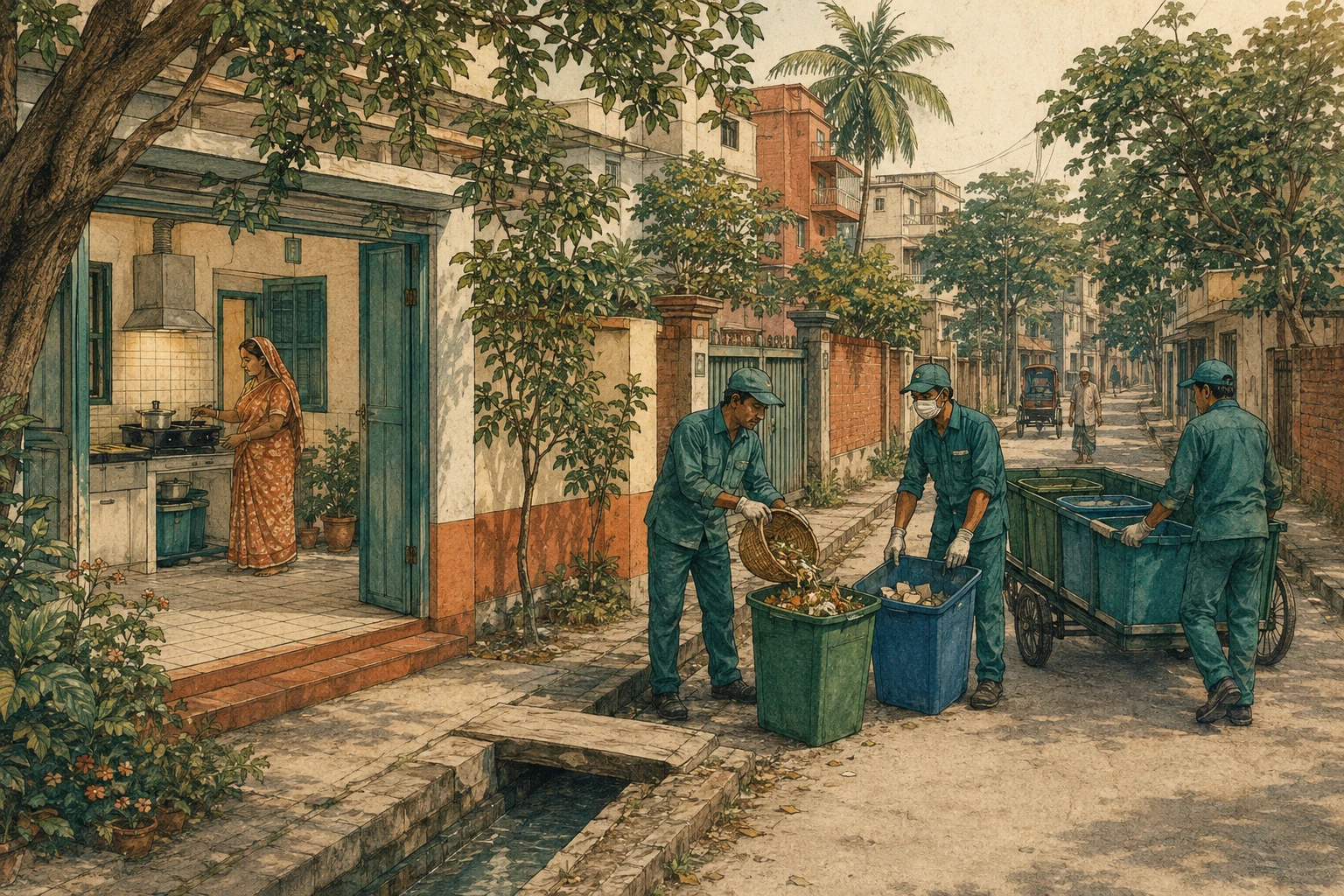
Exposure, waste finance and wetland protection
The national PM2.5 record is measured by satellite and it has no safe corner. Mean annual exposure ran at 64.7 micrograms per cubic metre in 1990, held near 67.5 in 2010 and 68.7 in 2014, peaked at 79.3 in 2018, and stood at 69.3 in 2023, the last tabulated year, a three decade band of roughly 63 to 79 with no sustained decline [WB WDI 2026]. The modelled population-exposure series places the population above the World Health Organization guideline at the tabulations cited here, and 99.95 percent breathed air above even the interim target 1 threshold of 35 micrograms per cubic metre in 2017, the last year of that series [WB WDI 2026].
The mortality tabulation is the heaviest in this book: the World Health Organization attributes 76,062 deaths, uncertainty range 59,652 to 94,709, to ambient air pollution in 2019 and 117,681 to household air pollution, separate estimates that overlap and must not be summed into a combined death toll [WHO GHO 2019, ambient and household air pollution attributable deaths] [WHO joint effects]. The ambient death rate is 66 per 100,000 population age standardized, and its cause split is cardiovascular, ischaemic heart disease at 25 and stroke at 23 per 100,000, with chronic obstructive pulmonary disease at 9, lung cancer at 7 and diabetes at 2 [WHO GHO 2019, AIR_42].
Children carry a separate ledger: 2,327 deaths of children under five were attributed to ambient air pollution in 2019, with an attributable burden of 128 disability adjusted life years per 100,000 [WHO GHO 2019, AIR_4, AIR_10]. Chapter 09 carries the health financing side; the burden is measured, not asserted.
The sources of the burden are now inventoried at source level, but emission mass is not the same as population exposure. The ClimateTRACE source level inventory puts national PM2.5 emissions at 170,130 tonnes in 2024: buildings account for 158,009 tonnes, 92.9 percent, and residential onsite fuel use alone for 152,106 tonnes, 89.4 percent, while transportation contributes 4,581 tonnes, 2.7 percent, of which road transport is 1,339 tonnes, manufacturing 4,046 tonnes, 2.4 percent, and power generation 3,494 tonnes, 2.1 percent [ClimateTRACE 2024]. The 2025 estimate is 172,198 tonnes, a rise of 1.2 percent, so the tonnage is not falling on its own [ClimateTRACE 2025].
Dhaka district emits 18,236 tonnes, 10.7 percent of the national total, and its profile is even more skewed than the country's: residential fuel is 16,915 tonnes, 92.8 percent of the district, against 177 tonnes from road transport [ClimateTRACE 2024]. The conversation about Dhaka air centres on brick kilns and traffic, and both belong in the account, but two facts discipline the story: the brick kiln fleet has no published count or emission total in the cited sources, so any kiln share of the city's particulate load could not be confirmed, with the Department of Environment's emission inventory as the resolving source, and the largest inventoried tonnage, residential fuel use, warrants attention alongside transport, industry and pollution transported into the area.
Clean fuel access, the variable that governs the cooking fire, stood at 28.4 percent of the population in 2023 [WB WDI 2026].
The waste record is a single city's accounts, kept properly, and they show a service that runs on subsidy. Dhaka North City Corporation collected 1,002,561 tonnes of municipal solid waste in FY2019-20, against a generation rate the corporation puts at 0.56 kilogram per capita per day and a corporation-wide load the report calls almost 3,500 tonnes per day, DNCC alone, not the full Dhaka city that also includes Dhaka South [DNCC 2020]. Collection coverage is about 80 percent, delivered through 52 secondary transfer stations and around 418 primary collection service providers, the rickshaw van and private crew economy a Japan International Cooperation Agency survey counted in 2018, running on 147 corporation vehicles and 3,914 cleaners [DNCC 2020].
The money is the finding: solid waste management spent 208.1 crore BDT in FY2019-20, 7.98 percent of the corporation's 2,608.6 crore BDT budget, while conservancy tax income was 48.3 crore BDT, so cost recovery ran at 23.2 percent by this chapter's arithmetic, and the landfill operation alone cost 249.80 BDT per tonne [DNCC 2020]. Everything ends at Aminbazar, a 52.88 acre site operating since 2006 whose 80 acre extension was still in process when the report closed, and the regulatory stack behind this system is long and largely prospective: the Environment Conservation Act 1995 with amendments in 2000, 2002 and 2010, the National 3R Strategy 2010, the Medical Waste Rules 2008, the E-waste Management Rules 2017 and the Solid Waste Management Rules that were still a draft awaiting endorsement in the FY2019-20 report [DNCC 2020].
On plastics specifically, the same regulatory table dates the polythene bag ban's legal base to the 2002 amendment of the Environment Conservation Act, and the corporation's own campaign material, "Stop using Polythene, Heal Dhaka City", was still running eighteen years later, which is the enforcement record in one slogan; a national plastic waste tonnage has no measured series in the cited sources and is not established, with the Department of Environment as the resolving source [DNCC 2020].
The wetlands and the urban population close the record. The census puts Dhaka district at 14,734,701 persons in 2022 at a density of 10,067 persons per square kilometre, with 687,534 counted in slums on the census definition, a count far below the 51.51 percent urban slum share of the UN-Habitat deprivation definition that chapter 14 carries, because the census counts declared slum areas while the index counts deprivations [BBS Census 2022, district population tables] [WB WDI 2026]. Chapter 14's account of that primacy, Dhaka holding 42.22 percent of the urban population in 2025, is the demand side of every number in this chapter [WB WDI 2026].
On the supply side of land, the state's newest instrument is the Bangladesh Haor and Wetland Conservation Act 2026, Act No. 10 of 2026, assented on 10 April 2026, which replaced the ordinance of the same year and created a Bangladesh Haor and Wetland Development Directorate with a mandated national list of haors and wetlands built up from district administration returns, a master plan, protection orders, protected area declarations and a penalty schedule covering, among scheduled offences, illegal occupation, excavation or conversion of wetland ridges, groundwater extraction that damages aquifers and acts that pollute soil and water; the general penalty ceiling in the act is two years imprisonment or a 200,000 taka fine [MoWR 2026].
Noise rounds out the urban environment with no monitoring series in the cited sources at all; its institutional footprint in FY26 is one project line of 11.6 crore BDT, the integrated and partnership noise pollution control project, in its third revision [Planning Commission ADP 2025].
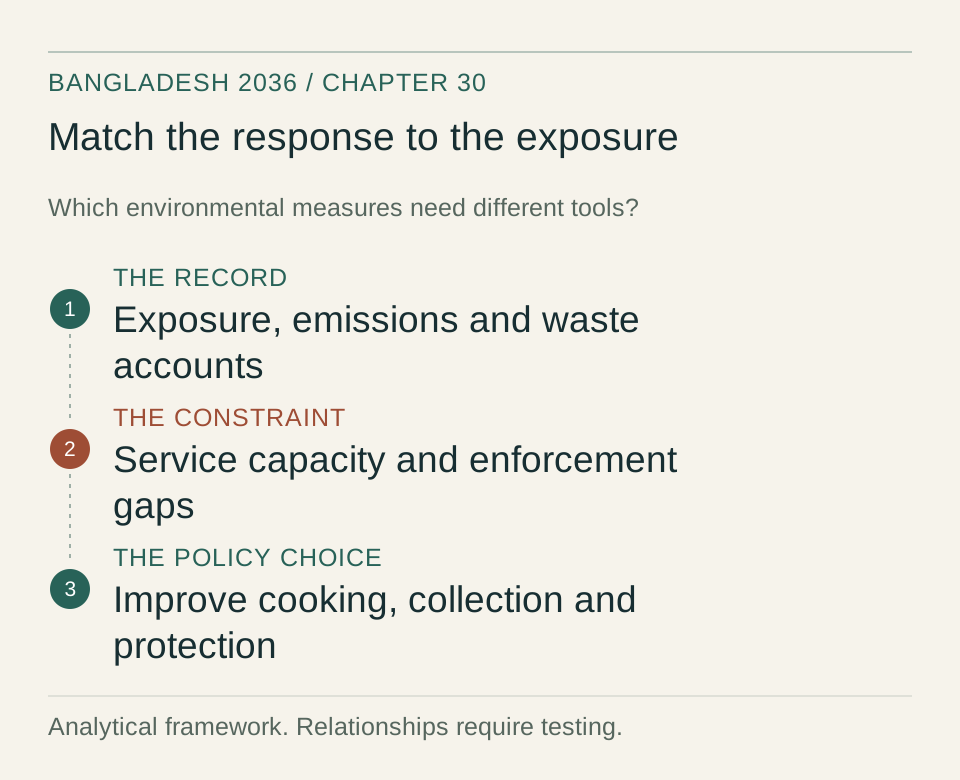
Fuel choices, collection and land-use incentives
Clean-cooking choices depend on affordability, access and the suitability of available fuels. Residential fuel use accounts for 89.4 percent of PM2.5 mass in this inventory, while 71.6 percent of the population lacks primary access to clean cooking in the separate access series, and the substitute, liquefied petroleum gas or piped gas, carries an installation cost, a cylinder deposit and a tariff that chapters 04 and 10 tax and price; the household decision is a monthly cash flow comparison, and the state has never put the two fuels on an equal footing [ClimateTRACE 2024] [WB WDI 2026].
Other sectors in this emissions inventory include: road transport at 1,339 tonnes nationally and 177 tonnes in Dhaka district, manufacturing at 4,046 tonnes, power at 3,494 [ClimateTRACE 2024]. What the inventory does not resolve is seasonal and local: the estimate is annual and district level, so the winter inversions that make Dhaka's air a public event, and the kiln belt ringing the city, register in the exposure series rather than the annual tonnage, and that gap is where the unconfirmed brick kiln share lives. For the decade, the exposure series shows no sustained decline: 2023 at 69.3 sits above the 1990 level of 64.7 and only 12.6 percent below the 2018 peak of 79.3, so any claim of an improving airshed is not visible in the satellite record and needs a monitor network to test it [WB WDI 2026] [ClimateTRACE 2024].
The waste mechanism is a fee that prices nothing. A corporation that recovers 23.2 percent of its solid waste cost runs a transfer from its general budget, dominated by property tax, to waste households, and the marginal tonne is always cheaper to dump at Aminbazar than to divert, which is why the 3R Strategy of 2010 produced campaigns rather than segregation and why the report leads with compactors rather than compost or recycling [DNCC 2020]. The fee instrument is also legally awkward: primary collection is de facto privatised to around 418 informal providers who charge households directly, so the corporation's conservancy tax competes with a private fee the household is already paying, and the formalisation the report promises, fixed providers appointed by tender, has been the plan in every report since 2016 [DNCC 2020].
What makes this more than a municipal accounting story is methane. In the ClimateTRACE city inventory the Dhaka urban area emitted about 84 million tonne of CO2 equivalent on a 20 year basis in 2024, of which waste was 17.4 million tonne, 20.8 percent, second only to power at 24.0 million tonne and ahead of manufacturing at 15.4; organic waste decomposing anaerobically at a dump site is the city's second emissions sector, and on a 20 year weighting methane is the variable, so the dump is a climate instrument as much as a sanitation one [ClimateTRACE 2024].
Chapter 28 carries the water side of the same dump: leachate that reaches the aquifer the city drinks from.
The plastics mechanism is a ban without a priced substitute, and the wetland mechanism is a law ahead of its inventory. The 2002 polythene ban failed for the reason its successors will fail or succeed: jute and cloth substitutes cost more at the till, enforcement was an occasional seizure rather than a supply chain control, and the package of instruments that would make compliance rational, a price on the alternative, deposit refund systems, producer responsibility, has never been assembled; the FY26 programme's 16.4 crore BDT plastics line, an integrated approach to sustainable plastic use and marine litter prevention with 35.8 crore BDT of committed cost, is a study project where a market intervention is needed [DNCC 2020] [Planning Commission ADP 2025].
The wetland act is the opposite error in the same family: it creates a directorate, a list procedure, master plans and penalties before the list exists, and the sequencing is the tell, because a gazette list built from district administration returns is the instrument that converts wetland filling from a quiet plot by plot act into a citable offence against a named water body; until the list is notified, the act protects an abstraction, and the land price gradient that chapter 51 discusses does the filling [MoWR 2026]. The common thread across all three is the one chapter 47 documents: Bangladesh's environmental mandate sits with a Department of Environment whose operating capacity is not visible in any series available to this chapter, and whose development programme spends its money on studies and assets rather than on inspectors, monitors and docket systems, which are operating budget lines.
Decisions on clean cooking, waste and wetlands
The named projections in this chapter's field are thinner than the measurement, and the gaps are themselves findings. The World Bank exposure series stops at 2023, so any current statement about exposure needs the Department of Environment's continuous air monitoring stations, which publish irregularly and hold no series available to this chapter, making any current Dhaka concentration figure impossible to confirm, with those stations as the resolving source [WB WDI 2026]. The World Bank Country Climate and Development Report is the resolving source for the standard finding that air and climate impacts subtract from GDP and that adaptation investment pays for itself; its specific air health cost range for Bangladesh could not be confirmed from the cited sources, the published report being the resolving source [WB CCDR 2022].
What the verified record supports is direction: an emission tonnage rising 1.2 percent in its latest year [ClimateTRACE 2025], clean-fuel access rising from 24.6 percent in 2020 to 28.4 percent in 2023, a 3.8 percentage point change [WB WDI 2026], a waste cost recovery at 23.2 percent and a wetland list whose notification was not established for this chapter [DNCC 2020] [MoWR 2026].
Three decisions carry the decade. The first is the clean cooking decision, which addresses a substantial source of exposure: moving clean fuel access from 28.4 percent toward the majority would attack the 117,681 household air pollution deaths at their source, and its authors are the Energy and Power Division with Petrobangla and the health ministry of chapters 09 and 31; the indicator to monitor is the access share, and the chapter 15 reform scenario assumes it crosses 50 percent within the decade while the stall scenario assumes it stays under 40 [WB WDI 2026] [WHO GHO 2019].
The second is the waste finance decision in the two Dhaka corporations and the local government division: whether the conservancy fee is reset to recover cost, whether the Aminbazar extension and the long promised waste to energy and resource recovery facilities displace open dumping, and whether the Solid Waste Management Rules 2021, amended in May 2026, are implemented through funded collection, reporting and enforcement [Bangladesh Gazette 2026]; the indicator to monitor is the cost recovery ratio off 23.2 percent [DNCC 2020]. The third is the wetland list decision under the 2026 act: the directorate is new, its headquarters and staffing are unfunded in any series available to this chapter, and the act's own architecture targets a gazette notification of the national list as the trigger for every protection order behind it; the indicator to monitor is the notification itself, and this chapter's arithmetic assumes the stall scenario leaves the list partial and contested while the reform scenario notifies it within two years of the directorate operating [MoWR 2026].
Around those three sit two quieter ones. The air quality management decision lands in the BEST project, the Bangladesh Environmental Sustainability and Transformation project whose implementation window targets June 2028, which takes 745.7 crore BDT of the FY26 environment ministry programme, 68 percent of its allocation and 2,995.9 crore BDT of committed cost, and is the only vehicle through which the airshed gets monitoring hardware and management capacity in this programme; whether its monitoring component produces a public, station level series, rather than project reports, decides whether the next edition of this chapter cites a monitor instead of a satellite grid [Planning Commission ADP 2025].
The plastics decision is whether the state converts the ban into market design, a producer responsibility instrument with a fee on virgin plastic that funds collection, or reissues the 2002 gesture; the committed 35.8 crore BDT project cost against a plastic consumption stream with no measured national tonnage in the cited sources says the design conversation has not started [Planning Commission ADP 2025].
Risks and opportunities
Risks. First, a lost decade for the airshed is already the base case: 2023, the last tabulated year, printed at 69.3 micrograms per cubic metre, well above the 35 microgram interim target 1 line that 99.95 percent of the population already exceeded in 2017, so the historical age-standardised ambient death rate of 66 per 100,000 is a warning, not a forecast or a lower bound, unless the next tabulation or the BEST project's monitor series breaks the three decade pattern [WB WDI 2026] [Planning Commission ADP 2025]. Second, a waste infrastructure trap: if cost recovery stays near 23 percent, every new facility, the transfer stations, the engineered landfill, any waste to energy plant, arrives with an operating deficit the corporation renegotiates downward each year; the indicator to monitor is conservancy tax income against the 48.3 crore BDT of FY2019-20, plus the methane tonnage off the 17.4 million tonne CO2 equivalent the Dhaka urban waste stream already emits [DNCC 2020] [ClimateTRACE 2024].
Third, wetland loss ahead of the list: filling is cheap, fast and done by parties the district administration does not control, so the window between the act and the notified list is when the stock is most exposed, and a late or exclusion-riddled list would leave the new protection framework without a complete public inventory; the indicator to monitor is the gazette notification and the first protection orders issued under it [MoWR 2026].
Upside. First, the clean cooking prize is the cheapest big number in the book: the fuel is commercially available, the mortality attribution is measured at 117,681 deaths a year, and the enabling moves are tariff and financing moves in chapters 04 and 10, so a serious programme buys health at a price the budget arithmetic of chapter 15 can actually pay [WHO GHO 2019] [WB WDI 2026]. Second, the methane dividend: a waste stream that emits 17.4 million tonne of CO2 equivalent on a 20 year basis in one city is a carbon finance asset the moment it is captured or covered, and the compliance markets chapter 27 describes are the buyers; the indicator to monitor is the first landfill gas or organics project financed against that tonnage [ClimateTRACE 2024].
Third, the enforcement upgrade is already legislated: the 2026 wetland act mandates a database, a list and citable offences, the e-GP procurement machinery of chapter 48 shows the state can digitise a docket when it decides to, and if the same list-first logic is applied to air monitors and waste transfer stations, the chapter 15 reform scenario's institutional assumptions become executable rather than aspirational; the indicator to monitor is the wetland database going public with mouza level entries [MoWR 2026].
Testing the policy case
The environment authorities and city corporations should compare interventions with measured exposure, collection quality and costs. Falling inventoried emissions without lower ambient exposure would call for source-apportionment and transport analysis. Higher fee recovery without better collection would show that financial reform alone has not improved the service.
What to watch
The thresholds below are author-proposed monitoring markers, not official targets or estimated policy effects. Interpret them alongside the source dates and definitions.
- Mean annual PM2.5 exposure, next tabulation. Latest cited value 69.3 micrograms per cubic metre in 2023, the last tabulated year, against a peak of 79.3 in 2018 and a 1990 level of 64.7 [WB WDI 2026]. Threshold: a tabulation at or above the 2018 peak would be consistent with the airshed lost the decade; a station level public series below 35, the interim target 1 line 99.95 percent of the population exceeded in 2017, marks the enforcement turn [WB WDI 2026].
- Clean fuel access share. Latest cited value 28.4 percent of the population in 2023, from 24.6 percent in 2020 [WB WDI 2026]. Threshold: a share above 50 percent would meet this chapter's proposed reform marker; the associated health benefit requires a separate exposure and risk assessment; a share stalling below 40 percent locks the cooking fire in as the largest emission source through FY36 [WHO GHO 2019].
- Dhaka North solid waste cost recovery. Latest cited value 23.2 percent in FY2019-20, conservancy tax of 48.3 crore BDT against 208.1 crore BDT of cost [DNCC 2020]. Threshold: a sustained ratio above 60 percent marks the fee based regime the service needs; a ratio below 20 percent with a growing collection volume would be consistent with the fiscal crowding regime.
- Waste share of Dhaka's greenhouse gas inventory. Latest cited value 17.4 of about 84 million tonne CO2 equivalent on a 20 year basis in 2024, 20.8 percent, second sector after power [ClimateTRACE 2024]. Threshold: a share above 25 percent marks the landfill growth regime; a falling share below 15 percent, taken with the collection record, marks capture and cover working.
- The gazette list of haors and wetlands. Current status: act assented 10 April 2026, list not notified in the cited sources, status not established, with the Ministry of Water Resources as the resolving source [MoWR 2026]. Threshold: a notified list with mouza level boundaries inside two years of the directorate operating marks the protection regime; no notification by 2029, which this chapter's stall scenario assumes, would leave the protection framework incomplete.
Sources used
[WHO joint effects] World Health Organization, explanation of joint ambient and household air-pollution burden and adjustment for overlap, accessed 2026-09-07.
[Bangladesh Gazette 2026] Bangladesh Government Press, SRO 97-Law/2026, amendment to Solid Waste Management Rules 2021, published 12 May 2026, pages 17635-17641; gazette listing checked 2026-09-07.
[WB WDI 2026] World Bank World Development Indicators via bdpolicy parquet wb_environment_bd_deep, series: EN.ATM.PM25.MC.M3, EN.ATM.PM25.MC.ZS, EN.ATM.PM25.MC.T1.ZS, EG.CFT.ACCS.ZS, EN.POP.SLUM.UR.ZS, EN.URB.LCTY.UR.ZS.
[WHO GHO 2019] World Health Organization Global Health Observatory via bdpolicy parquet who_gho_bd, series: ambient air pollution attributable deaths (AIR_41), household air pollution attributable deaths (AIR_11), ambient air pollution attributable death rate age standardized (AIR_42), ambient deaths in children under 5 (AIR_4), ambient attributable DALYs per 100,000 children under 5 (AIR_10), 2019.
[ClimateTRACE 2024] Climate TRACE coalition, PM2.5 emissions by source type and district and CO2e 20 year GWP emissions by city area, calendar 2024, via the hdx/climate-trace/bgd-climate-trace CSVs, national and Dhaka district and Dhaka urban area aggregates by chapter arithmetic.
[ClimateTRACE 2025] Climate TRACE coalition, PM2.5 emissions by source type, calendar 2025, via the hdx/climate-trace/bgd-climate-trace CSVs.
[DNCC 2020] Dhaka North City Corporation, Waste Management Department, Waste Report FY2019-20, waste collected, generation rate, transfer stations, primary collection service providers, Aminbazar landfill, solid waste management budget and conservancy tax income, regulatory framework table, via ocr_text/dhaka_north_cc.
[Planning Commission ADP 2025] Revised Annual Development Programme FY2025-26, Programming Division, Planning Commission, Ministry of Environment, Forest and Climate Change project list, allocations and committed costs in lakh taka converted to crore, including the BEST project, the plastics and marine litter project and the noise pollution control project, via bdpolicy.db adp_projects table. The published original programme gives the ministry 1,380.48 crore BDT across 30 projects, 0.60 percent of the 230,000.00 crore programme, Annual Development Programme 2025-2026, Programming Division, Bangladesh Planning Commission, June 2025,
[BBS Census 2022] Bangladesh Bureau of Statistics, Population and Housing Census 2022, district population, density and slum population tables via the bbs_census dataset.
[MoWR 2026] Bangladesh Haor and Wetland Conservation Act 2026, Act No. 10 of 2026, assented 10 April 2026, gazette text via ocr_text/mowr, directorate, list procedure, protection orders and penalty schedule.
[EMDAT 2026] EM-DAT Emergency Events Database, UCLouvain, Bangladesh disaster deaths 2024, via bdpolicy.db, referenced from chapter 11.
[WB CCDR 2022] World Bank Bangladesh Country Climate and Development Report, resolving source for air and climate GDP impact estimates, figures not held in the cited sources.