Port capacity needs efficient connections and operations
Chattogram handled 123.24 million tonnes of cargo and 3.17 million TEU in FY24 [CPA 2024]. The port's performance matters far beyond its boundary: customs clearance, rail and road connections, shipping services and inland storage determine how quickly a shipment reaches a factory or buyer. New terminals add capacity, but their economic return depends on those connections and operating arrangements. The figures below distinguish throughput from service quality and system costs.
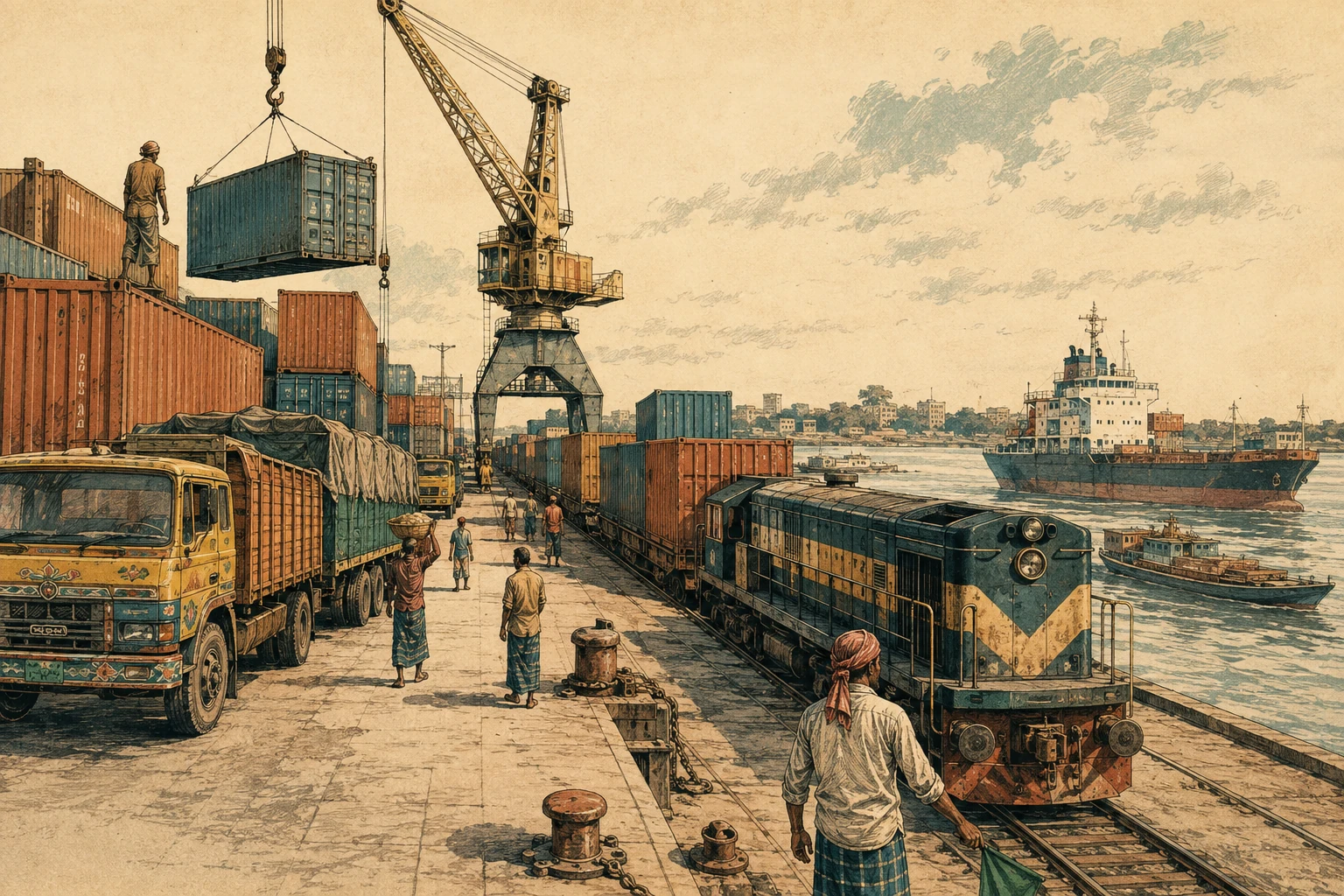
Throughput, delays and transport costs
The Chattogram record is the measured core. Container throughput ran 2.808 million TEU in FY18, 3.097 in FY21, a crisis peak of 3.255 in FY22, 3.007 in FY23 and 3.169 in FY24 [CPA 2024]. Total cargo rose from 85.05 million tonnes in FY18 to 123.24 in FY24 [CPA 2024]. Vessels calling grew from 4,186 in calendar 2010 to 7,969 in calendar 2022, the latest stored year [CPA 2024]. The service metrics tell the pressure story: berth occupancy hit 92 percent in FY22, the congestion year chapter 17's export peak meets, eased to 78.17 in FY23 [CPA 2024], while container dwell time, the import-side cost, ran 9.0 days in FY22 and 9.55 in FY23 [CPA 2024].
The port's own accounts returned 1,706.6 crore BDT of operating profit in FY23 [CPA 2024], a profitable monopoly whose pricing the traders' complaints and the operating metrics indict together. Vessel turnaround time, the ship-side counterpart to dwell time, fell from 3.0 days in FY21 to 2.0 in FY22 before drifting back up to 2.19 in FY23 and 2.58 in FY24 [CPA 2024], a mild reversal against the dwell-time deterioration over the same years.
The modal split is the structural number. Bangladesh Railway carried 4.41 million tonnes of freight in FY23 [Bangladesh Railway 2023] earning 1,074.85 million net tonne-kilometres [Bangladesh Railway 2023], against the port's 123.24 million tonnes of cargo [CPA 2024]; rail's share of surface freight could not be confirmed because road freight has no cited series, but the order of magnitude, single-digit percentage by tonne-kilometre, is what the stored two series imply. The railway's own economics are the modal-shift constraint: the operating ratio, expenses against revenue, ran 236.27 percent in FY23, up from 170.46 in FY15 [Bangladesh Railway 2023], meaning the railway covers less than half its costs from revenue, a fact that makes every freight-rate reform a fiscal decision chapter 04 examines.
Inland waterways, historically the delta's freight backbone, carry no cited series, the BIWTA statistics being the resolving source, so the chapter treats the modal record as rail plus road with the water leg not established.
The capacity pipeline is where the decade lives. The Matarbari deep-sea port, the first harbour able to take mother vessels directly, is under construction alongside the power plant chapter 10 records; its opening timeline could not be confirmed from the cited sources, the CPA and Ports Division documents being the resolving sources. The Bay Terminal, the Chattogram offshoot designed to move container handling out of the river port, is likewise unconfirmed in its construction status. The Mongla and Payra ports operate at fractions of their design capacity. Mongla handled 10.86 million tonnes of cargo and 31,044 TEU of containers in FY24, both down from a container peak of 43,957 TEU in FY21, and fell further to 10.41 million tonnes and 21,456 TEU in FY25 [MPA 2025].
Payra has no cited cargo tonnage series; the IMF PortWatch vessel-call count is the only trace, and it shows the port going quiet, 43 vessel calls across all of FY25 and zero calls in most months since [PortWatch 2026]. Their underutilisation is the story of a port policy that built capacity ahead of the hinterland connections chapter 24's transport account carries. The national logistics policy, approved in the transition period, could not be confirmed in its implementation status, the Shipping Ministry documents being the resolving source.
The cost layer is where logistics meets the trade accounts. Transport service imports of 6.73 billion USD in 2023 [IMF BOP 2023] include more than freight alone, and the logistics cost as a share of export value that the policy debate quotes could not be confirmed, no cited series computing it; the World Bank Logistics Performance Index scored the country 2.60 of 5 overall in the 2022 survey wave, essentially flat against 2.58 in 2018 [WB LPI 2022]. Customs automation, the ASYCUDA World e-filing and the National Single Window whose go-live status could not be confirmed here, is the paper-side of the same cost. The dwell time at 9.55 days [CPA 2024] against the three-to-five-day benchmarks of competing regional ports is the arithmetic gap between the available evidence and the frontier.
The inland waterways are the delta's forgotten freight arm, and their absence from the available evidence is itself the finding. A country threaded by roughly seven hundred rivers moves its construction materials, foodgrain and fuel on boats whose volumes, and whose accident record, are not stored anywhere this chapter draws on, the BIWTA and Bangladesh Inland Water Transport Corporation statistics being the resolving sources. The waterways' economics are unambiguously cheap per tonne-kilometre and unambiguously neglected per the siltation record: the dredging budget chapter 28 measures is the maintenance line, and the ferry and launch safety record is the human cost line the disaster chapters touch.
The chapter's modal argument needs the water leg only qualitatively: rail at 4.41 million tonnes [Bangladesh Railway 2023] and waterways at an unconfirmed tonnage together carry the share that keeps the roads survivable, and both lose traffic to trucks whenever the roads are expanded, because the truck is the mode that pays its own way into a fragmented market while rail and water wait for institutional buyers.
The air cargo leg is small and strategic. The stored civil aviation series chapter 56 carries counts landings and passengers but not air freight tonnage, the Civil Aviation Authority tables being the resolving source, so the chapter records the qualitative fact: perishables and high-value garments samples move by air, the belly capacity of Biman's fleet chapter 56 measures is the domestic base, and the air cargo deficit sits inside the transport services debit [IMF BOP 2023]. The freighters that the pharmaceutical cold chain chapter 19 and the high-value agriculture chapter 16 would need do not exist in the national fleet, and the export diversification this book measures is capped at the margin by that absence.
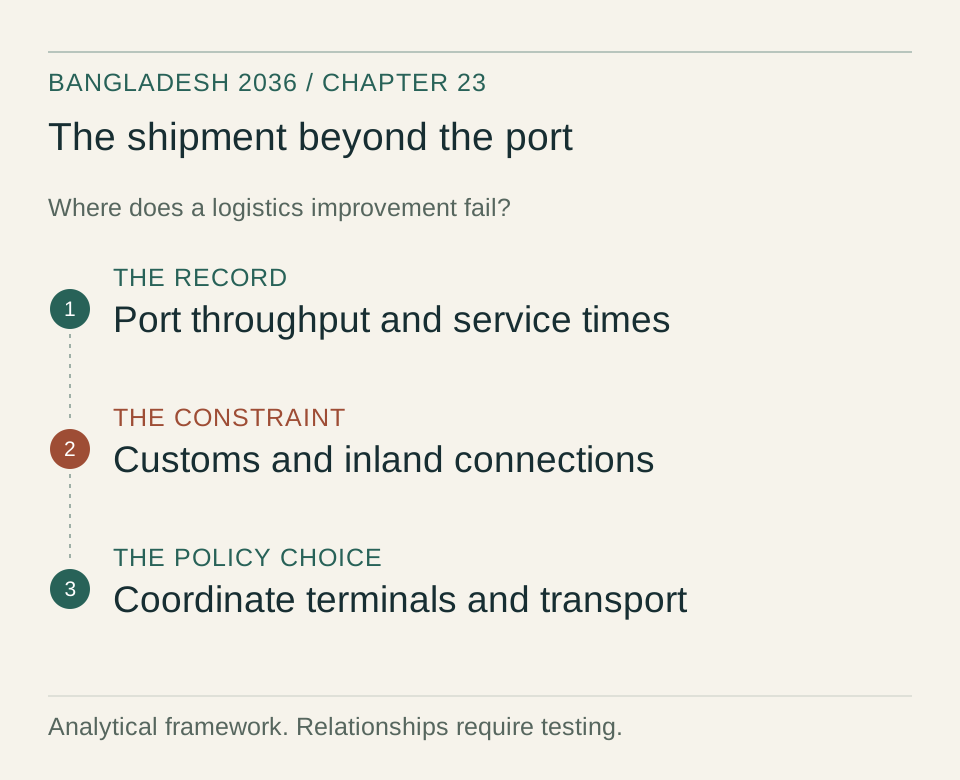
How port and inland constraints interact
The mechanism that produced the metrics has three layers. The first is the channel draft constraint: Chattogram sits up a river, mother vessels anchor offshore and lighterage adds cost and delay to every import and export, which is why the dwell time and turnaround numbers cannot reach the frontier however well the terminal runs, and why the Matarbari and Bay Terminal projects are structural rather than incremental. The second is the governance constraint: the port's pricing and investment decisions run through the state, terminal concessions were contested for years, and the 1,706.6 crore operating profit [CPA 2024] reflects a tariff structure that taxes congestion instead of financing capacity.
The third is the hinterland constraint: the garments of chapter 17 and the import bill of chapter 03 move on trucks through Dhaka's streets because the rail link's freight share is single-digit [Bangladesh Railway 2023] and the waterways are unpriced, so the port's efficiency is hostage to the roads' congestion, which chapter 50 measures from the other side.
The shock record stress-tested the system. The 2022 import boom chapter 03 documents pushed throughput to 3.255 million TEU and berth occupancy to 92 percent [CPA 2024], the congestion year in which shipping lines added congestion surcharges and the export factories chapter 17 measured paid in delay; the 2023 compression chapter 03 records eased the metrics without fixing the structure. The 2024 political transition added the shutdown week chapter 13 marks [Not confirmed, chapter 13], when the corridor stopped, and the stored port record carries the volume cost only as the FY24 recovery pattern.
The macro mechanism is the freight bill's growth path, and it is the one that turns port metrics into national accounts. Transport service imports of 6.73 billion USD [IMF BOP 2023] scale with trade volume, and chapter 17's export growth at flat unit values [BACI 2024] means the bill compounds unless the share is clawed back through fleet ownership, regional shipping services and port efficiency. The freight bill is the logistics tax on the balance of payments chapter 03 carries; every day of dwell time and every point of occupancy above 80 percent is a price the current account pays, and the buyer who waits pays it twice, once in freight and once in the order that moves to a faster shore.
The regional comparison sharpens the stakes. The Sri Lankan and Indian transshipment hubs that handle Bangladesh's mother-vessel traffic earn the fees the country pays, and the port development race around the Bay of Bengal, Colombo's expansion, Indian ports on both coasts, and the Kyaukphyu question chapter 45's geoeconomics carries, is a race for the same transshipment margin. Bangladesh's volume is large enough to anchor its own hub economics at Matarbari if the draft, the handling productivity and the customs layer arrive together, and large enough to lose the margin permanently if they do not. The available evidence carries no transshipment volumes, the Shipping Ministry statistics being the resolving source, and the chapter treats the hub ambition as a scenario whose precondition list is what this chapter measures.
Decisions on terminals, customs and connections
The forces the FY36 scenarios assume are four. First, the volume arithmetic: the export growth the reform scenario of chapter 15 assumes, 6.5 percent GDP growth with diversification, implies container volumes above 4 million TEU early in the window, against a river port at its practical ceiling; the deep-sea capacity decision is therefore not optional. Second, the modal shift: rail freight at 4.41 million tonnes [Bangladesh Railway 2023] with a 236 percent operating ratio [Bangladesh Railway 2023] needs both the Padma rail link chapter 24 delivers and a freight pricing reform, and the two together are the only path to double-digit rail share.
Third, the digital customs layer: the single window and risk-based clearance would cut the dwell time's paper component, and its go-live could not be confirmed here. Fourth, the port governance reform: concession, corporatisation or performance contract, the choice determines whether the 1,706.6 crore profit [CPA 2024] finances capacity or subsidises inefficiency.
No cited logistics projection targeting 2036 exists; no forecast is adopted here, and the named authors whose work would resolve it are the World Bank's trade and logistics programme and the Asian Development Bank's transport assessments in its Asian Development Outlook [ADB ADO 2026, named reference, no cited series]. The decision points: the Matarbari and Bay Terminal sequencing, the rail freight pricing, the customs single window, and the port concession decision.
The labour dimension runs through the dock and the truck. Port labour productivity, moves per crane-hour and gate transactions per day, could not be confirmed here, the CPA operations reports being the resolving source, and the trucking market's structure, fragmented owner-operators on per-trip pay, is the queue-generation machine the gate data would show. The reforms that move the metrics are labour-process reforms, appointment systems, pre-gate data, weighed containers, as much as concrete, which is why the single window and the terminal concession decisions sit together in the decade's decision set, and why the 9.55 days [CPA 2024] is a management number before it is a construction number.
Risks and opportunities
Risks. First, the ceiling breach: volume growth against the river port's practical limit recreates the FY22 congestion year, 92 percent occupancy [CPA 2024], as the permanent state, and the indicator to monitor is the occupancy and dwell-time pair. Second, the white-elephant risk: deep-sea capacity arriving before the hinterland connections chapter 24 delivers converts a bottleneck into an underused asset, the Payra pattern; the indicator to monitor is the utilisation of the new capacity in its first three years. Third, the fiscal drag: rail's 236 percent operating ratio [Bangladesh Railway 2023] growing with the network chapter 24 expands is a recurring subsidy the budget chapter 04 discusses; the indicator to monitor is the operating ratio's trend.
Upside. First, the freight-bill clawback: every point of the 6.73 billion USD [IMF BOP 2023] converted to national shipping and efficient handling is a services export chapter 20 records. Second, the dwell-time dividend: cutting 9.55 days toward the frontier releases working capital across the entire trade economy at zero fiscal cost. Third, the corridor premium: a functioning Dhaka-Chattogram logistics corridor raises the export competitiveness of every factory chapter 17 and chapter 18 measure, the only reform that is simultaneously an industrial policy, and its benefits arrive in the accounts of firms rather than the budget, which is why it needs a state that prices the externality.
Testing the policy case
The port authority, customs and transport operators should track door-to-door shipment time and reliability, not only berth performance. Shorter port dwell times with unchanged factory delivery would locate the bottleneck inland. Higher throughput with rising costs would require a different response from additional terminal construction alone.
What to watch
The thresholds below are author-proposed monitoring markers, not official targets or estimated policy effects. Interpret them alongside the source dates and definitions.
- Container throughput. Latest cited value 3.17 million TEU in FY24 [CPA 2024]. Threshold: sustained growth above 5 percent a year marks the volume regime the deep-sea port must serve; a fall marks the export contraction chapter 17 fears.
- Container dwell time. Latest cited value 9.55 days in FY23 [CPA 2024]. Threshold: a fall below 7 days marks the efficiency turn; a rise above 12 marks the congestion regime returning.
- Berth occupancy. Latest cited value 78.17 percent in FY23 [CPA 2024]. Threshold: above 85 percent is the surcharge zone; below 70 percent with rising volumes marks the capacity relief the new terminals promise.
- Rail freight. Latest cited value 4.41 million tonnes and 1,074.85 million net tonne-km in FY23 [Bangladesh Railway 2023]. Threshold: a doubling marks the modal shift; a third consecutive fall marks the road-lock deepening.
- Transport service imports. Latest cited value 6.73 billion USD in calendar 2023 [IMF BOP 2023]. Threshold: a falling share of total trade marks the freight-bill clawback; growth with volume marks the silent tariff compounding.
Sources used
[CPA 2024] Chattogram Port Authority operational and financial statistics via bdpolicy.db, series: cpa_container_throughput_teus, cpa_total_cargo_handled_million_mt, cpa_chattogram_port_vessels, cpa_berth_occupancy_rate_pct, cpa_container_dwell_time_days, cpa_operating_profit_crore_bdt, cpa_vessel_turnaround_time_days.
[Bangladesh Railway 2023] Bangladesh Railway operational statistics via bdpolicy.db, series: br_freight_tonnes_total_thousand, br_freight_net_tonne_km_million, br_operating_ratio_pct.
[IMF BOP 2023] IMF Balance of Payments via the trade/bd_bop_flows parquet, item 121 debit and credit, transport services, calendar-year 2023, not joined to any BB fiscal-year table.
[WB LPI 2022] World Bank Logistics Performance Index, overall score, via bdpolicylab indicators/wb_full_bd parquet, series: LP.LPI.OVRL.XQ, 2022 survey wave.
[BACI 2024] CEPII trade via the trade/bd_hs6_trade parquet, series: bd_hs6_trade, garment export values cited from chapter 17.
[MPA 2025] Mongla Port Authority annual operational statistics via bdpolicy.db, series: mpa_cargo_handled_million_mt, mpa_container_throughput_teus.
[PortWatch 2026] IMF PortWatch monthly vessel-call estimates via bdpolicy.db, series: portwatch_payra_portcalls_monthly.
[ADB ADO 2026] Asian Development Outlook, named institutional reference for the 2036 logistics scenario; no cited series backs it.
[Not confirmed, chapter 13] shutdown week volume cost, qualitative reading.
[Not confirmed, chapter 23] Matarbari and Bay Terminal timelines, single window go-live, logistics cost share, inland waterways series; resolving sources CPA, Ports Division, Shipping Ministry and BIWTA documents.