Make formality worthwhile for firms and workers
Informal employment accounted for 84.9 percent of employment in 2022, only 2.6 percentage points below its 2010 share [BBS LFS 2022]. SME lending also declined relative to GDP [IMF FAS 2024]. Registration, finance and social protection need to work together if formality is to become worthwhile for small firms and workers. Digital payment records could help, provided access to services and fair treatment improve alongside visibility to the state.
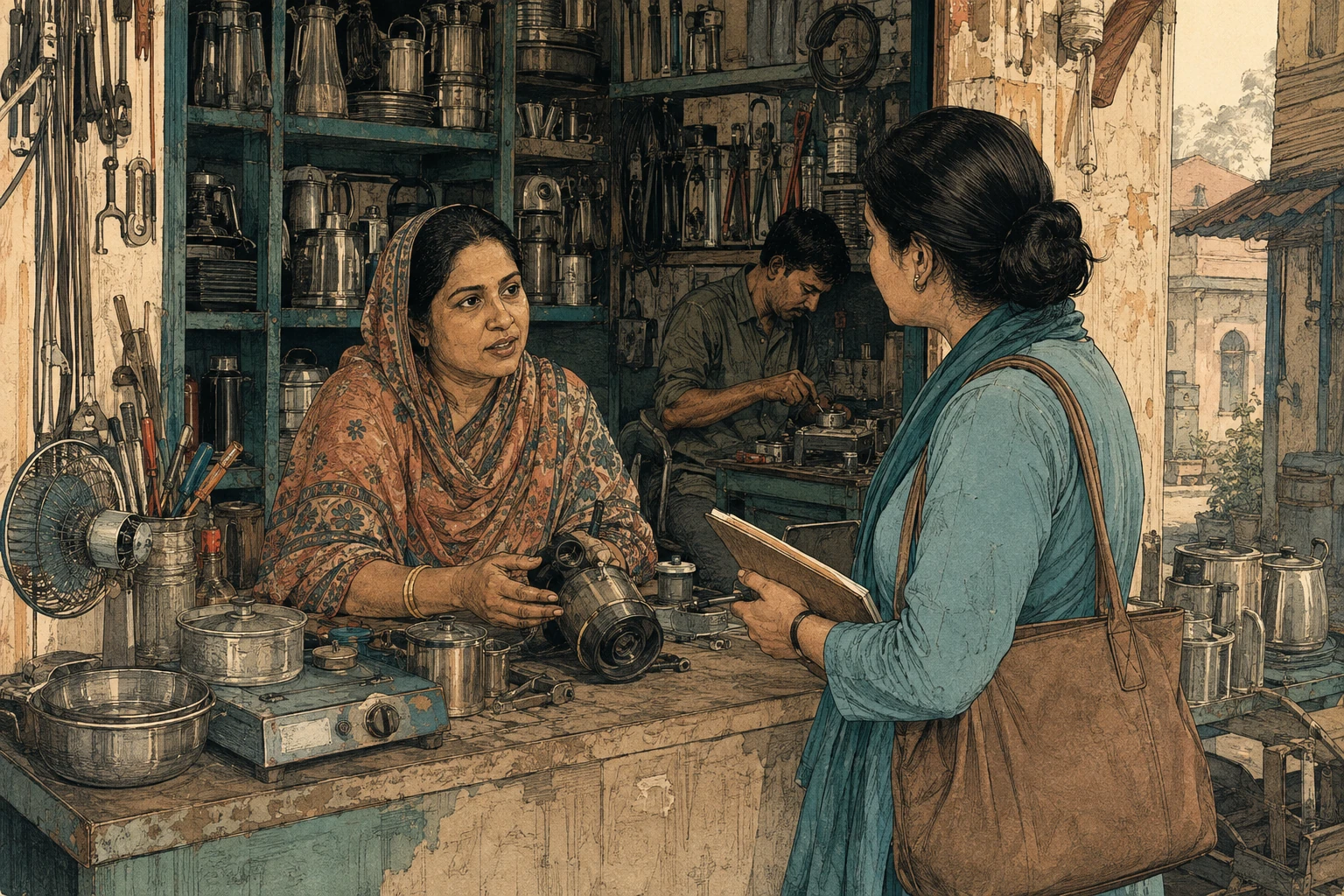
Informal work, small-firm credit and registration
The informality record is the starting point. The labour force survey series places informal employment at 87.5 percent of employment in 2010, 87.4 in 2013, 86.2 in 2016, 85.1 in 2017 and 84.9 in 2022 [BBS LFS 2022]. Twelve years of change moved the share by less than three percentage points, and the composition chapter 08 measures explains why: of 69.07 million employed persons in 2024, 35.76 million were own-account workers and 4.40 million unpaid family helpers [ILO 2025], employment-status categories that do not, by themselves, establish informality, and the 2.73 million employers [ILO 2025] employ the rest in firms whose size and registration the record does not store.
Self-employment in its three forms is 62.1 percent of employment on the chapter 08 arithmetic [ILO 2025], and the vulnerable employment measure, own-account plus unpaid work, stands at 57.74 percent [WB WDI 2026]. The enterprise census that would count the firms behind these workers is not in the cited data; the BBS economic census and the SME Foundation's counts are the resolving sources, so firm counts by size band could not be confirmed here, and the chapter uses the employment shares, which are measured.
The credit record is the measured price of informality. SME loans fell from 9.09 percent of GDP in 2017 to 8.16 in 2020, 6.93 in 2021, 6.63 in 2022, 6.34 in 2023 and 5.98 in 2024 [IMF FAS 2024], the decade of decline chapter 07 diagnoses, and the decline raises a question about access to small-firm finance; the aggregate series does not identify how classification changes affected different borrower sizes. The count of financed borrowers tells the same story from the access side: 96.4 borrowers per 1,000 adults in 2024 [IMF FAS 2024], against 1,143.4 depositors per 1,000 [IMF FAS 2024], a system that takes deposits from the small and lends to the large.
The refinance machinery, the Bangladesh Bank's SME and CMSME refinance schemes with their subsidised rates and quotas, is the state's response, and its share of the SME book could not be confirmed from the cited sources, the Bangladesh Bank scheme reports being the resolving source; chapter 07's verdict, that refinance subsidises price without building underwriting, is this chapter's mechanism hypothesis.
The cottage and micro tier has one measured pulse. The industrial production index for cottage manufacturing rose from 100 in 2016 to 188.47 in 2023 [BBS IIP 2024], nearly doubling while the informality rate fell 2.6 points, which is the chapter's clearest evidence that the tier grows without formalising: output up 88 percent, formality up almost none. The tier's employment, credit and enterprise counts could not be confirmed here, the economic census being the resolving source. The digital acceptance record is the newest input: mobile money moved 34.7 percent of GDP in transactions [IMF FAS 2024] and the merchant payment rail reaches stalls and workshops that no bank branch does, so the transaction record exists before the tax registration does, which is the reversal this chapter's formalisation path builds on.
The registration and tax burden is the price side of the equilibrium. A firm needs a trade licence from the local government body, a TIN from the NBR, and, past thresholds, VAT registration; the time and cost of each step are not stored as series, the Doing Business discontinuation having removed the standard benchmark, so the burden figures could not be confirmed, with the National Board of Revenue and Local Government Division publications the resolving sources. What is measured is the incentive structure at the margin: formal and informal firms face different tax and compliance obligations; the cited sources do not establish that informal firms pay zero tax, particularly once indirect taxes are considered, and the NBR's own reform documents acknowledge the compliance gap qualitatively, the precise VAT gap not established, per chapter 04's account [NBR 2025].
The social protection entry price completes the ledger: the safety net reaches 32 million beneficiaries at 126,272 crore BDT in FY25 [MoF Budget 2025], but it is a state budget line for the informal, not a contribution system they own, and the pension gap chapter 38 measures is the formality dividend they are not earning.
The sectoral map of informality explains where the locks bind hardest. Informality is widespread in agriculture, but sector alone is not an employment-status definition: the 44.7 percent of employment in farming [ILO 2025] sits outside any registration logic except input subsidies and procurement, and its output chapter 16 measures enters the market through intermediaries whose own registration is thin. Construction and transport are project- and vehicle-licensed rather than firm-registered, so the informality there is a patchwork of permits with no firm-level record. Retail and personal services, the largest informal employers in the cities chapter 50 measures, sit on the payment rail's edge: the corner shop takes mobile payments, which makes it visible, and remains unregistered, which makes it untaxed and unfinanced.
Manufacturing is the split case: the export factories are formal by buyer demand, the domestic workshops are not, and the cottage index at 188.47 [BBS IIP 2024] is the latter's growth without the former's record.
The urban-rural gradient follows the infrastructure: informal shares are highest where the state's service reach is thinnest, and the district-level informality split could not be confirmed from the cited sources, the quarterly labour force survey's geographic tables being the resolving source. What the census does measure is the household frame: 3.95 million households receiving remittances [BBS Census 2022] and the enterprise-owning households chapter 14's regional account carries are the two populations whose formalisation is financed from abroad or from land, and the rest of the tier formalises, if at all, through the credit and registration channels this chapter prices.
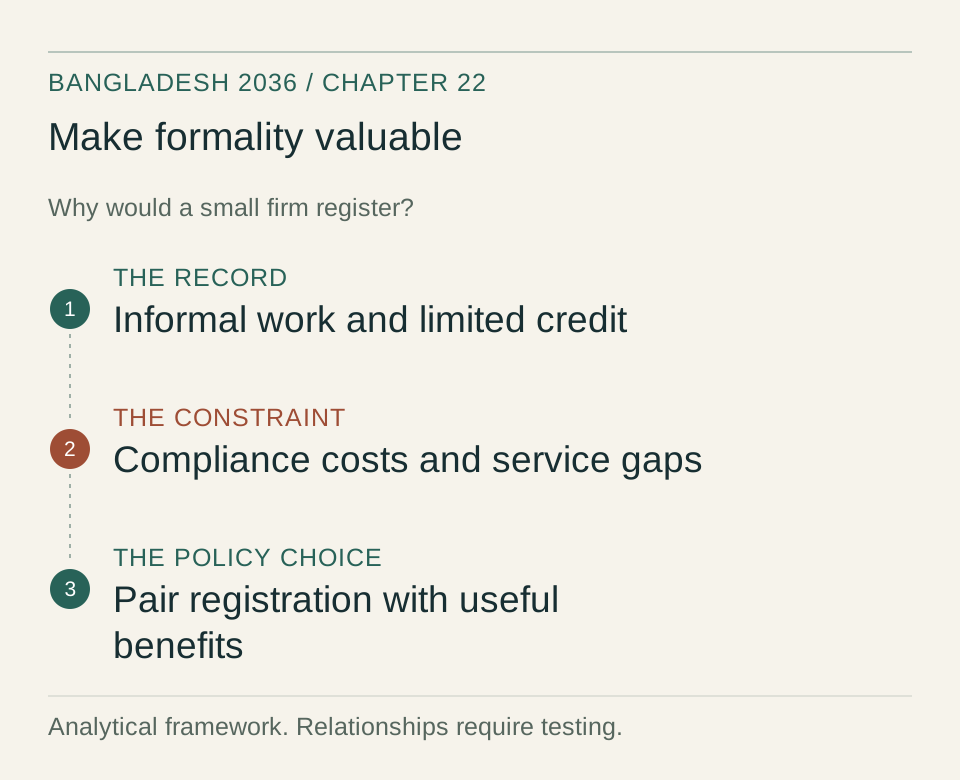
Finance, compliance costs and incentives
The mechanism that sustains the rationing equilibrium runs through three locks. The first lock is the credit lock: banks lend against collateral and documentation, the informal firm has neither, so the firm funds itself from savings and suppliers, which caps its scale at the owner's savings; the 96.4 borrowers per 1,000 [IMF FAS 2024] and the 5.98 percent SME share [IMF FAS 2024] are the indicators. The refinance lines do not unlock it because they flow through the same collateral-first banks, chapter 07's mechanism. The digital ledger unlocks it differently: a merchant payment history is underwriting data that does not ask for a land title, and chapter 07's recommendation to make ledgers attached to digital identity admissible is this chapter's credit unlock.
The second lock is the registration lock: formality costs fees, time and visibility, and returns almost nothing the firm values. Tax registration buys the attention of a revenue authority whose ratio is 7.64 percent of GDP [WB WDI 2026]; trade licences buy the right to be inspected. The state has never offered the informal firm a package, formality in exchange for services, and the digital rails make the package newly cheap to build: a registered mobile-money merchant with a transaction history is a taxpayer at negligible marginal cost if and only if the tax design starts where the firm is. The G2P digitisation the safety net runs, 65 percent of payments digital in FY25 [MoF Budget 2025], shows the state can already transact with the informal at scale; the direction of the flow, state to household, is the missing reverse gear.
The third lock is the enforcement ratchet: informality is tolerated until firms grow, then enforcement arrives as a cost of success, which teaches every small firm that growth is punished. The VAT threshold, the audit probability and the inspection burden all step up with size, but the relevant schedules and firm responses have not been established here, so deliberate avoidance of thresholds remains a hypothesis. The 84.9 percent informality rate [BBS LFS 2022] is not a stock of laggards; it is the equilibrium output of a step function, and smoothing the steps is the reform.
The gender mechanism runs through all three locks and lands hardest: the female workers chapter 08 and chapter 35 measure are concentrated in the informal tiers, home-based work and own-account trade, where the credit lock binds through the collateral the property regime chapter 51 documents denies them. The 27.50 percent female share of TVET [BANBEIS 2023, institutions and students by tier] and the 34.22 percent female share of wage and salaried employment [WB WDI 2026] bound what the tier can become without a formalisation push aimed at it.
Choices for a gradual transition
The forces the FY36 scenarios assume are four. First, the demographic arithmetic: the working-age share peaks this decade and the window chapter 08 dates closes, so the informality rate's slope is the difference between cashing the dividend and wasting it. Second, the digital rails: chapter 13's accounts, 53.42 percent internet use [WB WDI 2026] and the 34.7 percent payment rail [IMF FAS 2024], give the state its first-ever transaction-level view of the informal economy; what the state does with visibility, service or extraction, is the decade's governance question. Third, the LDC graduation incentive shift: the cash incentives and bonded-warehouse privileges chapter 18 details expire or convert, and the SME tier is where their replacement matters most.
Fourth, the banking cleanup: chapter 06's resolution, if it restores intermediation, reopens the credit lock from the supply side, and if it does not, the 5.98 percent share [IMF FAS 2024] is the decade's ceiling.
No cited formalisation projection exists; any 2036 informality figure is not established, the scenario arithmetic assumes no slope of its own, and the named authors whose work would resolve it are the ILO's informality estimates and the BBS quarterly labour force series since 2023. The decision points: the credit unlock, whether transaction-ledger underwriting becomes admissible; the registration package, whether formality ships with services; the threshold smoothing, whether VAT and audit steps flatten; and the enforcement sequencing, whether visibility is used before punishment.
The measurement problem is itself part of the mechanism. The 84.9 percent figure is an employment share [BBS LFS 2022], not the share of GDP imputed without observation. National accounts combine surveys, administrative records and estimation; those methods require assessment separately from employment formality. Chapter 53 carries the statistics credibility record in full; the point for this chapter is that formalisation is also a measurement reform, every firm that registers converts an imputation into an observation, and the credibility dividend the statistics chapter prices is a side payment of the registration package.
Risks and opportunities
Risks. First, the extraction trap: the state uses the digital visibility to tax before it uses it to serve, and the 84.9 percent [BBS LFS 2022] responds by going cash, which the relevant indicator, cash-out shares in the MFS data, would show. Second, the credit shortage deepening: the SME share falling below 5 percent of GDP [IMF FAS 2024] while the cleanup absorbs capital, the credit-shortage scenario chapter 07 defines. Third, the automation squeeze: the informal tier's tradable activities, tailoring, repair, food, face platform competition whose entry is formal and whose pricing is algorithmic, and the indicator to monitor is the cottage index decoupling from tier employment, not confirmed here.
Upside. First, the G2P on-ramp: the programme reports 32 million beneficiaries and 65 percent of payments delivered digitally, which does not establish that every beneficiary receives a digital payment [MoF Budget 2025], and the same rail in reverse, payments to registered micro-suppliers, is formalisation by procurement. Second, the merchant rail: the transaction ledger as underwriting data is the credit unlock that needs no land title, priced at the 34.7 percent rail [IMF FAS 2024]. Third, the graduation-forced simplification: the incentive reform chapter 18 frames, if done as simplification rather than removal, can trade the wall of reliefs for one low rate that the informal firm can actually pay, which is how the tier converts from a tax problem into a taxpayer base, and how the 84.9 percent starts to fall for the first time at the pace the decade requires.
Testing the policy case
NBR, Bangladesh Bank and local authorities should test simplified registration alongside tangible services and safeguards. If registrations rise but firms return to cash or close, the package may have increased burdens without benefits. Credit and productivity gains among participating firms should be compared with similar firms outside the programme.
What to watch
The thresholds below are author-proposed monitoring markers, not official targets or estimated policy effects. Interpret them alongside the source dates and definitions.
- Informal employment share. Latest cited value 84.9 percent in 2022, the last survey reading [BBS LFS 2022]. Threshold: a fall below 80 percent in the next survey wave marks the formalisation turn; a return above 87 marks the stall.
- SME loans to GDP. Latest cited value 5.98 percent in 2024 [IMF FAS 2024]. Threshold: recovery above 8 percent marks the small-firm credit turn chapter 07 targets; below 5 would be consistent with the credit-shortage scenario.
- Borrowers per 1,000 adults. Latest cited value 96.4 in 2024 [IMF FAS 2024]. Threshold: above 150 marks credit deepening to the tier; stagnation below 100 marks the collateral lock holding.
- Cottage industry production index. Latest cited value 188.47, base 2016 equals 100, in 2023 [BBS IIP 2024]. Threshold: continued growth with a falling informality rate marks the good equilibrium; growth with flat informality confirms growth without formality.
- Digital G2P share. Latest cited value 65 percent of safety net payments in FY25 [MoF Budget 2025]. Threshold: above 90 percent marks the full digital on-ramp; the state's use of the same rail for revenue is the regime marker this chapter watches.
Sources used
[BBS LFS 2022] Bangladesh Bureau of Statistics Labour Force Survey via bdpolicy.db, series: bbs_lfs_informal_rate.
[ILO 2025] ILOSTAT modelled estimates via the labor/ilo parquets, series: ilo_emp_temp_sex_ste_nb_a.
[WB WDI 2026] World Bank World Development Indicators via bdpolicy.db, series: SL.EMP.VULN.ZS, SL.EMP.WORK.FE.ZS, GC.TAX.TOTL.GD.ZS, IT.NET.USER.ZS.
[IMF FAS 2024] IMF Financial Access Survey via bdpolicy.db, series: imf_fas_sme_loans_pct_gdp, imf_fas_commercial_bank_borrowers_per_1k, imf_fas_commercial_bank_depositors_per_1k, imf_fas_mobile_money_tx_pct_gdp.
[BBS IIP 2024] Bangladesh Bureau of Statistics industrial production index via bdpolicy.db, series: bbs_iip_mfg_cottage_annual.
[MoF Budget 2025] Finance Division safety net series via bdpolicy.db bdfacts series, series: bdfacts_ssn_beneficiaries_million, bdfacts_ssn_budget_bdt_crore, bdfacts_ssn_digital_payment_pct.
[NBR 2025] National Board of Revenue annual reports, resolving source for compliance gap and burden figures that could not be confirmed.
[BANBEIS 2023] Bangladesh Bureau of Educational Information and Statistics, TVET tier tables, cited from chapter 09.
[BBS Census 2022] BBS Population and Housing Census 2022, district workbook bangladesh_bbs_population-and-housing-census-dataset_2022_admin-02.xlsx, sheet Foreign Remittance Recipient. The district household counts sum to 3,950,155; stored series census2022_remittance_recipient_households_nos.