Bank repair starts with recognising losses
Bangladesh Bank reports classified loans at 30.6 percent of the loan book at end December 2025, against 18.96 percent a year earlier [BB NPL 2026]. The figure excludes loans already written off and rescheduled loans still classified as performing. The increase therefore needs to be read alongside changes in recognition rules and loan performance. The immediate tasks are to establish losses, protect depositors and resolve weak institutions; lending growth alone cannot repair impaired balance sheets.
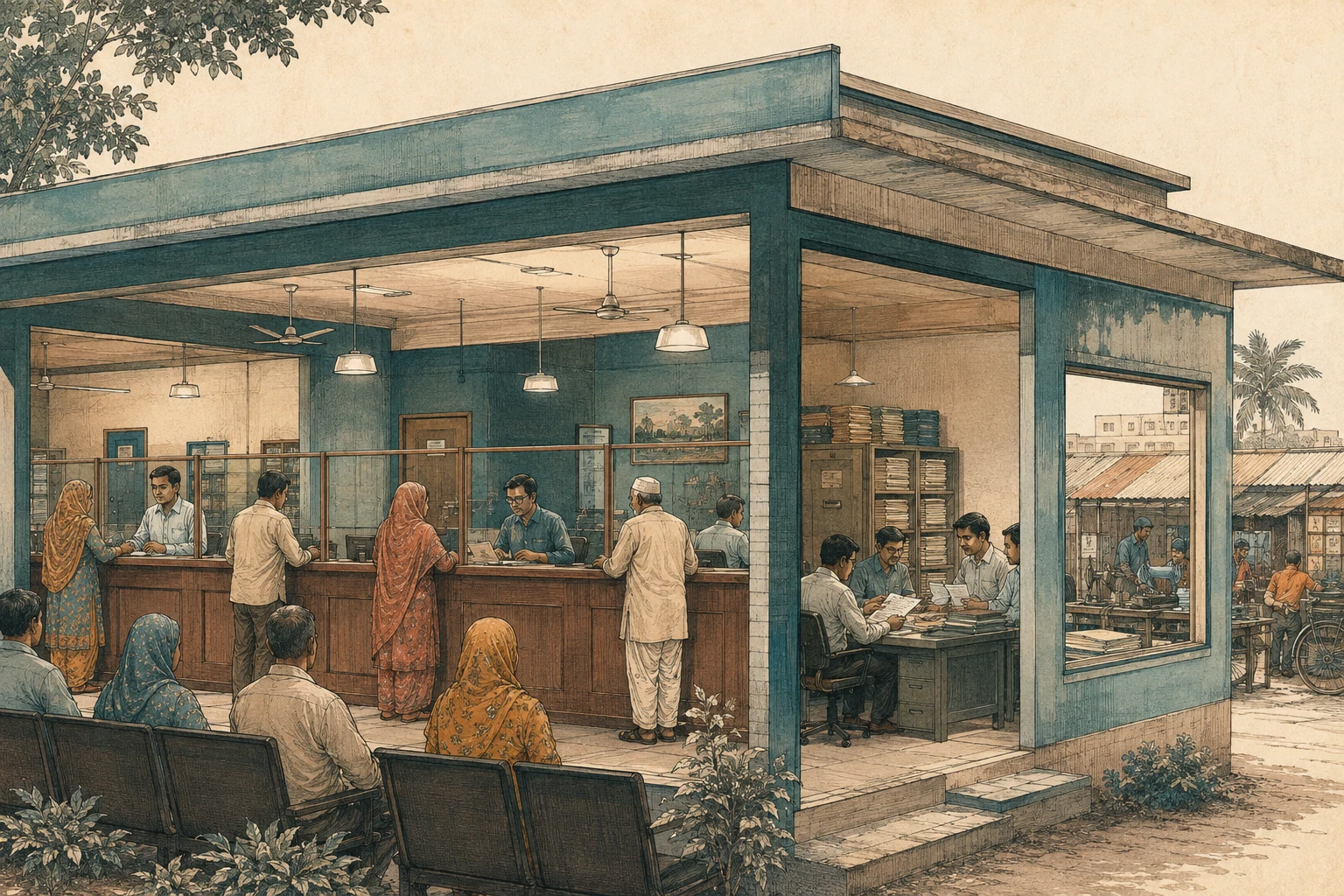
Classification changes complicate the history
The World Bank series gives the shape of the under statement. Bank non performing loans to gross loans were 8.40 percent in 2015, 9.89 percent in 2018, 7.74 percent in 2020 and 9.57 percent in 2023 [WB WDI 2026]. Bangladesh Bank's own annual report table explains each dip as a relief event rather than a recovery: the ratio was 9.7 percent in 2014, the fall to 8.8 percent in 2015 followed large loan restructuring facilities, the fall to 9.3 percent in 2019 followed an amended past due definition and a special rescheduling and one time exit facility, and the fall to 7.66 percent in 2020 followed the COVID 19 debt moratorium; after the moratorium withdrew, the ratio printed 9.00 percent in December 2023 and 12.56 percent in June 2024 [BB AR 2024, annual report FY24, Table 5.03(a)].
A series that only moves on amnesty is a series measuring policy, not bank health.
The reset broke the pattern. The central bank's reading for end December 2025 is 30.6 percent against 18.96 percent at end 2024 [BB NPL 2026], and the corollary counts were already large before it: 1,012,721 classified borrowers of banks and finance companies at June 2024, up from 938,822 a year earlier, out of 7,593,820 bank borrowers, and a classified amount including written off loans of 2,934.83 billion BDT in June 2024, up about 30 percent from 2,257.78 billion BDT in June 2023 [BB AR 2024, annual report FY24, credit information bureau]. Even before the reset, the written off and classified stock was compounding at close to the growth of total lending, which is consistent with a book that is not being recovered.
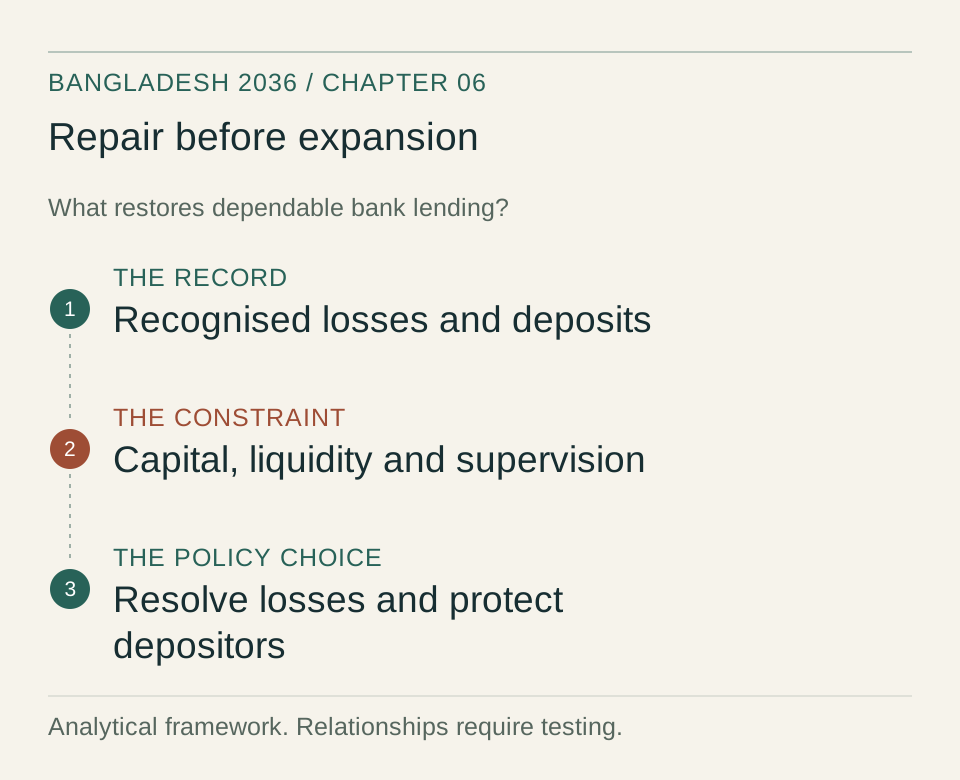
Weakness differs sharply across bank groups
The June 2024 bank group table, read under the old classification rules, already located the problem. Gross non performing loans were 32.77 percent at state owned commercial banks and 13.11 percent at specialised banks, against 7.94 percent at private commercial banks and 4.74 percent at foreign banks, for an industry ratio of 12.56 percent [BB AR 2024, annual report FY24, Table 5.03(a)]. The capital and earnings tables point the same way. The industry capital to risk weighted assets ratio was 10.64 percent at June 2024, but 5.44 percent at state owned banks against 12.29 percent at private banks and 39.46 percent at foreign banks; four state owned banks and five private banks failed the minimum capital requirement, and the two specialised banks, BKB and RAKUB, failed the minimum capital to risk weighted assets test outright [BB AR 2024, annual report FY24, Table 5.02].
State owned banks earned a return on equity of minus 11.40 percent in June 2024 and specialised banks minus 10.08 percent, against 8.75 percent for private banks, 19.33 percent for foreign banks and 7.85 percent for the industry, whose return on assets was 0.40 percent [BB AR 2024, annual report FY24, Tables 5.09 and 5.10]. Provisions tell the solvency truth most directly: state owned banks held 69.64 percent of their required provisions at June 2024 and private banks 80.18 percent, so the weakness is not just capital, it is the loss already booked against it [BB AR 2024, annual report FY24, Table 5.06].
The World Bank series corroborates the thinness of the aggregate buffer: bank capital to assets was 6.55 percent in 2023 after 4.76 percent in 2021 [WB WDI 2026].
The Islamic tier is the concentration risk inside the private segment. Ten full fledged Islamic banks held 4,410.84 billion BDT of deposits at December 2023, 25.22 percent of the industry, and their deposit growth stalled first: Islamic deposits rose 2.44 percent in the six months from December 2023 to June 2024, to 4,518.59 billion BDT, while the industry's deposits rose 7.77 percent over the twelve months to June 2024, to 18,412.48 billion BDT; on an annualised basis the Islamic tier grew at about 4.9 percent against the industry's 7.77 percent [BB AR 2024, annual report FY24, Chapter 6 and Chapter 5].
The report states plainly that the Islamic system faced acute consecutive liquidity constraints through the year, and the central bank ran Mudarabah liquidity support, the Islamic banks liquidity facility and special liquidity support throughout the year to keep it upright; gross non performing investments reached 4.89 percent of investments, 242.28 billion BDT, at June 2024, and the tier's capital to risk weighted assets ratio fell from 12.66 percent at December 2023 to 11.96 percent at June 2024 [BB AR 2024, annual report FY24, Chapter 6, Tables 6.03 and 6.04]. The bank by bank exposures behind these aggregates are the resolving detail, and the Bangladesh Bank Financial Stability Report is the source for them [BB FSR 2025].
Deposits and liquidity under pressure
Commercial bank deposits fell from 43.70 percent of GDP in 2020 to 43.40 percent in 2021, 39.52 percent in 2022, 39.14 percent in 2023 and 37.89 percent in 2024, a loss of nearly 6 percentage points of GDP [IMF FAS 2024]. The same survey shows the flight is a rationing of balances, not an exit of customers: depositors per 1,000 adults rose from 932.01 in 2020 to 1,143.38 in 2024, and female depositors per 1,000 female adults rose to 764.41 [IMF FAS 2024]. Depositor counts can include the same person at several institutions. A declining deposits-to-GDP ratio does not establish an absolute fall in balances or identify where funds moved; bank-level flows are needed to test those hypotheses.
The nominal aggregates confirm how tight the squeeze is. Broad money growth slowed to 6.13 percent in 2024 from 9.18 percent in 2021, while consumer prices rose 10.47 percent in 2024 [WB WDI 2026], so the real deposit base contracted, and broad money fell from 57.76 percent of GDP in 2020 to 48.80 percent in 2024 [WB WDI 2026]. The later M2 snapshot lacks a verified reference month and is excluded from dated comparisons [BB Econ 2026, snapshot 2026-09-04]. The safety net under the household side of this flight is thin. Through FY24 deposit insurance paid a flat ceiling of BDT 100,000 per depositor under the Bank Amanat Bima Act 2000, a pay box system funded by premiums of 0.08 to 0.10 percent of deposits depending on the bank's category [BB AR 2024, annual report FY24, deposit insurance].
The Deposit Protection Ordinance 2025, approved on 9 October 2025, doubled the ceiling to BDT 200,000, brought finance companies into the scheme with a separate fund and cut the claim settlement window from 180 to 17 working days, and the Deposit Protection Act 2026, Act 75 of 2026 assented on 10 April 2026, carried it into statute [MinLaw 2026]. BDT 200,000 is about 1,629 USD at the 122.75 BDT/USD rate of May 2026 [BIS 2026].
The allocation of credit
Total bank advances stood at 14.46 trillion BDT in December 2023 [BB Econ 2024]. Industry took 5.78 trillion BDT and trade 4.89 trillion BDT, together 73.84 percent of the book, with construction at 1.17 trillion BDT, agriculture at 0.71 trillion BDT, 4.91 percent of advances, and consumer lending at 1.31 trillion BDT [BB Econ 2024]. Growth in the two December years in the available data shows the tilt worsening as the crisis built: consumer lending grew 23.5 percent in each of 2022 and 2023, the fastest of any category, while industry lending decelerated from 12.4 to 8.5 percent and trade from 15.0 to 10.7 percent [BB Econ 2024].
Working capital for industry and trade, the categories where related party lending lives, crowds the book; the category the state directs most loudly, agriculture, takes under 5 percent; and consumer credit compounded through the liquidity crisis. When the classification reset repriced the book, the categories easiest to misclassify repriced first.
How lending and supervision created losses
The machine had four parts. Directed lending at below market rates, first to agriculture and jute, then to power and infrastructure through state banks, created the initial losses. Related party lending by legacy private banks, the S Alam era concentration the transition documents allege, multiplied them. The supervisory response of rescheduling, restructuring and court stays, visible in the annual report's own account of every post 2015 dip in the ratio, converted losses into carrying costs [BB AR 2024, annual report FY24, Table 5.03(a)]. And the 9 percent lending cap documented in chapter 05 removed the margin that could have absorbed the losses.
The reset of 2025 ended the conversion mechanism, and the stock appeared. The machine had a fiscal twin: the same related party networks reached the capital market through margin loans and the land market through developer finance, so the cleanup propagates into chapter 07's market record and chapter 14's land prices.
Crowding out closes the loop with the state. Banks held 4,034.89 billion BDT of treasury securities at June 2024, 15.88 percent of total assets of 25,412.76 billion BDT [BB AR 2024, annual report FY24, aggregate balance sheet], and World Bank series place claims on the central government at 14.75 percent of GDP in 2024 [WB WDI 2026]. Liquid reserves to bank assets fell to 7.46 percent in 2024 from 11.47 percent in 2017 [WB WDI 2026], and net foreign assets of the banking system fell from 3.15 trillion BDT in 2021 to 1.78 trillion BDT in 2024, the domestic mirror of the reserve pressure chapter 03 records [WB WDI 2026].
An insolvent but liquid bank buys government paper and survives; a solvent but illiquid one fails. The machine therefore channels fresh household savings into financing the state and servicing the past, which is why domestic credit to the private sector, all lenders, falls from 39.16 percent of GDP in 2020 to 35.81 percent in 2024 even as the state's development programme grows [WB WDI 2026].
Microfinance and finance companies need separate assessments
Microfinance loans stood at 3.19 percent of GDP in 2024, up from 2.69 percent in 2021, delivered through 26,070 MFI branches with 28.96 million female borrowers recorded [IMF FAS 2024]. Grameen Bank alone counted 10.27 million members, 96.85 percent of them women, with cumulative disbursement of 275,627.93 crore BDT and a cumulative recovery rate of 94.46 percent [Grameen Bank / BBS 2022]. Households and micro firms are substituting toward a sector whose repayment discipline is intact; the deposit flight series and the MFI growth series are two views of the same trust reallocation.
The non bank tier above microfinance is sicker than the banks it mirrors. Thirty five finance companies now operate under the Finance Company Act 2023, promulgated after the industry's setbacks, with total assets of 1,007.17 billion BDT at June 2024 and deposits of 475.14 billion BDT, down from 477.22 billion BDT a year earlier; their gross non performing loan ratio was 33.15 percent at June 2024, above the banking sector's own figure under the same pre reset rules [BB AR 2024, annual report FY24, Chapter 8]. The non bank distress that made the 2019 to 2023 headlines is therefore not a legacy but a running condition, and a resolution strategy should assess finance companies separately rather than infer their share of system distress from their own non-performing loan ratio.
Resolution, recapitalisation and supervision
The consolidation scenarios that chapter 15 assumes run as follows. The reform scenario assumes the weak Islamic banks and insolvent legacy private banks are merged or resolved under the resolution framework early in the window, state banks are recapitalised against an audited balance sheet, and the measured classified ratio falls below 10 percent by around FY31 as recoveries and write offs proceed. The baseline scenario assumes partial consolidation, the worst banks resolved and the rest carried, with the ratio drifting down but staying above 15 percent. The stall scenario assumes the reset is reversed, rescheduling returns, and the measured ratio falls without any recovery of the underlying stock, which is what the pre reset series looked like. The baseline and stall paths are indistinguishable in the headline ratio, which is why this chapter's indicators are balance sheet measures, not ratios alone.
The decision points are now anchored in instruments that exist. Resolution: the Bank Company (Amendment) Act 2023 added section 77Ka, under which Bangladesh Bank issued the rule based prompt corrective action framework, BRPD Circular 17 of 5 December 2023, effective 31 March 2025 on audited December 2024 financials, grading weak banks into four categories on capital, net non performing loans, liquidity and governance, with resolution tools from amalgamation and restructuring to bail in and liquidation, and a separate amalgamation policy of 4 April 2024 covering voluntary and mandatory mergers [BB AR 2024, annual report FY24, Box 5.02].
Recapitalisation: the state bank repair bill competes with every other claim in chapter 04's budget, and no audited consolidated balance sheet is public in any source available to this chapter. Supervision: the same 2023 amendment defined wilful defaulters, capped family board members at three, and widened inspection powers, the statutory base on which the central bank independence law pursued in chapter 05 must build [BB AR 2024, annual report FY24, Chapter 5]. Safety net: the Deposit Protection Act 2026 has raised the ceiling to BDT 200,000 and brought finance companies into the scheme, with full finance company enrolment targeted for July 2028 [MinLaw 2026].
The external verdict on sequencing and size is the IMF's 2025 Article IV consultation, concluded on 30 January 2026: the Executive Board asked for a banking sector reform strategy with estimates of undercapitalisation, a defined fiscal support envelope, legally robust restructuring and resolution plans, and asset quality reviews of every systemic and state owned bank, and cautioned against unsecured liquidity injections into weak banks [IMF Art IV 2026]. No Financial System Stability Assessment has been published for Bangladesh since the 2010 one, so the undercapitalisation estimate the Board asked for could not be confirmed from the cited sources, and the asset quality reviews would settle it [IMF FSSA 2010].
The sequencing the balance sheet implies is specific: protect deposits so the flight stops, work out the stock, then grow credit, because growing credit first is the evergreening that built the 30.6 percent. The microfinance network of 26,070 branches [IMF FAS 2024] offers extensive reach. Its portfolio quality and borrowers' total obligations require their own assessment before closer credit-bureau integration.
Risks and opportunities
Risks. First, a deposit flight spiral: if a large weak bank fails messily, the near 6 percentage point deposit loss already recorded [IMF FAS 2024] becomes a run, and the indicator to monitor is the deposit growth gap between the Islamic tier and the industry, 2.44 percent in the half year to June 2024 against 7.77 percent for the industry over the full year, widening again [BB AR 2024, annual report FY24, Chapter 6]. Second, fiscal absorption: if state bank recapitalisation lands on the budget at once, chapter 04's arithmetic breaks, and the indicator to monitor is the recapitalisation line in the budget documents [MoF Budget 2026].
Third, a severe credit shortage: if the classified ratio stays above 20 percent, domestic credit to the private sector never leaves the 35 percent of GDP band [WB WDI 2026], the investment stall in chapter 01 becomes permanent, and the indicator to monitor is the quarterly classified loan series [BB NPL 2026].
Upside. First, a clean system is investable: the flat FDI stock in chapter 03 has a banking confidence component, and a resolved system is the precondition for the foreign bank entry the transition agenda targets, a segment whose 39.46 percent capital ratio and 4.74 percent classified ratio show what a working franchise earns here [BB AR 2024, annual report FY24, Tables 5.02 and 5.03(a)]. Second, the inclusion dividend: 1,143 depositors per 1,000 adults, 21,248 agent banking outlets and the digital rails of chapter 13, attached to solvent banks, are the distribution system for the formalisation agenda, and the 28.96 million female MFI borrowers are the identifiable first users of a credit bureau linked graduation path into small enterprise finance [IMF FAS 2024].
Third, the honesty dividend: a measured 30.6 percent [BB NPL 2026] is worse news than a printed 9.57 percent [WB WDI 2026] only once, and every decision after the measurement is made on real numbers, which the last decade of banking policy could not claim.
Testing the policy case
Bangladesh Bank and the Finance Division should publish recovery, write-off and capital information alongside classified-loan ratios. A falling ratio without stronger capital, recoveries or reliable depositor access would not demonstrate repair. Recapitalisation should be assessed against verified losses and changes in lending governance.
What to watch
The thresholds below are author-proposed monitoring markers, not official targets or estimated policy effects. Interpret them alongside the source dates and definitions.
- Classified loan ratio. Latest cited value 30.6 percent at end December 2025 [BB NPL 2026]. Threshold: a fall sustained by recoveries and write offs is the resolution regime; a quiet fall without write offs is the old regime returning.
- Bank deposits to GDP. Latest cited value 37.89 percent in 2024 [IMF FAS 2024]. Threshold: stabilisation above 38 percent signals confidence holding; a fall below 35 percent signals the run regime.
- Domestic credit to the private sector, all lenders. Latest cited value 35.81 percent of GDP in 2024 [WB WDI 2026]. Threshold: a recovery above 39 percent is the intermediation regime returning; a fall below 34 percent is the credit shortage.
- State bank recapitalisation in the budget. Latest cited value: the FY26 allocation could not be confirmed from the cited sources; the budget documents would settle it [MoF Budget 2026]. Threshold: any allocation above 0.5 percent of GDP in a single year is the absorption event chapter 04 must price.
- Deposit insurance coverage. Latest cited value BDT 200,000 per depositor under the Deposit Protection Act 2026, up from BDT 100,000 under the Bank Amanat Bima Act 2000 [MinLaw 2026] [BB AR 2024, annual report FY24, deposit insurance]. Threshold: the finance company fund enrolled on schedule and the ceiling reviewed at the three year interval the Act sets marks the safety net regime; a first bank liquidation paid outside the 17 working day window marks the confidence ceiling.
Sources used
[BB NPL 2026] Bangladesh Bank classified loan ratio, 30.6 percent at end December 2025 on the central bank's own definition (unclassified rescheduled loans and written off loans excluded), as stated in its 2026 clarification on the Financial Stability Report 2025; indicator snapshot updated 2026-09-04 via bdpolicy.db, series: bb_npl_ratio, previous reading 18.96 percent for 2024.
[BB AR 2024] Bangladesh Bank Annual Report 2023-24 via ocr_text/bb/annual_report, banking sector performance, regulation and bank supervision, Islamic banking system, finance companies, deposit insurance.
[BB FSR 2025] Bangladesh Bank Financial Stability Report, resolving source for bank level exposure detail behind the Islamic tier aggregates.
[BB Econ 2024] Bangladesh Bank monthly economic trends via bdpolicy.db, series: bb_m2_money_supply, bb_bank_advances_total and advances by sector.
[BB Econ 2026] Indicators snapshot updated 2026-09-04 via bdpolicy.db, series: bb_m2_money_supply, usd_bdt_rate. Neither is a Bangladesh Bank figure despite the label: M2 comes from World Bank FM.LBL.BMNY.CN (broad money, LCU), and the taka rate from the @fawazahmed0/currency-api dataset served from jsDelivr.
[WB WDI 2026] World Bank indicator snapshot updated 2026-09-04 via bdpolicy.db and finance/wb_financial_sector_bd.parquet, re-read from the WDI API on 2026-09-06 (FB.AST.NPER.ZS 2024 = 18.96, FP.CPI.TOTL.ZG 2024 = 10.47, 2025 = 8.77). WDI year labels are used as published; for Bangladesh the WDI year N of the national accounts rows is FY N ending June, and the financial and price rows here carry their WDI year without a calendar or fiscal claim. Series: wb_bank_npl_ratio, wb_financial_sector_bd indicator codes FB.AST.NPER.ZS, FB.BNK.CAPA.ZS, FS.AST.PRVT.GD.ZS, FM.LBL.BMNY.ZG, FM.LBL.BMNY.GD.ZS, FS.AST.CGOV.GD.ZS, FD.RES.LIQU.AS.ZS, FM.AST.NFRG.CN, plus FP.CPI.TOTL.ZG.
[BIS 2026] Bank for International Settlements USD/BDT series via bdpolicy.db, series: bis_usd_bdt_monthly_eop.
[IMF FAS 2024] IMF Financial Access Survey via bdpolicy.db, series: imf_fas_commercial_bank_deposits_pct_gdp, imf_fas_commercial_bank_depositors_per_1k, imf_fas_depositors_female_per_1k, imf_fas_mfi_loans_pct_gdp, imf_fas_mfi_branches, imf_fas_mfi_borrowers_female, imf_fas_agent_banking_outlets.
[Grameen Bank / BBS 2022] Grameen Bank via BBS compilation, series: grameen_bank_members_total, grameen_bank_female_member_pct, grameen_bank_cumulative_disbursement_crore, grameen_bank_cumulative_recovery_rate_pct.
[IMF Art IV 2026] IMF Press Release 26/029, Executive Board concludes 2025 Article IV consultation with Bangladesh, 30 January 2026, banking sector reform strategy, asset quality reviews, liquidity support caution.
[IMF FSSA 2010] IMF Country Report 10/38, Bangladesh: Financial System Stability Assessment, the last FSSA published for Bangladesh.
[MinLaw 2026] Deposit Protection Act 2026, Act 75 of 2026, assented 10 April 2026, replacing the Deposit Protection Ordinance 2025 approved by the Advisory Council on 9 October 2025: BDT 200,000 per depositor ceiling, separate bank and finance company funds, 17 working day settlement, three yearly ceiling review.
[MoF Budget 2026] Ministry of Finance budget documents, resolving source for state bank recapitalisation allocations.