Disinflation depends on credible monetary and fiscal policy
Inflation eased from 10.47 percent in calendar 2024 to 8.77 percent in 2025 in the World Bank series, but remained well above the pre-shock range [WB WDI 2026]. Bangladesh Bank changed exchange rate arrangements, removed the SMART lending-rate system and raised the policy rate during the adjustment [BB AR 2024]. These measures changed the price of credit as well as the price of imports. Durable disinflation depends on fiscal discipline, bank repair and a monetary framework that can withstand political pressure.
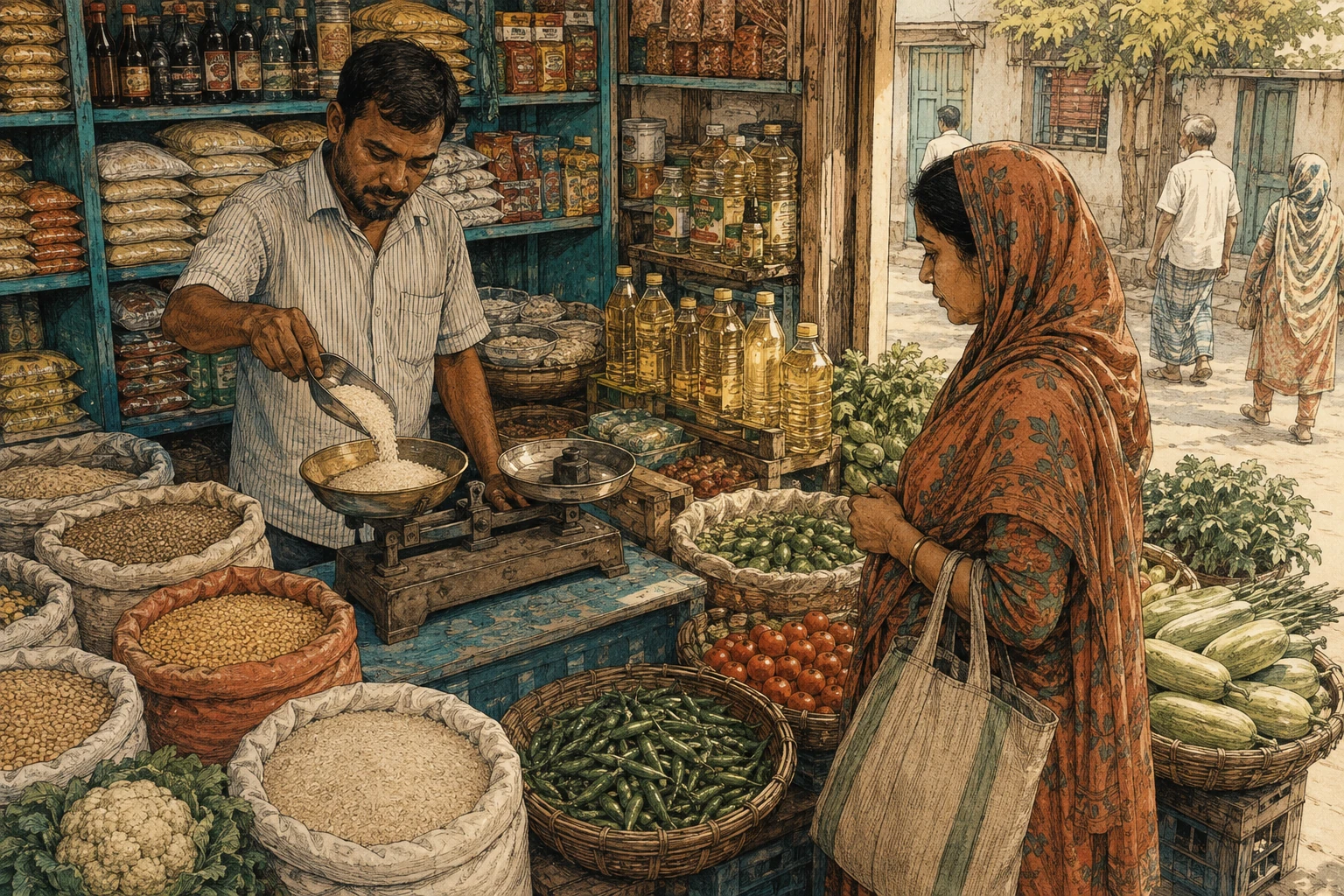
Inflation and the exchange rate adjustment
The inflation record has two regimes. In the first, national CPI inflation ran between 5.44 and 6.15 percent in every year from FY17 to FY22 [BBS CPI 2023]. In the second, it jumped to 9.02 percent in FY23 [BBS CPI 2023], reached a twelve month average of 9.73 percent in June 2024 [BB AR 2024, annual report FY24, monetary policy stance], ran at 9.68 percent rural and 9.94 percent urban in March 2024 [BBS CPI 2024], and stood at 9.88 percent in calendar 2023 and 10.47 percent in calendar 2024 before easing to 8.77 percent in 2025 [WB WDI 2026].
The IMF WEO series puts FY25 at 10.0 percent and projects 9.2 percent for FY26 [IMF WEO 2026]. The burden shifted between town and country as the spike ran: rural inflation, which is food weighted, sat above urban inflation in January and February 2023, 8.67 against 8.39 percent and 8.80 against 8.75 percent, and below it by March 2024, 9.68 against 9.94 percent [BBS CPI 2024]. The food price series the WFP tracks, rice at 49.44 BDT per kg and soybean oil at 188.38 BDT per litre in the latest snapshot [HDX WFP 2026], is the household level face of the regime.
The composition of the spike dates its origin. In FY23, the first full year of the regime, non food inflation ran at 9.39 percent while food inflation ran at 8.71 percent, against 6.31 and 6.05 percent respectively in FY22 [BBS CPI 2023]. Non food leading the spike points at the import price and administered energy channel rather than a harvest failure, and food catching up points at the cost of production, fertiliser and fuel, working through with a lag. That sequencing is the fingerprint of an exchange rate driven inflation rather than a purely domestic one.
The exchange rate tells the same story in one line. The taka was held at 110.5 per USD in October and November 2023 and at 110.0 from December 2023 through April 2024, jumped to 117.7 in May 2024 when Bangladesh Bank replaced the fixed rate with a crawling peg at a mid rate of 117.00 per USD on 8 May 2024 [BB AR 2024, annual report FY24, exchange rate regime], and reached 122.9 per USD by May 2025, against 85.8 per USD at the end of 2021 [BIS 2026]. The latest snapshot puts the rate at 122.6 BDT per USD [BB Econ 2026]. Relative to 85.8 BDT per USD at end 2021, the 122.6 snapshot represents a 42.9 percent rise in the dollar's taka price, or a 30.0 percent fall in the taka's dollar value. These are reciprocal measures of the same exchange rate change.
Money and credit show the cost of the cure. Broad money reached 18.87 trillion BDT by December 2023, up 37 percent in three years from 13.74 trillion BDT at the end of 2020 [BB Econ 2024]; a later snapshot lacks a confirmed reference month and is excluded from the comparison [BB Econ 2026]. Private credit fell as a share of GDP every year from 2020: 39.16 percent in 2020, 39.08 in 2021, 38.96 in 2022, 37.64 in 2023, 35.81 in 2024 and 34.50 percent in 2025 [WB WDI 2026]. Interest rates tell the correction the record had been waiting for: under the cap years the weighted average rate on advances sat at 7.31 percent in FY23 against 9.02 percent FY23 inflation [BB AR 2024, annual report FY24, interest rates on deposits and advances] [BBS CPI 2023], and the reset took the weighted average advance rate to 11.52 percent and the deposit rate from 6.06 to 9.08 percent in FY24 [BB AR 2024, annual report FY24, interest rates on deposits and advances].
Against the 9.73 percent twelve month average inflation of June 2024 [BB AR 2024, annual report FY24, monetary policy stance], the real deposit rate stayed negative, minus 0.65 points from minus 2.96 points a year earlier, while the real advance rate turned positive, 11.52 against 9.73 percent; the flip inside one fiscal year was for lenders, not yet for savers.
The risk perception around the regime is measurable. The five year sovereign CDS estimate moved from 305 basis points in 2019 to 285 in 2021, then widened to 605 basis points in 2023 before easing to 480 in 2024 [IMF Art IV 2024], and Fitch downgraded the sovereign from BB minus to B plus on 21 May 2024 [Fitch 2024]. Both moved on the external side of the same shock the exchange rate series records. One measurement note belongs here: the CPI basket was rebased during the transition and chapter 12 carries the statistics credibility record in full; the series used here is internally consistent within each pull, and the regime finding, 6 percent or 10 percent, is vintage independent.
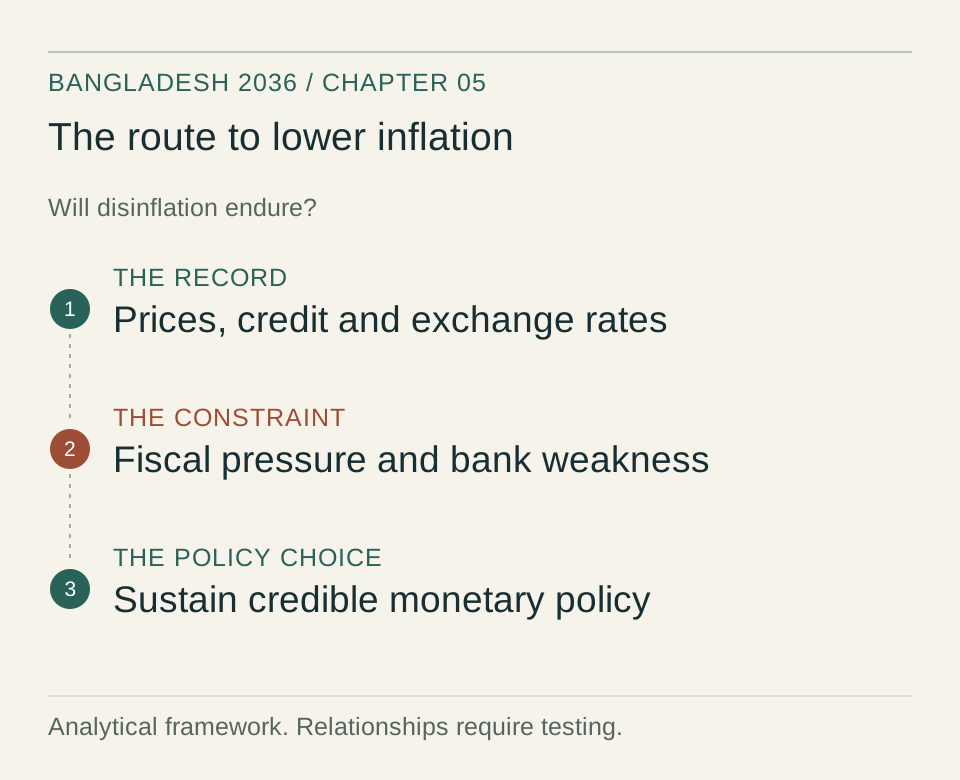
The shocks and the policy response
The inflation regime was made by four shocks arriving together. First, the import price shock: the taka's path from 85.8 to over 122 per USD between end 2021 and 2025 [BIS 2026] raised the domestic price of fuel, fertiliser, food oils and every other traded input, and administered energy prices were adjusted upward in steps rather than all at once, so the pass through stretched over two years. Second, the global commodity cycle of 2022, which chapter 03's terms of trade record shows, fed world food and fuel prices directly into the CPI. Third, the money overhang of the low rate years: broad money grew 37 percent in the three years to December 2023 [BB Econ 2024] while the lending cap held administered credit below its market price, so excess demand for credit showed up as excess demand for foreign exchange, which is the shortage the reserves record in chapter 03 documents.
Fourth, expectation persistence: with three consecutive fiscal years near 9 to 10 percent, FY23 to FY25, and a fourth projected by the IMF at 9.2 percent [IMF WEO 2026], wage and price setting adapted, which is why disinflation has been slow even after global prices stabilised.
The policy response ran through three breaks, and the annual report of the central bank dates each one. The crawling peg of 8 May 2024, mid rate 117.00 per USD with banks free to deal around it, replaced the fixed rate at 110 [BB AR 2024, annual report FY24, exchange rate regime], and the BIS end of month series records the step to 117.7 in May 2024 and the drift to 122.9 by May 2025 [BIS 2026]; the crawling peg then gave way to a freely quoted rate on 14 May 2025, when Bangladesh Bank issued FE Circular No. 18 allowing exchange rates to move freely, after which the taka depreciated mildly through late May and stood at 122.77 per USD at the end of June 2025, a fall of 3.89 percent over FY25 [BB MPS 2025, July to December 2025 statement, section 2.6], and chapter 03 analyses the external balance.
The lending cap era ended on 8 May 2024, when Bangladesh Bank withdrew the SMART reference rate system, a cap construct tied to the six month treasury bill moving average, and instructed banks to price loans at market rates [BB AR 2024, annual report FY24, BRPD Circular Letter No. 10 of 8 May 2024]; the cap itself was set by BRPD Circular No. 03 of 24 February 2020, which fixed the interest or profit rate on all unclassified loans and investments other than credit cards at a maximum of 9 percent, capped penal interest on a defaulted borrower at a further 2 percent, left the pre-shipment export rate at 7 percent, and took effect on 1 April 2020 under section 45 of the Bank Company Act 1991 [BB BRPD 2020, Circular No. 03 of 24 February 2020, clauses 2 and 4].
The policy rate was raised five times in FY24 for a cumulative 250 basis points to 8.50 percent, with the standing lending facility at 10.00 percent and the standing deposit facility at 7.00 percent effective 9 May 2024 inside an interest rate corridor introduced on 1 July 2023 and narrowed to plus or minus 150 basis points on 21 January 2024, and the overnight policy rate was then revised to 10.00 percent from 9.50 percent effective 27 October 2024, the latest recorded action in the available data [BB AR 2024, annual report FY24, policy rate and interest rate corridor].
The sequencing was deliberate: the exchange rate was moved first so the real exchange rate could do the external adjustment, then credit was repriced so domestic demand stopped leaking into imports, then the policy rate was raised so the repriced credit market did not reignite demand. The chronology alone does not establish which sequencing would have produced a better outcome; external conditions, fiscal policy and reserve intervention also affected the adjustment.
The money market side of the mechanism is the government's own footprint. Through the capped rate years the state financed itself below market, banks bought treasury paper because it was liquid and capital friendly rather than profitable, and the private borrower at the administered rate was rationed out. With the cap gone the treasury's cost repriced first, and net government borrowing from the banking system rose to 3.12 percent of GDP in FY24 from 2.63 percent in FY23 while non bank borrowing fell to 0.01 percent of GDP from 0.14 percent [BB AR 2024, annual report FY24, public finance]; the private credit share fell to 35.81 percent of GDP in 2024 and 34.50 percent in 2025 [WB WDI 2026].
The transmission the reforms intended, a market price for credit the private sector can also access, is incomplete while the weak banks documented in chapter 06 hold the government's paper and the deposits of the state's enterprises rather than private loans. National savings certificates complete the triangle: the schedule in force from 14 January 2024 pays 11.04 to 11.76 percent across the four certificate types, social security premium included [BB Econ 2025, table XIIB], above the 9.08 percent weighted average deposit rate of FY24 and above the old lending cap, so every household that shifts from a bank deposit to a certificate narrows the deposit base from which private credit can be funded.
The institutional mechanism is the third leg. Bangladesh Bank entered the transition with a governance reset and a framework shift from monetary aggregate targeting to interest rate targeting, which the annual report records as the design change of FY24 [BB AR 2024, annual report FY24, monetary policy stance], and the resolution framework for weak banks is chapter 06's record. A new central bank law to replace the Bangladesh Bank Order, 1972 was on the transition agenda; its text and status could not be confirmed from the cited sources, and it is the key institutional variable for the decade. The mechanism that matters here is simple: a central bank that can refuse to finance deficits and can let insolvent banks fail is the precondition for the inflation regime holding, and the new law is where that capability is either anchored or not.
Making the monetary framework durable
The target path anchors the near term. The national budget that framed the FY24 monetary programme targeted CPI inflation of 6.00 percent, the target was revised to 7.50 percent during the year, and the outturn was a twelve month average of 9.73 percent in June 2024 [BB AR 2024, annual report FY24, monetary policy stance], the IMF projects 9.2 percent average inflation for FY26 after 10.0 percent in FY25 [IMF WEO 2026], and the monetary policy statement series [BB MPS 2026] is the resolving source for the target as it moves. On that base the scenarios of chapter 15 assume: a reform path that holds the policy rate positive in real terms until inflation is inside the neighbourhood of the 6 percent budget target by around FY28, a baseline that reaches it nearer FY30 because food and administered price pass through is still incomplete, and a stall that reverts to administered money, a revived lending cap and deficit financing habits, which would put inflation back above 10 percent and restart the credit misallocation the cleanup is meant to end.
The probabilities between the scenarios are this chapter's judgement and no projection is quoted for them.
Three decision points decide which scenario runs. The new central bank law, whether it insulates the governor's term, the monetary policy committee and the balance sheet from the ministry, decides the regime's survival across governments. The savings certificate rate, whether it follows the market down as inflation falls or stays as a political instrument, decides whether the deposit market normalises. The exchange rate regime, whether the rate is allowed to clear the market and backed with reserves rather than re-fixed, decides whether chapter 03's reserves record becomes an asset or a liability again.
Risks and opportunities
Risks. First, reversion: a future government that revives the lending cap or directs bank credit would reproduce the 2020 to 2023 mechanism within two years; the indicator to monitor is the interest rate spread, which the annual report measures at 2.93 percent in June 2023 and 6.03 percent in June 2024 after the cap withdrawal [BB AR 2024, annual report FY24, interest rates on deposits and advances], and whose compression back toward 3 percent without a fall in inflation would signal administered pricing returning. Second, fiscal dominance: if the state's financing need outruns the market's appetite, the central bank's balance sheet becomes the treasury's lender of last resort; the indicator to monitor is net government borrowing from the banking system, already 3.12 percent of GDP in FY24 [BB AR 2024, annual report FY24, public finance], with the bank level exposure measured in chapter 06.
Third, second round inflation: if administered energy and gas prices are held below cost while the taka depreciates, the subsidy bill in chapter 04 and the inflation regime feed each other; the indicator to monitor is the diesel price, 120.25 BDT per litre in the latest snapshot [HDX WFP 2026].
Upside. First, an inflation target regime: if the new law institutionalises a numerical target and an independent committee, Bangladesh gains the disinflation credibility its peers in the region took a decade to build. Second, positive real deposit rates: with inflation at 10.47 percent in calendar 2025 [WB WDI 2026] and the weighted average deposit rate at 9.08 percent in FY24 [BB AR 2024, annual report FY24, interest rates on deposits and advances], the flip to positive real deposit rates as inflation falls pulls household savings back into banks and lets the private credit share recover from 34.50 percent of GDP in 2025 [WB WDI 2026].
Third, the exchange rate as shock absorber: a rate that clears the market removes the incentive for the remittance leakage chapter 03 documents, and it already showed up in the record, with remittances of 30,328.80 million USD in FY25, up 26.8 percent from 23,912.22 million USD in FY24 [BB Econ 2025, table XVIII].
Testing the policy case
Bangladesh Bank should evaluate inflation together with expectations, credit and fiscal financing. Falling inflation with persistent food-price pressure would call for supply-side analysis, while tighter credit without disinflation would question the strength and cost of monetary transmission. Rate changes should not be judged from one monthly price reading.
What to watch
The thresholds below are author-proposed monitoring markers, not official targets or estimated policy effects. Interpret them alongside the source dates and definitions.
- CPI inflation. Latest cited value 8.77 percent in calendar 2025, down from 10.47 in calendar 2024 [WB WDI 2026]. Threshold: a sustained print below 6.5 percent is the proposed marker that allows the policy rate to normalise; a return above 11 percent signals regime failure.
- USD/BDT rate. Latest cited value 122.6 per USD, snapshot of 4 September 2026 [BB Econ 2026]. Threshold: a two sided market with reserves accumulating, chapter 03's measure, is the regime working; a return to a fixed rate is the reversion signal.
- Private credit to GDP. Latest cited value 34.50 percent in 2025 [WB WDI 2026]. Threshold: a recovery above 39 percent signals the credit market normalising; a fall below 34 percent signals the banking drag of chapter 06 dominating.
- Policy rate stance. Latest cited value 10.00 percent, the overnight policy rate effective 27 October 2024, the latest recorded action in the available data [BB AR 2024, annual report FY24, policy rate and interest rate corridor]. Threshold: the real policy rate staying above 2 percent until inflation is inside the band is the hard money test; a cut into negative real territory before the band is reached is the political pressure signal.
- Sovereign risk price. Latest cited value 480 basis points on the five year CDS estimate in 2024 [IMF Art IV 2024]. Threshold: a sustained move below 300 basis points is the market's verdict that the regime change is believed; a move above 700 is the verdict that it is not.
Sources used
[WB WDI 2026] World Bank World Development Indicators, series FP.CPI.TOTL.ZG read from indicators/wb_full_bd.parquet for 2023 and 2024 and from the World Bank API on 2026-09-06 for 2025, which the local parquet does not carry, plus finance/wb_financial_sector_bd.parquet series wb_financial_sector_fs_ast_prvt_gd_zs. This price series is on the calendar year, unlike the World Bank national accounts rows for Bangladesh: its 2022 reading of 7.70 percent matches neither the BBS fiscal year FY22 of 6.15 nor FY23 of 9.02, and the BBS fiscal year series is bbs_inflation_national_general. The bdpolicy.db series wb_cpi_inflation holds zero rows and is not used.
[BBS CPI 2023] Bangladesh Bureau of Statistics CPI, national annual averages via bdpolicy.db, series: bbs_inflation_national_general, bbs_inflation_national_food, bbs_inflation_national_non_food.
[BBS CPI 2024] Bangladesh Bureau of Statistics CPI, monthly rural and urban via bdpolicy.db, series: bbs_inflation_rural_general, bbs_inflation_urban_general.
[IMF WEO 2026] IMF World Economic Outlook, PCPIPCH for Bangladesh via the IMF DataMapper API (fiscal years ending June) and the bdpolicy.db snapshot, series: imf_cpi_inflation_avg.
[BIS 2026] Bank for International Settlements USD/BDT series via bdpolicy.db, series: bis_usd_bdt_monthly_eop.
[BB Econ 2026] Indicator snapshot updated 2026-09-04 via bdpolicy.db, series: usd_bdt_rate, bb_m2_money_supply. Neither is a Bangladesh Bank figure despite the label: the taka rate comes from the @fawazahmed0/currency-api dataset served from jsDelivr, and M2 from World Bank FM.LBL.BMNY.CN (broad money, LCU).
[BB Econ 2024] Bangladesh Bank monthly economic trends via bdpolicy.db, series: bb_m2_money_supply, December readings.
[BB Econ 2025] Bangladesh Bank Monthly Economic Trends October 2025, table XVIII, remittances, and table XIIB, interest rate structure of National Savings Certificates, read via the bb/remittances lake.
[BB AR 2024] Bangladesh Bank Annual Report 2023-24, read via ocr_text/bb/annual_report, sections: monetary policy stance, policy rate and interest rate corridor, interest rates on deposits and advances, exchange rate regime, public finance, BRPD Circular Letter No. 10 of 8 May 2024.
[IMF Art IV 2024] IMF Article IV via bdpolicy.db parquet bd_sovereign_spreads, series: bd_sovereign_spreads_cds_5y.
[Fitch 2024] Fitch Ratings sovereign rating action, Bangladesh, 21 May 2024 via bdpolicy.db parquet sovereign_ratings_bd.
[BB MPS 2025] Bangladesh Bank Monetary Policy Statement, July to December 2025, section 2.6 on the movement of the exchange rate and foreign exchange reserves,
[BB MPS 2026] Bangladesh Bank Monetary Policy Statement series, resolving source for the inflation target as it moves.
[BB BRPD 2020] Bangladesh Bank Banking Regulation and Policy Department, BRPD Circular No. 03 of 24 February 2020, rationalisation of the interest and profit rate on loans and investments, clauses 2 and 4,
[HDX WFP 2026] WFP food and fuel price series via bdpolicy.db indicator snapshot, series: hdx_wfp_rice_coarse_price, hdx_wfp_oil_soybean_price, hdx_wfp_fuel_diesel_price.