Chapter 60 of 60 in the Bangladesh 2036 research base. Contents of the series.
A diaspora strategy needs an investment account
Bangladesh’s overseas population supports households through remittances and connects the country to skills, markets and institutions abroad. Those relationships extend beyond the size of the annual transfer flow. A useful diaspora strategy needs evidence on participation in investment products, the costs of migration and the institutions that build trust.

Migration, remittances and investment instruments
The stock record is a destination map with three regions and two genders. The world total rose from 5,450,443 persons in 1990 to 6,319,871 in 2010 and 7,401,763 in 2020, growth of 35.8 percent over the thirty years and 17.1 percent in the last decade [UN DESA 2020]. India holds 2,488,471 persons, 33.6 percent of the stock, but the tabulation counts country of birth, so that line is largely a legacy population born in the territory of present day Bangladesh and settled before and around 1971, not an active corridor.
The active volume corridor is the Gulf: Saudi Arabia 1,277,624 persons, the United Arab Emirates 1,095,231, Kuwait 380,046, Oman 316,467, Qatar 261,672 and Bahrain 115,071, a GCC total of 3,446,111 or 46.6 percent of the world stock [UN DESA 2020]. Malaysia holds 415,717 [UN DESA 2020]. The settlement region holds the rest that matters: the developed regions total is 852,523 persons, 11.5 percent of the stock [UN DESA 2020], of which the four settlement economies chapter 33 tracks hold 619,452, the United States 261,496, the United Kingdom 241,799, Canada 63,250 and Australia 52,907, with Italy 135,468, Singapore 79,857 and Germany 13,612 the next European and Asian lines [UN DESA 2020].
Women are 2,429,833 of the world stock, 32.8 percent, and the female share by destination separates the two migration regimes: 6.3 percent in Oman, 7.6 percent in Qatar and 13.1 percent in the United Arab Emirates against 51.4 percent in the United States, 48.8 percent in the United Kingdom, 49.2 percent in Canada and 44.1 percent in Australia [UN DESA 2020]. Rotating male labour and settling families are different assets that a single diaspora label conceals.
The flow record is the one the state measures, because it clears through the banking system. Cumulative recorded clearances from 2001 to 2023 sum to 13,186,182 workers on the stored BMET annual series, with the 2023 calendar peak at 1,305,453 [BMET 2023, cumulative sum of stored annual series] and the FY25 fiscal year at 1,015,675 [BB Econ 2025, Table XVIII]. The remittances those flows generated reached 23,912.22 million USD in FY24 and 30,328.80 million USD in FY25, up 26.83 percent [BB Econ 2025, table XVIII]; the World Bank calendar series records 27.52 billion USD for 2024 [WB WDI 2026] and its 2025 reading could not be confirmed, so the two bases are read separately and never joined in one rate.
Chapter 21's finding stands and is not restated here: the step was a price event, the float removing the wedge that made the informal channel the better deal. What matters for this chapter is what happened after the money landed. The census counts 3,950,155 receiving households, 9.8 percent of all households [BBS Census 2022], and the transfer stops there: no stored series measures how much of the flow, historically or currently, moves into any savings instrument, security or project, and the figure could not be confirmed; Bangladesh Bank and the National Savings Directorate would resolve it.
The instrument ledger is the blank page. The state has issued diaspora facing savings and investment vehicles for decades, the Wage Earner Development Bond, the US Dollar Premium Bond and US Dollar Bond, and the Non-resident Investor's Taka Account for portfolio investment; each vehicle's launch date could not be confirmed. The legal base for the settlement diaspora is dual nationality available to citizens naturalised in designated countries on registration under the Citizenship Act 1951 and its amendments [MinLaw 2026, Citizenship Act 1951 via bdlaws]. None of the outstanding holdings, net sales or uptake counts for these vehicles is available to this chapter; each could not be confirmed; Bangladesh Bank and the National Savings Directorate would resolve them, the same institutions chapter 38 names for the domestic savings certificate book; the 2.5 percent remittance cash incentive itself is verified [MoEWO 2022], but its booked outlay, which chapter 21 flags as not confirmed, the Finance Division budget documents the resolving source, routes through the same gap in public accounting.
The gap is the finding: a country that has moved more than 13 million workers out since 2001 [BMET 2023] publishes no account of what its diaspora holds at home.
The brand ledger is not blank, it is negative. The Voice and Accountability estimate fell from minus 0.32 in 2010 to minus 1.16 in 2024, the Rule of Law estimate from minus 0.85 to minus 0.96 and Control of Corruption from minus 1.02 to minus 1.10, while Government Effectiveness improved from minus 0.81 to minus 0.62 [WB WGI 2024]. The World Justice Project overall score slipped from 0.41, rank 112 of 126, in 2019 to 0.39, rank 127 of 142, in 2024 [WJP 2024], and the press freedom score from 50.33, rank 150 of 180, in 2019 to 47.42, rank 165 of 180, in 2024 [RSF 2024].
The market priced the same slide: the five year credit default swap spread widened from 285 basis points in 2021 to 605 in 2023 before easing to 480 in 2024 [IMF AIV 2024], the rating actions chapter 42 records sit in the single B range from 2024, and the inward FDI stock has gone nowhere, 17.86 billion USD at end-2024 [IMF CDIS 2024], a record chapter 03 reads as private capital declining to vote. Cricket and the cultural presence abroad, the widest recurring audience the country has, carry no series available to this chapter at all; any revenue or reach figure for them would not be established, and the soft power ledger is unmeasured as well as thin.
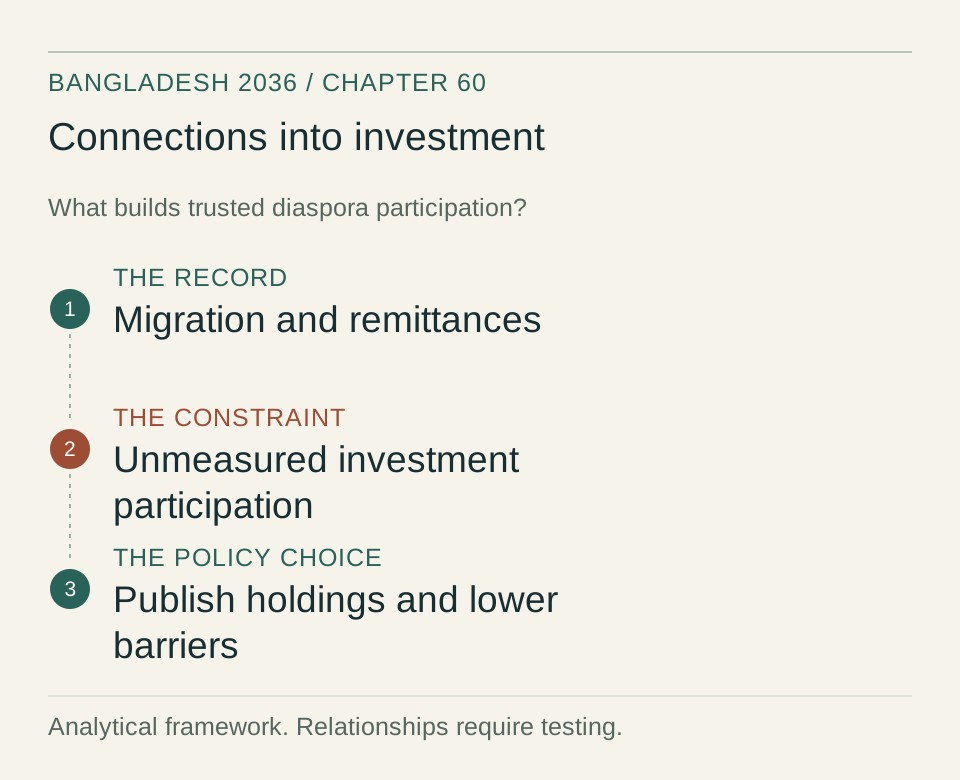
How overseas connections affect finance and reputation
The stock mechanism is settlement arithmetic. A rotating labour corridor caps its stock at the flow times the contract length, which is why the GCC, 46.6 percent of the stock [UN DESA 2020], tracks the departure flow chapter 21 dissects and resets continuously. The census counted 466,666 returned international migrants in 2022, the sediment of that rotation [BBS Census 2022]. A settlement corridor compounds: the United States stock is 12.2 times its 1990 level, Italy 25.0 times, Canada 15.0 times, Australia 22.9 times, while the mature United Kingdom stock is 2.4 times its 1990 level [UN DESA 2020], and the female shares near 50 percent in the settlement economies [UN DESA 2020] say family formation, not contract labour.
Dual nationality registration [MinLaw 2026, Citizenship Act 1951 via bdlaws] is the hinge of the mechanism, because it converts a migrant into a permanent dual constituency with savings, pensions, property and inheritance at home. The settlement diaspora is the half that can buy bonds, hold equity, fund university chairs and lobby legislatures, and it is the half the instrument ledger does not measure. The decade's stock arithmetic therefore runs on rules the Ministries of Home Affairs, Law and Expatriates' Welfare own, not on anything the central bank prices.
The flow mechanism is the exchange rate, and it is chapter 03's and chapter 21's, so one sentence carries it: the float made the banking channel the best price for a dollar, the recorded flow jumped 26.83 percent in FY25 [BB Econ 2025], and the same mechanism runs in reverse if the rate regime turns. The corridor cost sits on top of the rate. The average transaction cost of sending remittances was recorded at 3.44 percent in 2022 and 7.65 percent in 2023 [WB WDI 2026], against the 3 percent Sustainable Development Goal target for remittance costs; the cause of the step between the two readings could not be confirmed.
Every point of that spread on the 30,328.80 million USD FY25 flow is 303 million USD a year that never becomes household income or savings [BB Econ 2025, table XVIII], which is why the cost line, usually filed under migration policy, is a diaspora finance variable.
The brand mechanism is due diligence, and it runs through three concrete channels. Buyers: the GSP+ application chapter 02 frames requires effective implementation of 27 international conventions [EU GSP 2023], and the compliance file the Commission will read is assembled from the same labour, justice and governance records the governance indices measure, so the buyer facing brand is now a tariff schedule input. Investors: the spread of 480 basis points [IMF AIV 2024] and the single B ratings chapter 42 record are the price of the sovereign's name on any instrument, diaspora facing or otherwise, and the flat 17.86 billion USD FDI stock [IMF CDIS 2024] is what that price buys.
Travellers and students: the arrivals chapter 56 tracks and the student outflows chapter 33 tracks both price safety, visa treatment and national reputation, the same underlying record the indices summarise. The mechanism's asymmetry is the decade's opening: the indices deteriorated through the 2010s while exports grew, because the preference regime did not price them; from graduation, with GSP+ conditions, corporate sustainability due diligence in chapter 58 and the post 2025 tariff wall in chapter 02, the brand becomes a priced input, and the diaspora is the constituency with the most standing to attest to it abroad.
Decisions on investment and engagement
The finance decision runs in three steps, and the first is not an instrument, it is an account. The chapter has not established a complete published account of non-resident bond and certificate holdings from Bangladesh Bank and the National Savings Directorate; until that stock appears, no instrument design has a diaspora baseline, and the split cannot be established [Not confirmed, chapter 60]. The nearest measured magnitude is the portfolio survey: non-residents held 485.41 million USD of Bangladeshi securities in the 2025 round, down 85.8 percent from 3,419.85 million USD at end-2017 [IMF CPIS 2025], about 1.60 percent of the FY25 remittance flow, and even that stock's diaspora share is unmeasured.
The second step is the instrument stack, where the existing vehicles, the wage earner and dollar bonds, the non-resident bond and the taka account for portfolio investment, need the disclosure, the repatriation guarantee and the rate honesty that chapter 07 names for the domestic bond market, because a diaspora investor is a retail investor with a long memory and a fax machine to the whole extended family. The third step is scale arithmetic, stated as this chapter's scenario so chapter 15 can adopt or amend it: the capture scenario assumes the instrument stack reaches 1 percent of annual remittance inflows, roughly 303 million USD a year on the FY25 base of 30,328.80 million USD [BB Econ 2025, table XVIII], a cumulative pool near 3.03 billion USD over the decade to FY36, equal to about 17 percent of the 17.86 billion USD FDI stock [IMF CDIS 2024]; a capture of 3 percent would reach about 9.1 billion USD of cumulative pool.
The pricing constraint sits underneath: an instrument carrying the sovereign's name prices off a curve at 480 basis points [IMF AIV 2024], so a market priced diaspora bond is a signal decision of the kind chapter 42 describes, not a financing need, and the honest sequence is rate honesty and repatriation first, issuance second.
The image decision is the transition itself, watched through indices rather than slogans. The governance estimates that fell through 2024 [WB WGI 2024] are the same record the GSP+ conventions test [EU GSP 2023], the due diligence regimes chapter 58 prices and the election cycle chapter 47 tracks; the repair scenario this chapter states assumes the Voice and Accountability estimate recovers from minus 1.16 toward minus 0.8 by FY30, and the indices' annual publication cycle makes the scenario checkable within a year of each data point. The diaspora's role here is unromantic: settlement communities amplify whatever the record is, and the demonstration politics of 2024 showed the channel works in both directions.
The cricket and cultural presence, unmeasured as it is, belongs here as the country's largest recurring audience; its soft power value is conditional on the same brand arithmetic, because visibility without a governance story has carried the country only as far as the tariff wall.
Two further decisions complete the set. The corridor decision: Gulf labour demand over the horizon is unprojected in the cited reports, and could not be confirmed; the World Bank migration outlooks and the Gulf development plans are the named authors, chapter 21 carries the corridor economics, and the settlement corridors of Malaysia, Japan and Korea are the decade's buildable additions. The citizenship decision: dual nationality registration [MinLaw 2026, Citizenship Act 1951 via bdlaws], the non-resident voting question and the NRB service desks in banks and missions are the legal plumbing of the settlement diaspora, and their administrative record is qualitative, not confirmed; the Ministry of Home Affairs and the Election Commission would resolve it.
How to test the argument. Bangladesh Bank and the National Savings Directorate should report diaspora participation separately from all foreign portfolio holdings. If remittances rise without wider investment participation, product access, returns and institutional trust require scrutiny rather than assuming the transfer flow will become capital.
Risks and opportunities
Risks. First, a corridor demand shock: 46.6 percent of the stock sits in the GCC [UN DESA 2020], an oil revenue cycle that no stored series projects, and a Gulf hiring contraction lands on the same 3,950,155 households the census counts as remittance receivers, three quarters of them rural, where the receive rate runs at 10.8 percent of rural households against 7.2 percent of urban ones [BBS Census 2022]; monitor the monthly remittance series chapter 03 watches and the BMET clearance counts, and departures below 800,000 a year is chapter 21's threshold for the shock arriving.
Second, a brand shock with a tariff attached: a labour rights episode or a contested election before the GSP+ file is lodged would compound chapter 02's tariff wall with a due diligence failure, and monitor the governance estimates [WB WGI 2024], the spread above 600 basis points [IMF AIV 2024] and the RSF and WJP ranks [RSF 2024] [WJP 2024]. Third, a trust shock: diaspora finance instruments fail durably if the first widely sold vehicle underperforms or an NRB branded deposit or bank fails, because the channel transmits through family networks that remember; monitor the uptake data the state does not yet publish, which is why the measurement step is first in the decade ahead.
Upside. First, settlement compounding: the four economy stock of 619,452 grew from 130,312 in 1990 [UN DESA 2020], chapter 33 carries its brain drain face, and the asset face is a naturalising, high savings constituency whose stock arithmetic compounds without a single new policy; monitor the next UN tabulation. Second, the formalisation dividend has room left: the post float step took the recorded flow to 30,328.80 million USD in FY25 [BB Econ 2025, table XVIII], and every further billion that moves onshore through the banking channel is a billion the instrument stack can compete for, the revealing indicator being the channel value per worker chapter 21 watches.
Third, the repair is cheap by the standards of statecraft: the governance reforms the indices reward are the compliance reforms the GSP+ application already requires [EU GSP 2023], so the state can buy the brand and the tariff schedule with one execution, and monitor the index print after each convention takes effect.
Diaspora indicators to follow
The benchmarks below are author-proposed monitoring points, not validated causal cutoffs or official forecasts.
- World diaspora stock. Current value 7,401,763 persons at the 2020 tabulation [UN DESA 2020]. Proposed benchmark: the next tabulation above 8.5 million may indicate the settlement and corridor model still compounding; a reading below 7.5 million means the flow model has narrowed faster than settlement replaces it.
- GCC share of the stock. Current value 46.6 percent [UN DESA 2020]. Proposed benchmark: a share above 55 percent may indicate volume concentration deepening and the asset's flow half dominating; a share below 40 percent with the total rising may indicate corridor diversification into Malaysia, Japan, Korea and Europe.
- Non-resident holdings of Bangladeshi instruments, the nearest measured proxy for the diaspora's instrument stack. Current value 485.41 million USD in the 2025 round of the IMF portfolio survey [IMF CPIS 2025], about 1.60 percent of the FY25 remittance flow of 30,328.80 million USD [BB Econ 2025, table XVIII]; the diaspora share of the stock is not measured, not confirmed; Bangladesh Bank and the National Savings Directorate would resolve it. Proposed benchmark: a holding above 2 percent of annual remittance inflows, about 607 million USD on the FY25 base, may indicate the finance regime this chapter's capture scenario assumes; first publication of a diaspora split is the story clearing event.
- Voice and Accountability estimate. Current value minus 1.16 in 2024 [WB WGI 2024]. Proposed benchmark: recovery above minus 0.8 by FY30, which the repair scenario assumes, may indicate the brand repair regime and de risks the GSP+ file; a fall below minus 1.3 may indicate the indices' slide as trend and prices into every buyer and investor decision.
- Five year credit default swap spread. Current value 480 basis points in 2024 [IMF AIV 2024]. Proposed benchmark: chapter 42's regime line applies, a move back above 600 closes the pricing window for any sovereign named instrument including a diaspora bond; a move below 350 opens it, and the companion indicator is the rating path chapter 42 tracks.
Sources
[UN DESA 2020] UN DESA International Migrant Stock 2020 tabulation via the humanitarian/undesa_migrant_stock_bd parquet, Bangladesh origin stock by destination, total and female, 1990 to 2020.
[BMET 2023] Bureau of Manpower, Employment and Training overseas employment series via bdpolicy.db, series: bmet_overseas_employment_total, calendar year clearances 2001 to 2023 and the cumulative sum.
[BB Econ 2025] Bangladesh Bank Monthly Economic Trends, October 2025, tables IB and XVIII: workers' remittances FY24 and FY25 and persons left for overseas employment FY25.
[WB WDI 2026] World Bank indicator snapshot via bdpolicy.db, personal remittances received BX.TRF.PWKR.CD.DT via the hdx/wb_combined mirror, remittance cost SI.RMT.COST.IB.ZS; the bdpolicy.db series wb_remittance_inflows holds zero rows and is not used.
[BBS Census 2022] Bangladesh Bureau of Statistics, Population and Housing Census 2022 via bdpolicy.db, series: census2022_remittance_recipient_households_nos, census2022_remittance_rural_households_nos, census2022_remittance_urban_households_nos, census2022_returned_migrants_total_nos, census2022_total_households_nos.
[IMF AIV 2024] IMF Article IV market risk indicators via the finance/bd_sovereign_spreads parquet, series: bd_sovereign_spreads, five year credit default swap estimates compiled from Bloomberg.
[WB WGI 2024] World Bank Worldwide Governance Indicators via the governance/wgi_bd parquet, series: GOV_WGI_VA.EST, GOV_WGI_RL.EST, GOV_WGI_CC.EST, GOV_WGI_GE.EST.
[WJP 2024] World Justice Project Rule of Law Index via the governance/wjp_rol_bd parquet, Bangladesh overall score and rank.
[RSF 2024] Reporters Without Borders World Press Freedom Index via the governance/rsf_press_freedom_bd parquet, Bangladesh score and rank.
[IMF CDIS 2024] IMF Coordinated Direct Investment Survey via bdpolicy.db, series: imf_cdis_inward_fdi_stock_usd.
[IMF CPIS 2025] IMF Coordinated Portfolio Investment Survey via bdpolicy.db and data.imf.org pull curated/imf/imf_cpis_portfolio_bd.parquet, series: imf_cpis_portfolio_liabilities_total_usd, non-resident holdings of Bangladeshi portfolio securities, end-2017 peak and 2025 round; the same record chapter 43 cites.
[MinLaw 2026] Legislative and Parliamentary Affairs Division, Bangladesh Code online, the Citizenship Act 1951 text via the lake/bdlaws_acts parquet.
[EU GSP 2023] GSP regulation (EU) No 978/2012 as applied, GSP+ vulnerability and convention conditions, as cited in chapter 02.
[MoEWO 2022] Ministry of Expatriates' Welfare and Overseas Employment annual report 2021-22 via ocr_text/expat, the 2.5 percent remittance cash incentive rate; the same record chapter 21 cites, where its booked outlay could not be confirmed.
[Not confirmed, chapter 60] Diaspora holdings in bonds, certificates and NITA accounts, each bond vehicle's launch date, the remittance cash incentive's booked outlay, non-resident voting and registration administrative counts, Gulf labour demand projections, and the cause of the 2022 to 2023 remittance cost step; resolving sources Bangladesh Bank, National Savings Directorate, Ministry of Home Affairs, Election Commission, World Bank migration outlooks, and the World Bank's Remittance Prices Worldwide methodology notes.
Back to: Bangladesh 2036 contents