Chapter 57 of 60 in the Bangladesh 2036 research base. Contents of the series.
Turning maritime rights into useful activity
Settled maritime boundaries provide jurisdiction; they do not themselves create fisheries management, shipping capacity or an offshore gas discovery. Bangladesh’s maritime economy needs institutions that can license activity, enforce standards and account for costs. The relevant tests differ across fishing, shipping, recycling and exploration.

Fisheries, shipping and offshore activity
The fisheries record is growth with the sea left behind. Total fish production rose from 2.44 million tonne in FY07 to 4.62 million tonne in FY21 [DoF 2021]. Inland aquaculture did the work, rising from 975,969 tonne in FY07 to 2,638,745 tonne in FY21, up 170.4 percent [DoF 2021]. Marine production rose from 487,438 tonne to 681,239 tonne over the same fourteen years, up 39.8 percent, but because ponds grew faster the sea's share of national fish output fell from 20.0 percent to 14.7 percent [DoF 2021]. The sector contributed 3.65 percent of national GDP and 23.81 percent of agricultural GDP at the FY16 reading [DoF 2016].
Exports are thin against the domestic industry: 546.28 million USD from 75,337.93 tonne of fish and fishery products in FY16 [DoF 2016], against a seventh plan target of 1.25 billion USD of frozen fish and shrimp export earnings by 2020 quoted in the same official document [DoF 2016].
Hilsa is the marine exception and the management showpiece. The national fish accounts for about 12 percent of total fish production as a single species [DoF 2016], and the official series records output rising from 290,000 tonne in FY08 to 565,183 tonne in FY21, including a 25.7 percent jump in one year, to 496,417 tonne in FY17 from 394,951 tonne in FY16 [DoF 2021]. The management system predates the settlements: juvenile jatka up to 25 centimetre are protected, a conservation week has run in 91 coastal upazila of 23 districts since 2007, five river sanctuaries shelter the spawning stock within a national network of 534 fish sanctuaries, and enrolled jatka fishers receive 40 kilogram of food grain per household per month during the February to May ban [DoF 2016].
About 65 percent of the hilsa catch originates in marine waters [DoF 2016]. The fleet that takes it is artisanal and densely licensed: the land based survey under the marine fisheries capacity building project counted 32,859 mechanized and 34,810 non mechanized boats in marine and coastal waters, registered with the Mercantile Marine Department and licensed by the Department of Fisheries [DoF 2016]. The Marine Fisheries Act 2020 replaced the 1983 ordinance under which a ban on catching, landing and transporting marine fish has run since 2015 for industrial trawlers and since 2019 for the whole fleet; the ban held at 65 days, 20 May to 23 July, through the 2025 season, and DoF's 2025 reporting records a shortened closure of 58 days, 15 April to 11 June, under the Marine Fisheries Rules 2023 [MinLaw 2020] [DoF 2025].
The shipping record runs the other way. Bangladesh Shipping Corporation, the flag carrier, owned 8 ships in FY22, 7 in FY24 and 5 in FY25, with the FY25 accounts recording a gain on the sale of an old vessel and noting that most of the fleet has passed or is near its 25 year economic life [BSC 2025] [BSC 2024] [BSC 2022]. The renewal that did happen was Chinese financed: three product oil tankers and three bulk carriers of about 39,000 DWT each, delivered under a concessional loan of RMB 1.2 billion, and the FY25 accounts disclose a further procurement programme for vessels of 55,000 to 66,000 DWT [BSC 2025].
The corporation is profitable in a shrinking state: operating income of 591.0 crore BDT, net profit of 306.6 crore BDT and a return on equity of 19.17 percent in FY25 [BSC 2025], on cargo of 4.55 million tonne in FY24, of which fertilizer carriage was 2.18 million tonne and crude oil 1.15 million tonne [MoF SOE 2024]. The Flag Vessel (Protection of Interest) Act 2019 reserves shares of state cargo for the flag [MinLaw 2019], but the reserve does not bind the market. Transport services exports, the carriage Bangladesh sells to the world, peaked at 1,444.3 million USD in calendar 2022 and fell to 772.8 million USD in 2023, while transport services imports were 6,730.0 million USD in 2023, a net freight bill near 6.0 billion USD in a single year [IMF BOP 2023, item 121 credit, item 121 debit].
Vessel activity prints the same fall at higher frequency: national port calls counted from ship transponders peaked at 3,086 in 2022 and fell to 2,669 in 2024 and 2,575 in 2025 [PortWatch 2026]. Chapter 23 carries the Chattogram throughput and turnaround record; the point here is who earns from it.
The offshore hydrocarbon record is the settlement dividend not yet collected. Under the Bangladesh Offshore Bidding Round 2012, production sharing contracts for the shallow offshore blocks SS-04 and SS-09 were signed with ONGC Videsh and Oil India, with BAPEX as participant [Bapex 2022]. The next instrument, the Offshore Model PSC 2023, was finalized only in 2023, nine years after the India award, to interest international companies in the blocks the 2014 settlement opened [Petrobangla 2023]. The national exploration effort in the window went landward instead: Petrobangla's drilling programme targets 100 wells drilled and worked over by 2028, of which BAPEX is assigned 52 wells plus 16 workovers, and the FY25 well list runs through eight onshore sites, none of them offshore; the year's discovery, Jamalpur-1 with a 10.31 billion cubic feet reserve, is inland and in line to be declared the country's 30th gas field [Bapex 2025].
The maritime infrastructure that did get built serves imports, not exploration: the single point mooring off Maheshkhali, the country's first ship to seabed pipeline crude discharge, is designed to unload 9 million tonne of crude a year [Petrobangla 2023], and the Matarbari port programme carries an allocated cost of 24,381.40 crore BDT with completion targeted in December 2029 [Planning Commission ADP 2025]. The gap an offshore discovery would displace is now measured: in 2024 the country produced 711.4 billion cubic feet of dry gas against consumption of 955.2 billion cubic feet, importing the 243.8 billion cubic feet difference [EIA 2025].
The ship recycling record is scale that is only now being certified. The Ministry of Industries reports the industry directly employs 25,000 to 30,000 people, indirectly supports about 1,000,000, and feeds more than 300 steel rolling mills that draw their raw material from recycled hulls, so that most of the country's iron demand is met from the beach at Sitakunda [MoInd 2025]. Governance arrived in layers: the Ship Breaking and Recycling Rules 2011, the Bangladesh Ship Recycling Act 2018, and the Bangladesh Ship Recycling Board constituted on 25 February 2020, whose full operations began on 10 April 2025 [MoInd 2025].
The compliance layer now has numbers: 8 yards were granted Hong Kong Convention compliance certificates in FY25 on top of 6 certified earlier, 14 yards in total, and the ministry record shows 109 no objection certificates for end of life ship imports and cutting permission on 99 ships in FY25 [MoInd 2025]. The convention entered into force on 26 June 2025, and Bangladesh's accession of 26 June 2023 was among the ratifications that satisfied its entry into force conditions [IMO 2025]. From here the regime prices the beach: inventory of hazardous materials documents, yard certification and downstream waste handling.
The security economics record is peace by arbitration guarded by a shrinking budget. Military expenditure fell to 1.02 percent of GDP in 2023, 4,208.0 million USD, from 1.24 percent of GDP in 2020 [SIPRI 2023]. The settlements removed the principal wartime scenarios with both neighbours, and what remains is an enforcement problem, illegal fishing, smuggling, search and rescue, that a coast guard sized force either handles or does not. Chapter 45 carries the naval modernization of the bay's larger powers; Bangladesh's fiscal commitment is shrinking, not growing.
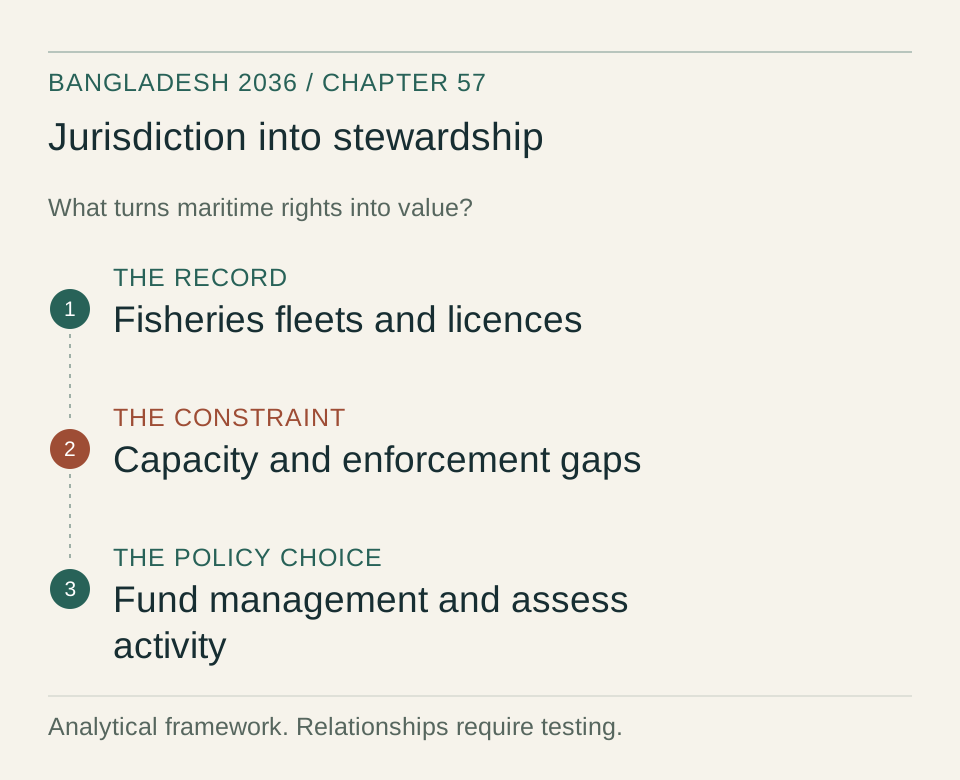
How maritime institutions affect output
The settlement mechanism is a lag, not a delivery. A judgment creates jurisdiction; it does not create a bidder, a rig or an inspector. The nine year gap between the 2014 award and the Offshore Model PSC 2023 [Petrobangla 2023] is the measurable form of the lag, and the two 2012 round blocks [Bapex 2022] show the second condition: even signed contracts produce nothing without exploration spend. What converted effort into output in the same window was administrative, the landward drilling programme with its assigned well list and declared discoveries [Bapex 2025], and the offshore half lacks the same trio: fiscal terms that clear at the current rig market, a regulator that can process a discovery, and gas purchase terms that make a subsea development bankable.
The incentive is the import gap stated in the record, a quarter of consumption bought from abroad at spot linked prices that chapter 26 traces.
The hilsa mechanism is a paid conservation compact, and it has been tested in both directions. The state buys compliance with food grain and alternative income support [DoF 2016], closes the fishery during spawning windows [MinLaw 2020], and the stock responds: the FY17 jump of 25.7 percent in one year [DoF 2021] followed the maturing of the sanctuary and ban regime. The compact's fragility is fiscal, not biological: allowances paid through a list of enrolled fishers decay when budgets or targeting decay, and an unenforced ban converts the stock gain of one season into the fleet's income of the next. The 58 day total ban [DoF 2025] scales this compact to the whole marine fleet [MinLaw 2020], which is why its enforcement record, not its text, is the variable to watch.
The shipping mechanism is a cargo rights question that the state keeps answering with the wrong instrument. The Flag Vessel Act 2019 reserves cargo [MinLaw 2019]; reservation does not create ships. BSC's economics show what does: six Chinese financed hulls renewed the fleet and the accounts stayed profitable [BSC 2025], yet the fleet shrank to 5 ships because deliveries lagged the scrapping rate of an ageing fleet [BSC 2025] [BSC 2024]. The 2023 freight arithmetic, 8.7 dollars paid abroad for every dollar earned carrying [IMF BOP 2023, item 121 credit, item 121 debit], is the price of a trade that rides other countries' tonnage, and the transponder count of 2,575 port calls in 2025 [PortWatch 2026] says the volume base is contracting while the state carrier’s fleet contracts.
The recycling mechanism is a cost curve shift imposed from outside. End of life ships flow to the lowest cost compliant yard; before the Hong Kong Convention took force, the beach price in Sitakunda was the world's clearing price because external costs were not internalized [MoInd 2025]. The convention internalizes them: certified yards, hazardous material inventories, worker protection, so a location rent becomes a compliance rent. Fourteen certified yards [MoInd 2025] mean the race has started from inside the industry, not from zero; certified yards keep the flow and the 300 mill supply chain, and uncertified ones lose ships to Indian and Pakistani rivals under the same convention.
The security mechanism is enforcement sized to theft, not to war. A 1.02 percent of GDP defence budget [SIPRI 2023] cannot and need not contest the bay; it must license, inspect and patrol a fishery and a coastline. It is the same mechanism as the hilsa compact: detection and penalty against unlicensed effort, a coast guard and Mercantile Marine Department staffing question.
Decisions on conservation, fleets and exploration
The offshore conversion, led by the Energy and Mineral Resources Division with Petrobangla and executed through the Offshore Model PSC 2023 [Petrobangla 2023], is the largest single decision. The contrast with the landward programme is the measure of the task: the state's own driller has 52 assigned wells through 2028 and every one is onshore [Bapex 2025], and the FY26 development budget lists no offshore well, its only sea projects being a pilot tuna and pelagic fishing programme and the Payra terminal [Planning Commission ADP 2025]. The decision points are visible events: block awards under the model PSC, the first offshore exploration spud since the 2012 round, and a purchase agreement that prices a discovery. The chapter 15 scenario that assumes offshore gas arrives by the early 2030s is the reform case; the stall case is a second bid cycle that closes with no award.
The fisheries conversion, led by the Department of Fisheries under the Marine Fisheries Act 2020 [MinLaw 2020], has two halves. The first is holding the hilsa compact as enforcement scales from one species to the whole fleet through the 58 day marine fishing ban [DoF 2025]. The second is moving growth from ponds back toward the sea in value terms: marine aquaculture, cage culture and value added processing that the seventh plan's 1.25 billion USD export target gestured at and FY16 delivery measured at 546.28 million USD [DoF 2016]. The first funded step exists, a FY26 pilot project for tuna and allied pelagic fishing in the deep sea, now in its second revision [Planning Commission ADP 2025]. The decision points are the allowance budget in each cycle of the FY27 to FY36 window the scenarios assume and the first marine aquaculture licensing regime.
The recycling conversion, led by the Ministry of Industries through the Ship Recycling Board [MoInd 2025], runs on the convention's clock, in force since 26 June 2025 [IMO 2025]. The decision is no longer whether to certify but whether certification keeps the cargo: 14 compliant yards must hold the 109 clearances a year the FY25 record shows [MoInd 2025] against rivals certifying under the same convention. Certification that keeps the flow is an industrial upgrade; certification that arrives after the flow has moved is the regulation of a graveyard.
The fleet and carriage conversion, led by the Ministry of Shipping with BSC, decides whether the Matarbari decade carries a Bangladeshi flag share. The FY25 accounts disclose the 55,000 to 66,000 DWT procurement track [BSC 2025]; the Flag Vessel Act provides the cargo pull [MinLaw 2019]; Matarbari's December 2029 completion target [Planning Commission ADP 2025] provides the transshipment platform that chapter 23's operations data would then measure. The services credit series [IMF BOP 2023, item 121 credit] is the scoreboard.
How to test the argument. The fisheries and shipping authorities should assess conservation outcomes, compliant operations and commercial activity separately. If licences and infrastructure expand without those outcomes, jurisdiction and capital spending have not supplied the missing management or market incentives.
Risks and opportunities
Risks. First, hilsa enforcement failure: if allowances decay or the ban erodes, the FY17 stock response works in reverse, and monitor the hilsa series falling persistently below recent comparable catches [DoF 2021]. Second, a recycling regime shock: if Sitakunda's 14 certified yards lose arrivals to South Asian rivals under the convention in force since June 2025 [IMO 2025], the 300 mill scrap chain starves [MoInd 2025] and the employment loss lands in Chattogram's informal economy; monitor the ship clearance count against the 109 of FY25. Third, the offshore dud: if the Offshore Model PSC 2023 produces no award or dry wells, the bay stays a reserve option and the LNG import bill of chapter 26 compounds through the decade; monitor the block award and spud record [Bapex 2022] [Petrobangla 2023].
Upside. First, the compliance rent: 14 certified yards are a head start few competitors hold, and a region that certifies first can keep, and price, the world's largest recycling flow, converting an environmental liability into the steel scrap base the mills depend on [MoInd 2025]. Second, an offshore discovery: any commercial find displaces imported LNG at a fraction of the foreign exchange cost, the mechanism chapter 10 states for onshore fields, and would be the largest change to the external accounts short of garments. Third, carriage and transshipment: a renewed fleet plus Matarbari as a deep water hub would move transport services credit back toward and beyond its 1,444.3 million USD 2022 peak [IMF BOP 2023, item 121 credit], turning a 6.0 billion USD net freight bill into a service export line, the same conversion chapter 20 traces for digital services.
Maritime indicators to follow
The benchmarks below are author-proposed monitoring points, not validated causal cutoffs or official forecasts.
- Hilsa production. Current value 565,183 tonne in FY21, the latest year in the official series [DoF 2021]. Proposed benchmark: a fall below 450,000 tonne may indicate the enforcement failure regime; a sustained level above 600,000 tonne may indicate the conservation compact is holding at scale.
- Marine fish production. Current value 681,239 tonne in FY21, 14.7 percent of national output, the latest year in the series [DoF 2021]. Proposed benchmark: below 600,000 tonne may indicate capture stress under the 58 day ban economy [DoF 2025]; above 800,000 tonne may indicate a marine aquaculture regime beginning.
- Transport services credit. Current value 772.8 million USD in 2023, the latest year of the IMF series, against the 1,444.3 million USD 2022 peak [IMF BOP 2023, item 121 credit]; the higher frequency check is 2,575 national port calls in 2025 against the 3,086 of 2022 [PortWatch 2026]. Proposed benchmark: credit below 700 million USD may indicate flag retreat; credit above the 2022 peak after Matarbari's targeted December 2029 completion [Planning Commission ADP 2025] may indicate the carriage regime change.
- Offshore exploration activity. Current value: two shallow blocks awarded under the 2012 round [Bapex 2022]; the published drilling programme, which targets 2028, contains no offshore well and the FY25 record lists only landward spuds and discoveries [Bapex 2025]; the SS-04 and SS-09 operator well status could not be confirmed. Proposed benchmark: the first exploration spud under the Offshore Model PSC 2023 [Petrobangla 2023] is the clearing event; two bid cycles closing without an award shuts the offshore option for the decade.
- Certified recycling capacity. Current value 14 Hong Kong Convention compliant yards at end FY25, against 109 ship import clearances and 99 cutting permits in the same year [MoInd 2025]. Proposed benchmark: the certified share of clearances holding or rising may indicate the compliance rent regime; ship arrivals falling while rival yards certify may indicate the diversion regime and the scrap squeeze for the 300 mill chain.
Sources
[ITLOS 2012] International Tribunal for the Law of the Sea, case no 16, Bangladesh and Myanmar maritime boundary delimitation judgment, delivered 14 March 2012.
[PCA 2014] Permanent Court of Arbitration, Bay of Bengal Maritime Boundary Arbitration, Bangladesh v India, UNCLOS Annex VII final award, 7 July 2014.
[IMO 2025] International Maritime Organization, Hong Kong International Convention for the Safe and Environmentally Sound Recycling of Ships 2009, status page: Bangladesh accession 26 June 2023, entry into force 26 June 2025.
[DoF 2016] Department of Fisheries, Annual Report 2015-16: hilsa conservation programme, jatka allowance, sanctuaries, fleet survey, GDP shares, export performance, seventh plan targets.
[DoF 2021] Department of Fisheries fish and hilsa production statistics via bdpolicy.db, series: dof_fish_total_production, dof_fish_inland_culture_production, dof_fish_inland_capture_production, dof_fish_marine_production, dof_hilsa_production, dof_shrimp_prawn_production.
[DoF 2022] Department of Fisheries, Marine and Coastal Fishes of Bangladesh: exclusive economic zone area and coastline length.
[MinLaw 2020] Marine Fisheries Act 2020, Bangladesh Code online, Legislative and Parliamentary Affairs Division: repeal of the Marine Fisheries Ordinance 1983; the ban runs since 2015 for industrial trawlers and since 2019 for the whole fleet.
[DoF 2025] Department of Fisheries, Bangladesh National Report to the Scientific Committee of the Indian Ocean Tuna Commission, 2025 (IOTC-2025-SC28-NR02): exclusive economic zone of 118,813 square kilometre, 710 kilometre coastline, and the current 58 day marine fishing closure of 15 April to 11 June under the Marine Fisheries Rules 2023.
[MinLaw 2019] Flag Vessel (Protection of Interest) Act 2019, Bangladesh Code online, Legislative and Parliamentary Affairs Division.
[Bapex 2022] Bangladesh Petroleum Exploration and Production Company Limited annual report FY2021-22: Bangladesh Offshore Bidding Round 2012 PSCs for shallow offshore blocks SS-04 and SS-09 with ONGC Videsh and Oil India, BAPEX participation.
[Bapex 2025] Bangladesh Petroleum Exploration and Production Company Limited annual report FY2024-25: 100 well drilling and workover programme targeted at 2028, 52 wells and 16 workovers assigned to BAPEX, the FY25 well list and the Jamalpur-1 discovery of 10.31 billion cubic feet.
[Petrobangla 2023] Petrobangla and Energy and Mineral Resources Division, National Energy Security Day 2023 publication: Offshore Model PSC 2023 finalized after the 2014 maritime settlement, Maheshkhali single point mooring crude unloading capacity of 9 million tonne per year.
[BSC 2022] Bangladesh Shipping Corporation annual report FY2021-22: fleet count of 8 ships.
[BSC 2024] Bangladesh Shipping Corporation annual report FY2023-24: fleet count of 7 ships.
[BSC 2025] Bangladesh Shipping Corporation annual report FY2024-25: fleet count of 5 ships, six vessels project and RMB 1.2 billion concessional loan, 55,000 to 66,000 DWT procurement programme, operating income 5,909.8 million BDT, net profit and return on equity, fleet economic life.
[MoF SOE 2024] Finance Division state owned enterprise evaluation tables via bdpolicy.db, series: bsc_total_cargo_transport_million_mt, bsc_fertilizer_transport_million_mt, bsc_crude_oil_transport_million_mt.
[MoInd 2025] Ministry of Industries annual report FY2024-25: Bangladesh Ship Recycling Board, Ship Recycling Act 2018, Ship Breaking and Recycling Rules 2011, employment of 25,000 to 30,000 direct and about 1,000,000 indirect, more than 300 steel rolling mills, 14 yards with Hong Kong Convention compliance certificates (8 in FY25, 6 earlier), 109 ship import no objection certificates and 99 cutting permits in FY25.
[PortWatch 2026] IMF PortWatch platform, daily port activity and shipment estimates for Bangladesh ports, vessel calls by day and port, via lake/trade/portwatch_bangladesh.parquet, series: portwatch_bangladesh.
[IMF BOP 2023] IMF Balance of Payments statistics via the trade/bd_bop_flows parquet, item 121 transport services credit and debit, calendar years.
[SIPRI 2023] Stockholm International Peace Research Institute military expenditure series via the governance/sipri_milex_bd parquet, Bangladesh share of GDP and current USD.
[EIA 2025] US Energy Information Administration international energy statistics, dry natural gas production, consumption and imports, Bangladesh, calendar years.
[Planning Commission ADP 2025] Annual Development Programme FY2025-26, Programming Division, Planning Commission: Matarbari port component costs and the December 2029 completion target.