Chapter 51 of 60 in the Bangladesh 2036 research base. Contents of the series.
Digital land records need dependable ownership
Online land records make documents easier to obtain, but ownership still depends on surveys, registration and the resolution of disputes. Faster distribution cannot substitute for accurate underlying records. The priority is to connect those processes so that a household or lender can rely on the same account of a property.
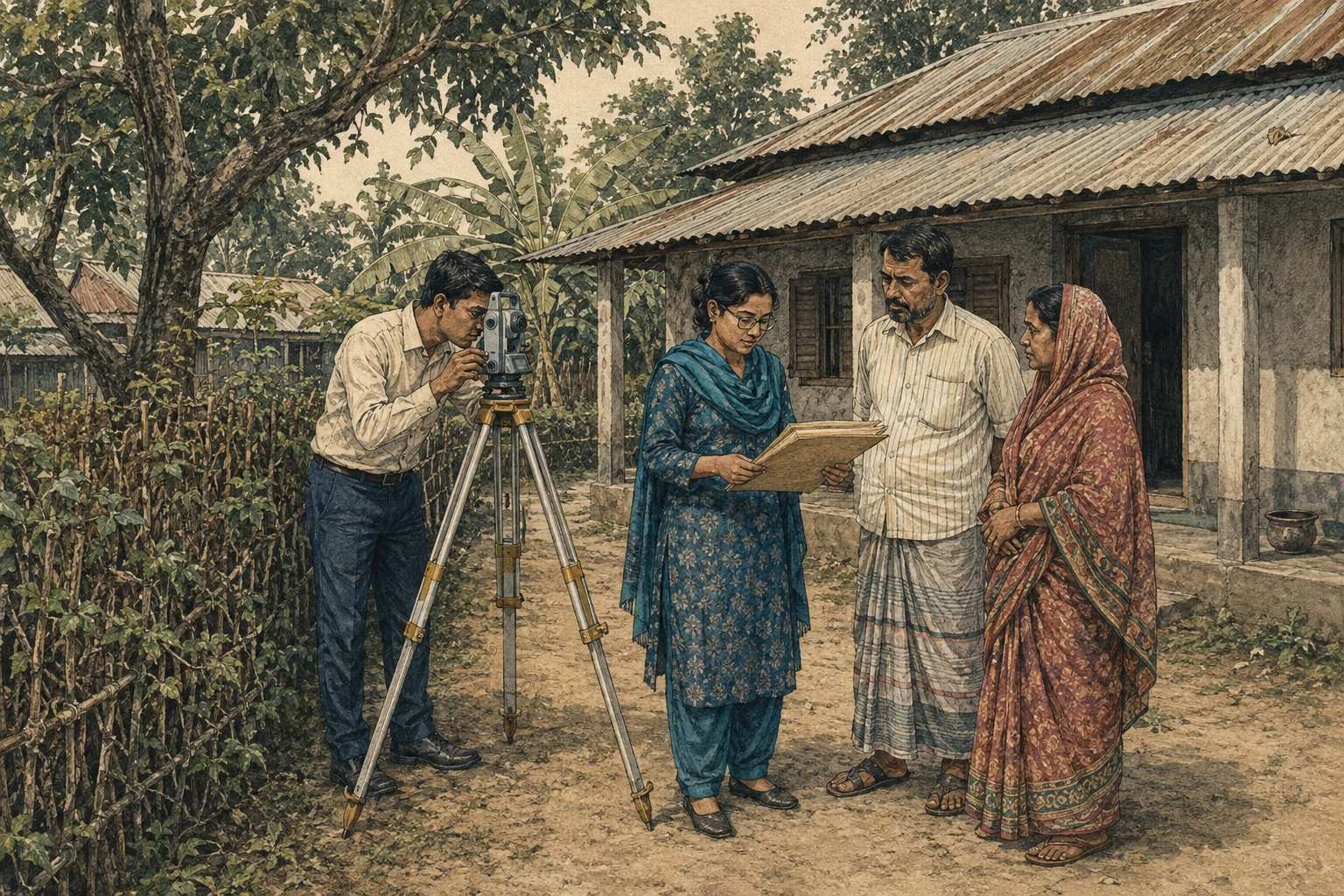
Records, surveys and disputes
The record distribution story is measured. In FY23 the settlement press entered 5.37 lakh khatians against an APA target of 3.00 lakh and printed 6.39 lakh against a target of 2.00 lakh, with 1.35 lakh mouza maps printed [DLRS 2023]. The khanapuri to bujharat pipeline that once delivered handwritten khatians, with misspelled owner names and column totals that did not sum, now generates indices, plot schedules and hal sabek tables automatically, notifies owners by SMS at record creation, and lets an owner verify her record from home for 100 BDT [DLRS 2023].
Land offices run cashless: mutation, land development tax and khatian services are paid over mobile financial services, the receipts posting to the treasury through an automated challan system the ministry values at about 5 crore BDT a day, with more than a dozen call centre memoranda and mobile land service vans carrying the counter to unions without one [MoL APA 2024]. The ministry records a 2021 United Nations Public Service Award and a WSIS prize for the online land development tax system [MoL APA 2024]; the second generation mutation automation software completed on 13 June 2024 [MoL APA 2024].
The survey base beneath that record is the finding. The revisional settlement programme operated by 19 zonal settlement offices and 1 diara settlement office carries a reported 41,266 mouzas, while the listed 40,470 traditional and 496 digital mouzas sum to 40,966; the 300-mouza difference needs reconciliation; 32,749 traditional mouza surveys and 94 digital ones are complete [DLRS 2023]. In FY23 the traditional pipeline handed over 3,893 mouzas to the deputy commissioners, with 3,828 still in progress, while the digital survey, built on 381 geodetic control points, handed over 220 completed mouzas with 482 in progress [DLRS 2023].
The arithmetic of pace is the constraint stated in the ministry's own numbers: at the FY25 APA target of 150 mouzas surveyed digitally [MoL APA 2024], re-surveying the 40,470 mouza traditional base takes calculated from the cited figures more than two and a half centuries; at the FY23 rate of 3,893 traditional handovers a year the printed residual clears inside a decade, but as scanned manual records, not new digital ones. The Bangladesh Digital Survey formally began in the Chattogram City Corporation area on 6 August 2023 under the Establishment of Digital Land Management System project, 383.50 crore BDT of Korean finance covering 3 city corporations, 1 pourashava and 2 rural upazilas with plot to plot digital maps and khatians [DLRS 2023].
A fourth generation survey drone piloted Patuakhali's Itbaria mouza, with 862 mouzas of Patuakhali and Barguna next and 32 upazilas of Pabna, Sirajganj and Gopalganj to follow [DLRS 2023]. In the Dhaka zonal settlement office's jurisdiction of 5,253 mouzas, 326 are programmed for the digital survey and 178 had final publication and gazette and were handed over by report time [DLRS 2023].
The systemry that would scale the survey is short staffed by design. The zonal settlement offices hold 2,099 working posts against 7,642 sanctioned, a 72.5 percent vacancy on the printed totals [DLRS 2023]. The ministry's FY25 APA responds with a fill of 3,255 vacant posts ministry wide, 150 digital mouza surveys, 10,000 mouza map scans and the start of 200 union and upazila land office buildings with integrated five storey co-located settlement and land functions [MoL APA 2024]. Map printing itself was suspended by a ministry order of 1 November 2023, so the FY24 map printing achievement was 0.23 lakh against a 1.20 lakh target, the APA's own note explaining the suspension and absent zonal demand [MoL APA 2024].
An administration that suspends printing while digitising is managing a transition; the printed stock is what courts and banks still demand, and the suspension's terms are the ministry's to publish.
Mutation and registration, the two counters every transfer passes, carry the World Bank's longest constant measurement. Registering property in Dhaka needed 8 procedures in every Doing Business round; the time rose from 424 days in the 2005 to 2007 rounds to 463 in 2008, then fell to 283 days from 2009, and 264 days from 2013, where it stayed through 2020; the cost fell from 11.0 percent of the property value in 2005 to 7.4 percent by 2011 and 7.1 percent by 2020; the score rose from 22.76 to 28.97 of 100, with the quality of land administration index at 6.5 of 30 against 4.5 two rounds earlier [WB DB 2020].
The series ends with Doing Business in 2020, and no successor has re-measured it; the World Bank's Business Ready 2025 assessment scored dispute resolution at 45.81 of 100 but carries no land administration topic [WB BREADY 2025]. The registration counter sits under the Law and Justice Division, not the land ministry: the Registration Directorate administers deed registration under the Registration Act 1908 with 61 district registrar posts and 493 sub-registrar posts across 3,005 sanctioned staff, and its reforms recorded in the last Law and Justice Division annual report held here, which stops at FY2015, are the single pay order for all taxes and fees, same day certified copies from digitised deeds, and a re-set land valuation table [LJD 2015].
Deed volumes for the 2020s could not be confirmed from the cited reports; the Registration Directorate would resolve it. What the two counters still lack is each other: a registered deed does not automatically mutate the record, and the land ministry's own APA names interconnection of systems after map digitisation as its biggest challenge [MoL APA 2024].
The dispute record is where the state measures least and the citizen waits most. On the settlement side, the Dinajpur zone, 3 districts, 23 upazilas and 3,109 mouzas whose field surveys ran from 2003 to 2009, carried 1,109,366 objection cases across 3,006 mouzas and had disposed of 1,091,826 across 2,886 mouzas by FY23, about 100,000 of them in FY23 alone; the appeal stage behind them held 77,620 cases with 59,861 disposed [DLRS 2023]. A plot whose field survey predates 2010 reached a clean record only after two decades of objection machinery, and the zone's online automation has entered about 1.4 million of its 1.7 million khatians, which the report notes is about 60 percent of the national online data entry total [DLRS 2023].
On the court side, the share of the civil docket that is land litigation, the number every reform speech quotes, has no series in the cited reports and could not be confirmed; the Supreme Court and the Law and Justice Division would resolve it; the Division's last held report counts 60,651 High Court writ cases pending in June 2015 and stops there [LJD 2015], chapter 48's measurement gap standing. What is measured is the settlement side's shadow docket and the project side's litigation: RAJUK's Purbachal progress report lists court cases over institutional plot allotments as a running delay cause in the state's own flagship land development [RAJUK 2023].
Khas land, acquisition and inheritance complete the record. Khas land settlement and sairat mahal management, the leasing of water bodies and markets, are core ministry functions [MoL APA 2024]; in the first half of FY24 the ministry approved 1,600.00 acres of agricultural khas land settlement proposals under the 2018 pledge to declare every district landless free, and the settlement unit per landless family is 0.02 acre, two decimals [MoL APA 2024]. The national khas land stock, the total the pledge would draw on, has no figure in the cited reports and could not be confirmed; the Ministry of Land would resolve it.
On acquisition, the ministry's FY25 programme builds a second generation Land Acquisition and Requisition Management System with online payment, milestones dated June 2025 [MoL APA 2024]; the compensation formula's current parameters have no text in the cited reports and could not be confirmed; the Ministry of Law would resolve it. Women's inheritance in practice is the outline's question this chapter's sources answer worst: no series measures female land ownership, joint titling or inheritance compliance, and the settlement software publishes no sex disaggregation, so the section's every candidate figure could not be confirmed; the Bangladesh Bureau of Statistics and the Ministry of Law would resolve them.
The digital survey is the one instrument that would make ownership sex countable: a plot to plot re-survey captures the owner list of every khatian it rebuilds.
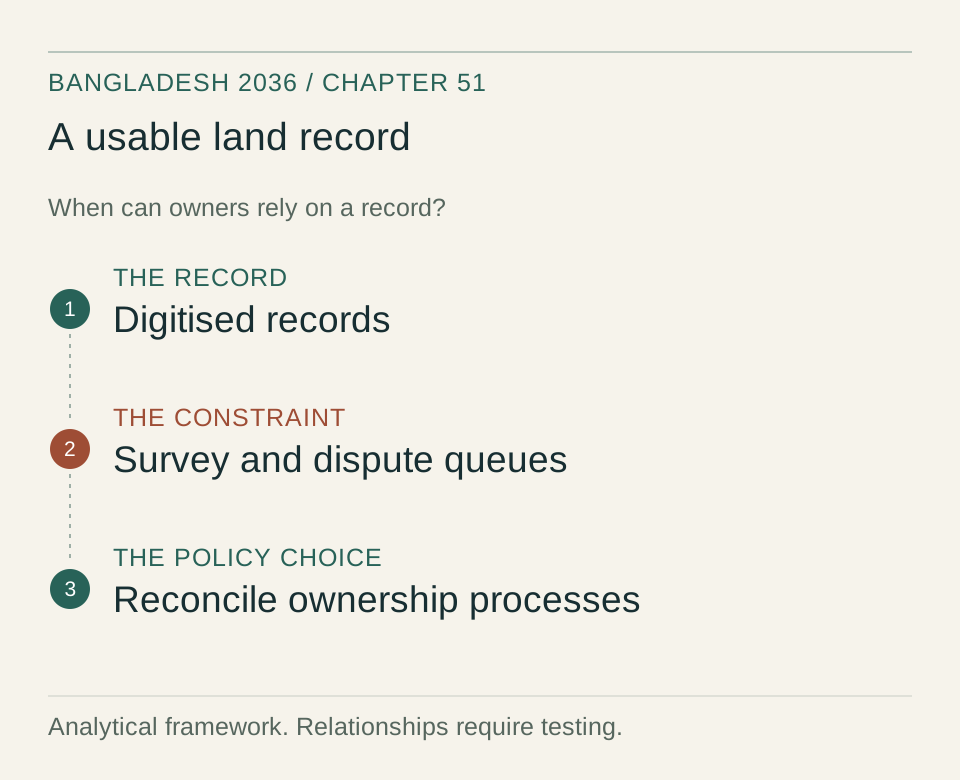
Where proof of ownership becomes a queue
The first queue is the survey, and its mechanism is vintage. The traditional settlement cycle the annual report describes ran roughly 56 months per stage of record preparation before software automated the indices [DLRS 2023], which is why the programme's stock still turns over on surveys commissioned decades ago and why objections, the stage where owners contest draft records, reached Dinajpur's scale. The digital survey attacks the cause: plot to plot measurement against georeferenced control points, tamper proof printed khatians, online objection filing in process [DLRS 2023]. But the systemry carries the 72.5 percent vacancy of the wing that must field check every drone output, and the ministry's FY25 target of 150 digital mouzas [MoL APA 2024] is small in comparison against 41,266.
Digitising distribution without scaling creation runs two cadastral systems for the decade: a digital one in a few hundred mouzas of Chattogram, Dhaka and the pilot districts, and a scanned colonial base everywhere else, precisely the asymmetry a mortgage market cannot price.
The second queue is dispute, and its mechanism is that every stage of proof is also a stage of contest. The objection and appeal stages exist to protect owners, and their stock is the settlement system's honest price tag: 1.11 million objections and 77,620 appeals in one three district zone [DLRS 2023], a per mouza load of about 369 objections. The same structure appears in miniature wherever the state touches land: Purbachal's plot allotments run through court cases [RAJUK 2023], and the courts that would clear any of it are the system chapter 48 measured, 1,442 days to enforce a contract in the last constant measurement [WB DB 2020] and a 45.81 dispute resolution score in the successor assessment [WB BREADY 2025].
The macro consequence runs through the collateral channel chapter 07 documents: bank advances to construction stood at 116,815 crore BDT in December 2023, 8.1 percent of total advances, against a record chapter 14 traced from 96,053 crore BDT in December 2021 [BB Econ 2024], and that flow finances developers with clean papers, not households with contested inheritances, because a khatian with an open objection is not collateral a bank can repossess. Land stays out of the credit system not for want of value but for want of a provable title, which is why the renter share chapter 50 measures in Dhaka district, 70.46 percent of households, and the owner occupancy the census counts nationally, 80.79 percent of households [BBS Census 2022, district tenancy tables], are the same phenomenon at different incomes.
The third queue is revenue, and its mechanism is that the state's largest asset carries one of its smallest taxes. Land development tax collection was 903 crore BDT in FY23 and 990 crore BDT in FY24, with a 1,050 crore BDT FY25 target in the ministry's own APA [MoL APA 2024]. Set the two flows side by side: construction advances, one sector's loan book, is about 118 times the annual land tax take. A property tax base, which is what municipal government in chapters 49 and 50 lacks, prices off the same record, as do the compensation regime acquisition pays on and the value capture chapter 50 proposes financing transit with.
The revenue queue is short because the record it would tax is unreliable, and the APA's FY25 plan to raise mutation and chandina viti licence fees by proclamation [MoL APA 2024] prices the service before the record it sells is trustworthy. The land price boom itself remains unmeasured, chapters 14 and 50 standing: no price index, no rent index, no mortgage stock series exists, so the boom's macro effect arrives only through what can be seen, construction sector growth of 10.06 percent in 2018 and 10.47 percent in 2019 easing to 6.98 percent in 2023 on the national accounts series [BBS NA 2024], and a banking system whose property exposed book grows while the record underneath it does not.
Decisions on surveys and land administration
The re-survey decision, led by the Ministry of Land with the Department of Land Records and Survey, is whether the Bangladesh Digital Survey leaves its pilot geometry. The elements exist: 383.50 crore BDT of Korean finance for six urban and rural areas, a drone pipeline of 862 mouzas in the coastal belt and 32 upazilas in the Padma basin, 381 geodetic control points, and software that already holds 60 percent of the national online khatian entry in one zone [DLRS 2023]. Scaling to the 40,470 mouza traditional base at the drone programme's own district geometry needs a financing decision the FY25 APA's 150 mouza target does not yet contain [MoL APA 2024].
The reform scenario in chapter 15 assumes the re-survey covers a substantial share of the national mouza base by 2036; the baseline assumes the current six area pilot plus coastal expansion; the stall scenario assumes the drone programme remains a demonstration. The staffing constraint is the tell: 5,543 vacant settlement posts [DLRS 2023] against an FY25 fill of 3,255 [MoL APA 2024] is a ministry that does not project a full wing this fiscal year.
The mutation and registration decision, authored jointly by the Ministry of Law's Registration Directorate and the Ministry of Land's land offices, is the single link that would make a deed a title. The pieces on record: the single pay order, same day certified copy and valuation re-set of the FY15 reform list [LJD 2015], the June 2024 second generation mutation automation [MoL APA 2024], the FY25 fee proclamation plan [MoL APA 2024], and the acquisition system's online payment module due at its June 2025 milestones [MoL APA 2024]. What none of these yet delivers is automatic mutation on registration, so the deed counter and the record counter stop being two queues. The APA names interconnection as the biggest challenge after map digitisation [MoL APA 2024]; the decision is whether it is budgeted as a system, or left as a memorandum of understanding between two ministries.
The dispute clearance decision, led by the Supreme Court with the land administration, is publication first. The land share of the civil docket could not be confirmed, the LJD series stops at FY2015 [LJD 2015], and no policy can sequence what no number counts. The settlement side shows clearance machinery working: 100,000 objection disposals in one zone in one year, with online objection and appeal filing in process [DLRS 2023]. The decision this chapter hands the scenarios: the reform case assumes the docket share is published and the digital objection channel scales nationally; the stall case assumes the objection stock migrates to the courts as digitised records make contestation cheaper, which is the scenario the Dinajpur arithmetic prices.
The khas, acquisition and counting decision, led by the Ministry of Land with the landless resettlement programme, is whether the 0.02 acre settlement unit and the 1,600 acre FY24 approval pace [MoL APA 2024] become a programme with a published national khas stock behind it, and whether the acquisition system's online payment module goes live with a published compensation schedule. The same decision carries the inheritance question: a survey that records the owner list of every rebuilt khatian makes female ownership and joint titling countable, converting the largest unconfirmed mark in this chapter into a series; the ministry's smart land services dashboard [MoL APA 2024] is the natural publisher.
How to test the argument. The land ministry and survey authorities should assess whether digitisation reduces disputed records, repeat visits and completed-transfer time. If document delivery accelerates while disputes persist, the record’s underlying accuracy and legal reconciliation need priority over further interface improvements.
Risks and opportunities
Risks. First, the digital backlog: the drone survey maps faster than the objection machinery settles, so newly digital mouzas accumulate a fresh objection stock, and monitor objection cases per mouza in digital survey zones against the Dinajpur benchmark of about 369 per mouza [DLRS 2023]. Second, revenue stagnation: land development tax stays near 1,000 crore BDT a year [MoL APA 2024] while the property boom chapter 50 prices in rents goes untaxed and unmortgaged, the property tax base chapters 49 and 50 need never materialises, and monitor the APA's own collection line against its 1,050 crore BDT target. Third, acquisition conflict: the second generation acquisition system slips past its June 2025 milestones [MoL APA 2024], megaproject land taking continues on the old compensation machinery, and plot litigation reproduces Purbachal's delay record [RAJUK 2023] across the corridor projects chapter 10 builds, with the revealing indicator the first published online acquisition payment.
Upside. First, the collateral dividend: a digital record that is created and mutated in the same system makes the family plot bankable, and chapter 50's birth certificate for the housing market, the first published mortgage stock series, becomes the revealing indicator alongside the construction advance share holding above 8 percent [BB Econ 2024]. Second, the revenue dividend: a trusted record plus the fee reform the FY25 APA plans [MoL APA 2024] lifts land development tax collection above 2,000 crore BDT within the decade and gives the cities a property tax base; monitor the collection series doubling from its FY24 reading.
Third, the dispute dividend: tamper proof digital khatians and online objections shrink the shadow docket at the settlement stage before it reaches the courts, and the Business Ready dispute resolution score moves off 45.81 toward the 55 threshold chapter 48 sets [WB BREADY 2025]; monitor the objection stock per mouza falling in digital zones while disposals hold above 100,000 a year nationally.
Land-administration indicators to follow
The benchmarks below are author-proposed monitoring points, not validated causal cutoffs or official forecasts.
- Digital survey mouza completions. Current value 94 digital mouza surveys complete, with 220 handed over in FY23 and an FY25 target of 150 [DLRS 2023] [MoL APA 2024]. Proposed benchmark: sustained completions above 1,000 mouzas a year mark a national re-survey inside the decade; completions holding under the 300 a year the FY23 APA itself delivered may indicate the multi decade base.
- E-mutation disposal rate. Current value 98 percent of e-mutation and jamakharij applications disposed in the fourth quarter of FY24 [MoL APA 2024]. Proposed benchmark: a gazetted automatic registration to mutation link may indicate the title regime; a rate back below 90 percent alongside the fee increase may indicate a service priced before its record is trusted.
- Land development tax collection. Current value 990 crore BDT in FY24, from 903 crore BDT in FY23, against a 1,050 crore BDT FY25 target [MoL APA 2024]. Proposed benchmark: collection above 2,000 crore BDT a year may indicate the revenue regime turning; a print below 1,100 crore BDT after the fee increase may indicate the untaxed asset.
- Land disputes share of the civil docket. Current value not established; the Supreme Court and Law and Justice Division are the resolving sources, and the held series stopped at FY2015 [LJD 2015]. Proposed benchmark: first publication of the share is the event; a published share above half the civil docket may indicate the land court lock, a share below a third alongside falling settlement objections may indicate the clearance regime.
- Khas land settlement acreage. Current value 1,600.00 acres of agricultural khas settlement proposals approved in the first half of FY24, at 0.02 acre per landless family [MoL APA 2024]. Proposed benchmark: sustained approvals above 10,000 acres a year with a published national khas stock mark the landless pledge delivery path; a fall below 1,000 acres a year may indicate the pledge abandoned.
Sources
[DLRS 2023] Department of Land Records and Survey, Ministry of Land, Annual Report 2022-23, khatian and mouza map digitisation, settlement press output, revisional settlement programme counts, geodetic control points, Bangladesh Digital Survey and EDLMS project, Dinajpur and Dhaka zone objection and appeal case stocks, staffing tables, drone survey programme, OCR text in the chapter's source archive.
[MoL APA 2024] Ministry of Land, Annual Performance Agreement 2024-25 and the Quarterly Achievement Report April to June 2023-24, cashless land offices and mobile financial service flows, e-mutation disposal rates, land development tax collections and FY25 target, mutation fee and chandina viti licence fee proclamation plan, second generation mutation automation and LARMS acquisition system milestones, khas land settlement approvals and 0.02 acre unit, FY25 staffing and office construction targets, map printing suspension, UN Public Service Award and WSIS prize, OCR text in the chapter's source archive.
[WB DB 2020] World Bank Doing Business 2020 and earlier rounds for Bangladesh, registering property procedures, time, cost and quality of land administration index, and enforcing contracts time, via the trade/bd_eodb parquet.
[WB BREADY 2025] World Bank Business Ready 2025 assessment, dispute resolution and commercial justice pillar score, via bdpolicy.db, series: wb_bready2025_dispute_resolution_overall, from chapters 14 and 48.
[LJD 2015] Law and Justice Division annual reports available to this chapter, ending FY2015, Registration Directorate structure and reform list, High Court writ pendency, the resolving source for court statistics, from chapter 48.
[BBS NA 2024] BBS national accounts via bdpolicy.db, series: bbs_gdp_growth_construction_pct, calendar year construction sector growth, December dated readings.
[BB Econ 2024] Bangladesh Bank monthly economic trends via bdpolicy.db, series: bb_bank_advances_construction, bb_bank_advances_total, million BDT converted to crore, December dated readings, from chapters 06 and 14.
[BBS Census 2022] Population and Housing Census 2022 district tenancy tables via bdpolicy parquet, national owner occupancy and Dhaka district renter share, from chapters 14 and 50.
[RAJUK 2023] Rajdhani Unnayan Kartripakkha, Purbachal New Town progress report, original resident plot allocation and allotment litigation, OCR text in the chapter's source archive, from chapters 14 and 50.