Chapter 49 of 60 in the Bangladesh 2036 research base. Contents of the series.
Giving local government the means to deliver
Regional poverty reduction has not removed differences in public services or local fiscal capacity. Central projects can build roads and facilities, while local bodies remain dependent on transfers and weak revenue systems. The next step is to connect elected responsibility, predictable finance and the capacity to maintain services.
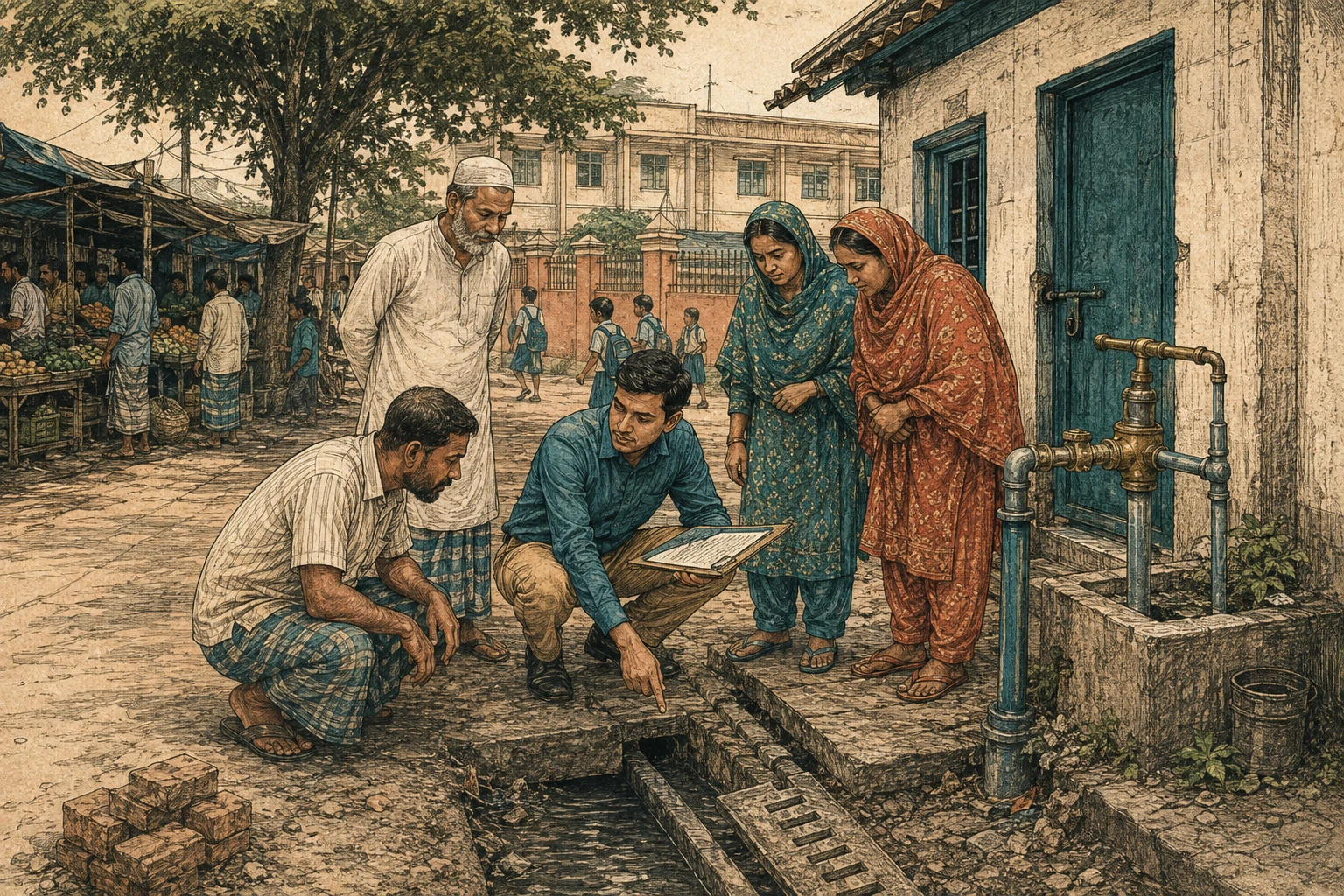
Local budgets and representation
Follow the money first. The FY26 ADP holds 230,000.00 crore BDT across 1,113 projects [Planning Commission ADP 2025, ADP at a glance table]. The local government and rural development sector receives 13,472.26 crore BDT across 101 projects, 5.86 percent, and the Local Government Division, whose ministry line carries the local development assistance blocks as well, receives 32,998.76 crore BDT across 223 projects, 14.35 percent [Planning Commission ADP 2025, ADP at a glance and ministry wise tables]. The published tables stop at the ministry, so the agency cut has to come from the revised programme's project table, where the division's 34,457.1 crore BDT splits into the Local Government Engineering Department at 19,142.15 crore BDT across 130 projects, 55.55 percent of the division, the Department of Public Health Engineering at 3,795.19 crore BDT across 40, four water and sewerage authorities at a combined 6,070.30 crore BDT, the eleven city corporations at 4,996.31 crore BDT, and 453.14 crore BDT for the division secretariat, five components that exhaust the division exactly [Planning Commission ADP 2025, revised FY2025-26 agency table].
Dhaka North alone takes 1,163.08 crore BDT and Dhaka South 951.34 crore BDT; Khulna takes 66.30 crore BDT. The system view is unambiguous: local government development finance is rural infrastructure engineering, urban government is a small line inside it, and the hill districts' development board is small relative to reserves.
The city corporation budgets show what the tier itself can raise, and the spread is the finding. Dhaka South's approved FY26 budget is 3,841.38 crore BDT, of which own revenue income is 1,320.43 crore BDT, 34.4 percent, government block and special allocations 127.00 crore BDT, and income from government and foreign sources 1,469.24 crore BDT, 38.2 percent, with an 845.16 crore BDT opening balance carrying another 22.0 percent; the budget was presented by a government appointed administrator on 6 August 2025 [City Corp 2025, Dhaka South budget FY2025-26]. Dhaka North's FY26 budget is 5,737.15 crore BDT with a tax and rate target of 3,350.80 crore BDT, 58.4 percent, dominated by a 1,080.00 crore BDT property transfer tax line and 940.50 crore BDT of holding tax, against revenue grants too small to print as a share [City Corp 2025, Dhaka North budget FY2025-26].
Rangpur City Corporation's FY26 budget is 751.54 crore BDT, of which total revenue income is 90.33 crore BDT, 12.0 percent, taxes 55.80 crore BDT, 7.4 percent, and development grants 625.84 crore BDT, 83.3 percent of the entire budget [City Corp 2025, Rangpur budget FY2025-26]. Three corporations, three fiscal animals: the capital's south lives a third on its own taxpayer and a fifth on cash carried forward, the capital's north has discovered the transfer tax, and the lagging region's corporation is an aid window with a letterhead. Execution then separates them further: Khulna City Corporation revised its FY22 budget down from 608.03 to 450.65 crore BDT, 74.1 percent attainment, with the development fund at 69.7 percent of target because government and donor project money arrived late [City Corp 2022, Khulna budget FY2022-23], and Rangpur's FY25 budget of 918.99 crore BDT was revised down to 178.19 crore BDT, 19.4 percent, with the donor financed line executing 11.08 crore BDT against a 587.12 crore BDT budget [City Corp 2025, Rangpur budget FY2025-26].
A lagging city cannot spend what the centre approves.
The village tier barely enters the fiscal record. The engineering agency reports 4,546 union parishads and a complex building programme that had delivered 3,064 parishad complexes by FY17, alongside about 108,000 kilometres of paved rural road [LGED 2017, annual report FY2016-17]; the national institute trained 293 of the 330 pourashava administrators in FY2024-25, the number itself the only primary count of the country's municipalities available to this chapter [NILG 2025, annual report FY2024-25]. What those parishads raise, spend and receive as grants is not measured: no source available to this chapter carries union parishad or pourashava own revenue or the intergovernmental transfer envelope, and the figure could not be confirmed; the Local Government Division's fiscal tables would resolve it, the same gap chapter 12 recorded.
The capacity instrument is correspondingly thin: the national institute ran 328 courses for 11,218 targeted local government representatives and officials in FY2024-25 and trained 10,315 [NILG 2025, annual report FY2024-25], a few thousand people a year against roughly five thousand parishads and municipalities.
Representation is the newest break in the record. The budget statement Dhaka South published records the mechanism: the mayor was removed on 19 August 2024 and the councillors on 26 September 2024 under the Local Government (City Corporation) (Amendment) Ordinance 2024, a government administrator appointed, and a 25 member managing committee constituted [City Corp 2025, Dhaka South budget FY2025-26]; Rangpur's FY25 budget opens with an administrator's message [City Corp 2024, Rangpur budget FY2024-25]. Every city corporation in the FY26 programme therefore presents budgets without an elected body, and the union parishad, upazila and zila parishad tiers face the same transition question. The schedule for restoring elected local government could not be confirmed, and the Election Commission would resolve it; chapter 47 carries the national election timeline this clock hangs from.
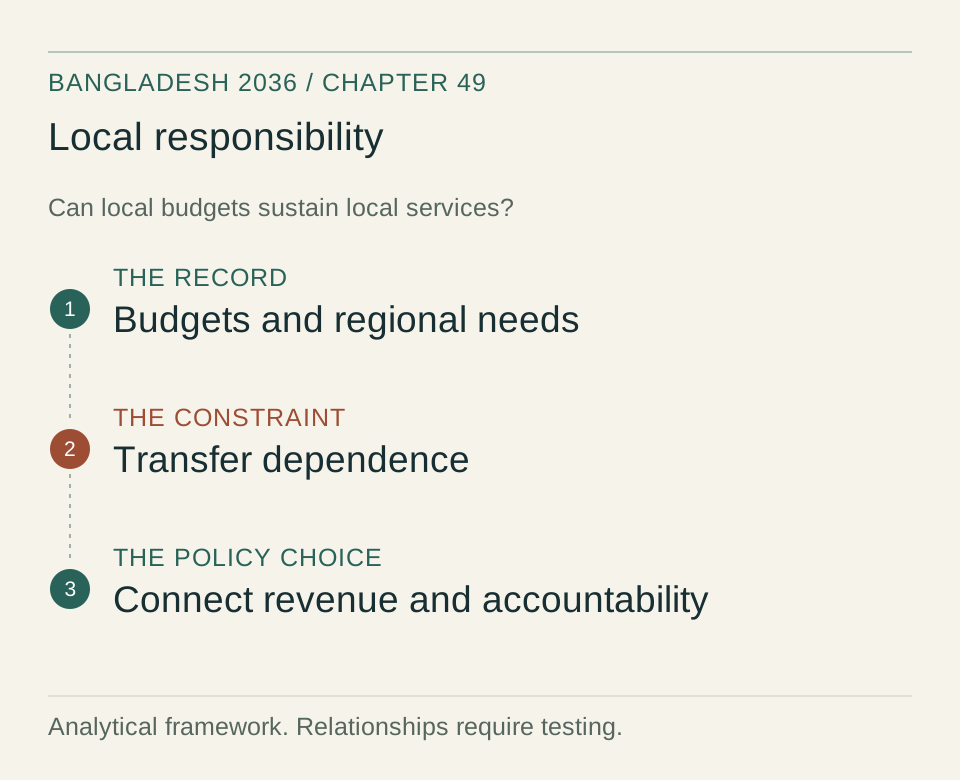
Why local revenue and needs diverge
The first mechanism is the delivery chain itself. Anti poverty money travels the centre to the engineering agency to a project list: the agency's rural road stock, about 108,000 kilometres paved [LGED 2017, annual report FY2016-17], is a potential contributor to Rangpur’s poverty decline, alongside changes in earnings, agriculture and transfers; the chapter does not identify the road effect separately, and the FY26 programme keeps the chain running at 19,142.15 crore BDT [Planning Commission ADP 2025, RADP FY2025-26 agency table]. The chain is effective at asset creation and silent at asset ownership: the road belongs to the agency's maintenance list, not to a parishad with a budget, which is why no institution on the map has an incentive or a revenue line for what happens to the asset after handover.
The consequence is visible in the very structure of the ADP: what the programme calls local government is a ministry executing works, and the tiers themselves appear only as venues for complex buildings.
The second mechanism is the mismatch between where money can be raised and where it is spent. The census counts 52.05 million urban residents, 31.51 percent of the population [BBS Census 2022, locality tables, chapter 14's basis], and the divisional sums computed for this chapter put 46.95 percent of Dhaka division's 44.22 million people in urban areas against 21.95 percent in Rangpur division's 17.61 million [BBS Census 2022, district locality tables, weighted division sums computed in this chapter]. The tax handles that come with density, property transfer, holding tax, advertisement, tariffs, sit in the cities, and the numbers above show the two Dhaka corporations raising 34.4 and 58.4 percent of their budgets while Rangpur raises 7.4 percent [City Corp 2025].
But the centre spends the cities' money through national agencies and returns project grants as a discretionary flow, so the corporation that could live off its tax base is fiscally a project of the ministry above it, and the lagging municipality that cannot raise revenue is entirely one. Decentralization of revenue without decentralization of spending authority changes nothing; the FY26 record is that neither moved.
The third mechanism explains why welfare converged while the deepest deprivation did not. Money poverty is a flow the roads and remittances can lift: divisional upper poverty in 2022 ranged from 14.8 percent in Khulna to 26.9 percent in Barishal, with Mymensingh at 24.2 and Rangpur at 24.8 [BBS HIES 2022, divisional poverty tables]. Multidimensional poverty, which counts the services a local government should deliver, ranks the divisions differently: the 2022 DHS round puts the national multidimensional headcount at 11.5 percent, with Sylhet highest at 22.2 percent and 6.6 percent in severe deprivation, against Khulna at 7.0 and Barishal at 9.7 percent [OPHI MPI 2024, subnational tables, DHS 2022 wave].
Sylhet is the proof of mechanism: it is rich in remittances, 17.15 percent of households receive them, second after Chattogram's 22.67 percent, and poor in piped water at 5.2 percent of residents against Dhaka division's 25.4 percent [BBS Census 2022, weighted division sums computed in this chapter]. Household income travelled in, public services did not, and no institution in Sylhet's municipalities was fiscally positioned to close the gap. The services that remain deprivation's last mile, piped water at 0.9 percent of Rangpur division's residents and 1.5 percent of Mymensingh's, against Brahmanbaria, Nilphamari, Cox's Bazar and Gaibandha districts all below 0.7 percent [BBS Census 2022, weighted district sums computed in this chapter], are exactly the ones the engineering chain does not maintain after the project closes.
The fourth mechanism is displacement without a receiving government. The International Organization for Migration counted 4,955,527 internally displaced persons nationwide on 31 October 2025, 1,212,461 of them in Chattogram division and 594,628 in Barishal [IOM DTM 2025, *]. Set against the census denominators, calculation from the cited figures on the two series, Barishal's displaced stock is 6.5 percent of the division's 9.10 million people, the highest relative burden in the country, against 1.8 percent in Dhaka division [IOM DTM 2025] [BBS Census 2022, district locality tables]. The coastal and hazard displacement chapters 11 and 29 document the causes; the receiving side here is a set of pourashavas and city corporations that raise 7 to 12 percent of their budgets in the lagging regions and hold no mandate, grant formula or borrowing line for displaced residents. The displacement geography of the 2030s lands on the weakest fiscal tier in the country.
Decisions on transfers, taxes and accountability
The arithmetic frame is chapter 14's and is restated for this chapter's purpose: the UN projects 196.74 million people in 2036 on the medium variant [UN WPP 2024, medium variant], chapter 14's urban path adds roughly 21 million urban residents by 2036, and the chapter 15 scenarios assume continued Dhaka primacy in the baseline and secondary city absorption in the reform case. Every path puts more people inside the jurisdiction of municipal governments that currently raise 7 to 58 percent of their budgets. Three decisions decide which.
The representation decision, led by the Election Commission with the Local Government Division, is whether parishad and corporation elections are restored early enough to matter: budgets approved by administrators are legally spendable and politically unowned, and the corpus of own revenue decisions, tax rerating, fee schedules, the collection reforms Dhaka South's statement lists [City Corp 2025, Dhaka South budget FY2025-26], needs an elected principal to survive contact with taxpayers. The fiscal decision, led by the Local Government Division with the Finance Division, is whether the tier gets a transfer formula and a borrowing framework or continues to live on project lists: the FY27 budget targets the division at 40,245.83 crore BDT, of which development takes 33,735.79 crore BDT, 6.6 percent below the FY26 original 36,101.12 crore BDT, while the programme itself grows [MoF Budget 2026, ministry allocations FY2025-26 and FY2026-27].
A shrinking divisional envelope is the wrong moment to keep allocation discretionary; it is the right moment to guarantee a formula floor for the tiers. The agency decision, led by the Local Government Division for the engineering department, is whether the 19,142.15 crore BDT continues as a works programme or is progressively converted into maintenance transfers and block grants that the parishads and pourashavas administer; the 55.55 percent of the division the agency already holds is the ceiling of what a central chain can deliver, and the piped water and deprivation record is the cost of it.
The hinge under all three is the cadastre chapter 14 documents: the Bangladesh Digital Survey that began in Chattogram in August 2023 and the e-Porcha record of 12.7 million digitised khatians [DLRS 2023, annual report 2022-23]. A completed cadastre is a municipal revenue machine waiting to be switched on: holding tax and property tax roll off the same record that mortgages do, and the corporation that prices property transfers, Dhaka North's 1,080.00 crore BDT line [City Corp 2025, Dhaka North budget FY2025-26], is collecting on a base the land ministry maintains.
This chapter's regional claim is that the cadastre dividend is largest outside Dhaka: Rangpur division's 0.9 percent piped water share and Mymensingh's 17.2 percent formal financial account share [BBS Census 2022, weighted division sums computed in this chapter] describe towns whose property and enterprise bases are informal for lack of a record, not for lack of value. A regional strategy that spends nothing new but completes the survey, assigns the tax handles and guarantees a transfer floor would move more than the engineering chain's next 19,000 crore BDT.
How to test the argument. The Local Government Division should link predictable transfers and local revenue authority to audited service outcomes. If higher local receipts do not improve maintenance or access, administrative capacity and accountability need attention alongside fiscal autonomy.
Risks and opportunities
Risks. First, the administrator permanence trap: if elected restoration slips past the FY28 budget the transition timeline targets, the 2024 to 2028 window trains a generation of local budgets under appointed officials with no electoral accountability, and monitor the Election Commission's local election schedule, not established until published [City Corp 2025, Dhaka South budget FY2025-26]. Second, the execution divergence: Rangpur's 19.4 percent FY25 budget execution against Khulna's 74.1 percent FY22 attainment shows lagging region corporations losing their development money twice, once in revision and once in donor financed lines that execute under 2 percent [City Corp 2025, Rangpur budget FY2025-26] [City Corp 2022, Khulna budget FY2022-23]; monitor each corporation's revised versus original budget in the statements the division targets over the next three fiscal years.
Third, the services divergence: the multidimensional map, Sylhet at 22.2 percent and the haor and char districts below 0.7 percent piped water [OPHI MPI 2024, subnational tables] [BBS Census 2022, weighted district sums computed in this chapter], plus the displacement stock chapter 11 projects, prints as a widening of the deprivation spread even while money poverty converges; monitor the next DHS multidimensional round's Sylhet and Mymensingh readings against the 2022 baseline.
Upside. First, the mobile money handle: Rangpur division already leads the country in mobile financial services at 43.42 percent of residents against Sylhet's 29.88 percent [BBS Census 2022, weighted division sums computed in this chapter], so the payment rail a parishad would need to bill and collect holding tax, market fees and water charges exists most where fiscal capacity is weakest; monitor a parishad pilot collecting any recurring fee digitally at scale. Second, the cadastre to property tax dividend: the survey chapter 14 tracks converts the informal bases described above into rolls, and the 43.4 and 17.2 percent access shares become the collector's address list [DLRS 2023, annual report 2022-23] [BBS Census 2022, weighted division sums computed in this chapter]; monitor the first pourashava outside the Dhaka region financing a fifth of its budget from property tax.
Third, the convergence compounding: Rangpur's poverty fall from 47.2 to 24.8 percent in six years happened with the weakest local institutions in the country [BBS HIES 2022, divisional poverty tables], and the same division now tops mobile money and contains Panchagarh, the division's fastest growing district by total population, at 1.58 percent a year [BBS Census 2022, district growth tables]; if fiscal capacity follows the convergence rather than lagging it by a decade, the reform scenario's regional assumptions in chapter 15 clear early. The revealing indicator is Rangpur division's own revenue collection, first measurable when the Local Government Division publishes the fiscal tables this chapter marks as not established.
Local-government indicators to follow
The benchmarks below are author-proposed monitoring points, not validated causal cutoffs or official forecasts.
- City corporation share of the Local Government Division. Current value 4,996.31 crore BDT across eleven corporations, 14.50 percent of the division's 34,457.1 crore BDT in the revised FY26 programme, the two figures taken from the same agency table [Planning Commission ADP 2025, revised FY2025-26 agency table]. The published programme does not print an agency cut, so the corporations' share of the national programme could not be confirmed. Proposed benchmark: a rise above 30 percent of the division would indicate the municipal finance turn; a fall below 11 percent may indicate the engineering consolidation regime.
- The Local Government Division's development allocation. Current value 33,735.79 crore BDT targeted in the FY27 budget, 6.6 percent below the FY26 original 36,101.12 crore BDT [MoF Budget 2026, ministry allocations]. Proposed benchmark: a further nominal fall below 30,000 crore BDT, or a division share below 11 percent of a growing programme, may indicate the squeeze on the entire local tier; a recovery above the FY26 original alongside a published transfer formula may indicate the regime change this chapter argues for.
- Rangpur City Corporation budget execution. Current value 178.19 crore BDT revised against a 918.99 crore BDT FY25 budget, 19.4 percent, with the donor financed line at 1.9 percent of its budget [City Corp 2025, Rangpur budget FY2025-26]. Proposed benchmark: two consecutive years above 70 percent attainment would mark a delivery turn in the lagging regions; a repeat below 30 percent may indicate the trap where approval is political and cash is notional.
- The multidimensional poverty spread. Current value 15.2 points in the 2022 DHS wave, Sylhet at 22.2 percent against Khulna at 7.0 [OPHI MPI 2024, subnational tables]. Proposed benchmark: a spread above 20 points in the next round, or Sylhet back above 25, may indicate the services divergence regime arriving; convergence below 8 points means local service delivery is following money poverty down.
- Elected local government restoration. Current status: city corporations governed by administrators since the August and September 2024 removals, the parishad tiers on the same transition clock, schedule not established; the Election Commission resolving [City Corp 2025, Dhaka South budget FY2025-26]. Proposed benchmark: a published local election schedule targeting the FY28 budget or earlier is the representation regime returning; no schedule targeted by the FY29 budget may indicate the unitary drift as the decade's settlement.
Sources
[Planning Commission ADP 2025] Annual Development Programme 2025-2026, Programming Division, Bangladesh Planning Commission, June 2025, ADP at a glance sector table and ministry wise allocation table, shares on the 230,000.00 crore approved programme, Source link, accessed 6 September 2026, from chapters 04 and 14. The same tag covers the revised FY2025-26 agency table via bdpolicy.db adp_projects, allocations in lakh taka converted to crore, named as the revised programme wherever it is used; the bdpolicy.db adp_book_projects table is the FY2023-24 programme book, not FY26, and is not used here.
[City Corp 2025] City corporation budget statements FY2025-26 and FY2024-25 via ocr_text: Dhaka South City Corporation budget speech of 6 August 2025 and approved budget at a glance, Dhaka North City Corporation budget at a glance FY2025-26, Rangpur City Corporation budget statement FY2025-26 with FY2023-24 actual and FY2024-25 original and revised columns.
[City Corp 2024] Rangpur City Corporation budget FY2024-25 with administrator's message, via ocr_text/rangpur_cc.
[City Corp 2022] Khulna City Corporation budget FY2022-23 with FY2021-22 original and revised attainment record, via ocr_text/khulna_cc.
[LGED 2017] Local Government Engineering Department annual report FY2016-17 via ocr_text/lged_deep, union parishad count and complex building programme, rural road stock paved.
[NILG 2025] National Institute for Local Government annual report FY2024-25 via ocr_text/nilg, training statistics including pourashava administrator batches.
[OPHI MPI 2024] Oxford Poverty and Human Development Initiative and UNDP global Multidimensional Poverty Index, Bangladesh subnational tables, DHS 2014 and 2022 and MICS 2019 waves, via lake/poverty/mpi_subnational_trends_bd.parquet.
[BBS HIES 2022] Household Income and Expenditure Survey 2022 divisional poverty tables via bdpolicy parquet, 2016 and 2022 rounds, from chapter 14.
[BBS Census 2022] Population and Housing Census 2022 district tables via bdpolicy parquets: locality urban rural, growth and dependency, remittance households, financial inclusion, youth NEET, drinking water, ethnic population; weighted division and national sums computed in this chapter and in chapter 14.
[IOM DTM 2025] International Organization for Migration, Displacement Tracking Matrix, internally displaced persons total and by division as of 31 October 2025, via HDX HAPI in bdpolicy.db, series: hapi_idps_*, from chapters 14 and 29.
[UN WPP 2024] UN World Population Prospects 2024 medium variant via bdpolicy parquet, from chapter 14.
[DLRS 2023] Department of Land Records and Survey annual report 2022-23 via OCR text, from chapter 14.
[MoF Budget 2026] Ministry of Finance, ministry allocation table, Local Government Division: FY2026-27 original and FY2025-26 original allocations, operating, development and total. Archived table supports the figures cited here; the original release URL has not been verified.