Chapter 46 of 60 in the Bangladesh 2036 research base. Contents of the series.
Financing a prolonged Rohingya response
The Rohingya response now requires planning for a prolonged stay as well as readiness for further displacement. Registered population counts have risen while recent completed appeals have received less funding. Camp services, host-community support and prospects for safe voluntary return need separate measures, rather than a single funding or population threshold.
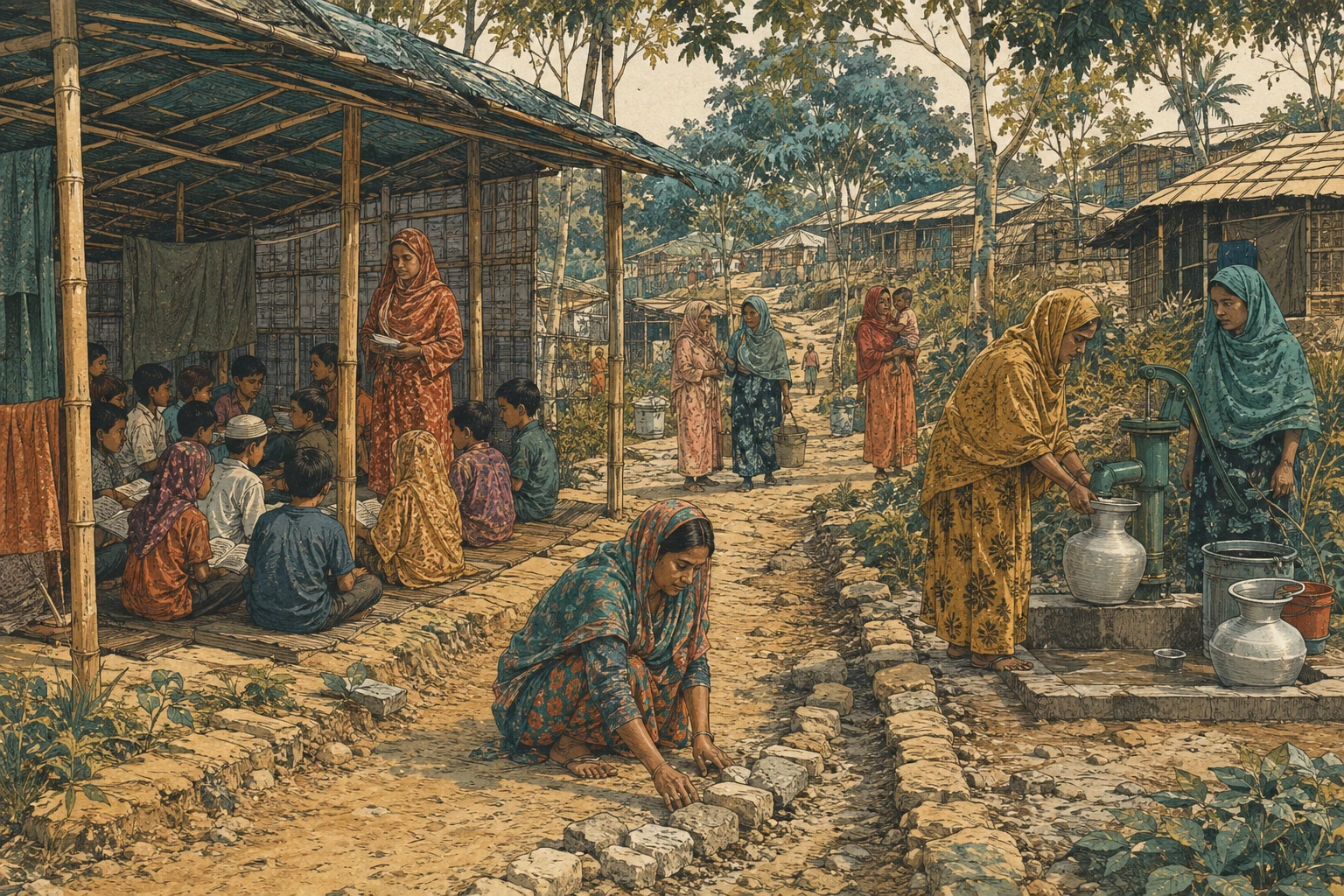
Population, funding and the host economy
The stock record has three phases. The long small phase: a registered population of 232,462 at end-2014, roughly static for a decade [UNHCR 2026]. The influx phase: 276,198 at end-2016 became 932,204 at end-2017, a rise of 656,006 persons or 237.5 percent in one year [UNHCR 2026], with the field reporting of the months after 25 August 2017 putting arrivals above 700,000, a figure not confirmed from the cited reports against the UNHCR operational reports. The consolidation phase: 906,635 at end-2018 and 854,764 at end-2019, a decline that reflects verification and deduplication rather than returns, then a slow climb back through 952,365 at end-2022 and 971,964 at end-2023 to 1,005,561 at end-2024 [UNHCR 2026].
End-2025 breaks the pattern: 1,178,003, up 172,442 persons or 17.1 percent, the largest rise of the consolidation phase and the first that reads as renewed flight rather than registration catch up. The drivers sit in Myanmar's civil war and the arrival counts behind the jump could not be confirmed here, UNHCR field reporting being the resolving source.
The demography is the decade's arithmetic. Female refugees were 606,719 of the end-2025 stock, 51.5 percent, and children under 18 were 603,735, 51.3 percent [UNHCR 2026]. The large child share makes education, documentation and family protection central to any return process. It does not establish birthplace or time spent in Bangladesh, and no stored series in the source archive measures camp births, the UNHCR health information system being the resolving source, so the natural increase component of the stock's growth could not be confirmed.
The funding record is the mirror image. The Joint Response Plan asked for 434.1 million USD in 2017, 950.8 million USD in 2018 and 920.5 million USD in 2019, and it was funded at 72, 72 and 75 percent in those years [FTS 2026]. Requirements after 2019 peaked at 1,058.1 million USD in 2020, sat in an 852.4 to 943.1 million USD band from 2021 through 2024, and rose to 934.5 million USD in 2025, the fourth largest ask on record behind 2020, 2018 and 2021, while receipts fell from 689.6 million USD in 2021 to 619.5 million USD in 2022, 542.9 million USD in 2024 and 492.3 million USD in 2025; the 2026 appeal, at 710.5 million USD required, has received 310.9 million USD to date [FTS 2026].
Coverage ran at 70 percent or higher in six of the first seven cycles, the exception 60 percent in 2020, then 64 percent in 2024, 53 percent in 2025 and 44 percent in 2026 to date [FTS 2026]. Dividing receipts by the registered stock, a calculation from the cited figures illustration because the plan also serves host communities, funding per person fell from roughly 810 USD in 2019 to roughly 418 USD in 2025, a 48 percent cut per person in nominal terms.
The aid aggregates place the response inside the external account chapter 03 tracks. Humanitarian aid to Bangladesh from all official donors, current prices, was 126 million USD in 2016, jumped to 357 million USD in 2017 and 614 million USD in 2018, and has run between 583 and 751 million USD every year since, reaching 751 million USD in 2024, its series high [OECD DAC 2025, measure: humanitarian aid, current prices]. Total gross ODA received, current prices, rose from 3,209 million USD in 2014 to 6,583 million USD in 2024, so the humanitarian line went from under 4 percent of the aid account in 2016 to 11.4 percent in 2024 [OECD DAC 2025, measure: gross ODA, current prices].
The government's own recorded channel is separate and larger: ERD records foreign aid disbursements of 9,891.96 million USD in FY24 against commitments of 10,720 million USD [ERD 2024], and the Rohingya response sits mostly outside that pipeline, executed by UN agencies and NGOs off the government's accounts.
The border trade record is the chapter's surprise, and it is a near zero. Bangladesh imported 67.2 million USD of goods from Myanmar in 2024 and exported 22.9 million USD, a two way flow of 90.1 million USD, about 0.15 percent of the 58.8 billion USD Bangladesh exported that year [BACI 2024]. The flow has a history: imports peaked at 203.4 million USD in 2017 and 204.2 million USD in 2018, when Myanmar fish, timber and ginger were a working border trade, and exports peaked at 86.7 million USD in 2012 [BACI 2024]. The informal trade that the Teknaf land and sea routes carry has no primary series in the source archive, the NBR and EPB recording official flows only, so its scale could not be confirmed.
The host district record shows an economy absorbing the response rather than crushed by it. Cox's Bazar district's population grew 1.86 percent a year in the 2022 census, against 8.03 percent a year in its urban areas and minus 1.05 percent in its rural areas, a redistribution toward the towns that host the camp economy [BBS Census 2022]. District literacy of the population aged 7 plus was 71.58 percent, 72.51 for men and 70.62 for women [BBS Census 2022]. Mobile financial services accounts covered 33.69 percent of the district's adults, 63,899 households received remittances, and the dependency ratio stood at 63.79 [BBS Census 2022].
Chattogram division's upper poverty rate was 15.8 percent in 2022, down from 18.4 percent in 2016 and the second lowest of the eight divisions [BBS HIES 2022], which is the quantitative floor under the claim that the host division entered the crisis relatively better off than the districts chapter 14 and chapter 49 flag as lagging.
The security budget record is the last leg. Military expenditure was 2,356.0 million USD in 2014 and 4,208.0 million USD in 2023, but as a share of GDP it fell from 1.136 percent to 1.023 percent, with 2020 the highest year of that span at 1.245 percent, still below the series' own high of 1.585 percent in 1999 [SIPRI 2024]. The entire 2025 refugee appeal, 492.3 million USD, was 11.7 percent of one year's military spending [SIPRI 2024] [FTS 2026]. The border crisis has so far been financed as a humanitarian line, not a defence line, and the budget documents the deployments draw on are not published at a level this chapter can cite, so the border operations component of the defence budget could not be confirmed, the Finance Division being the resolving source.
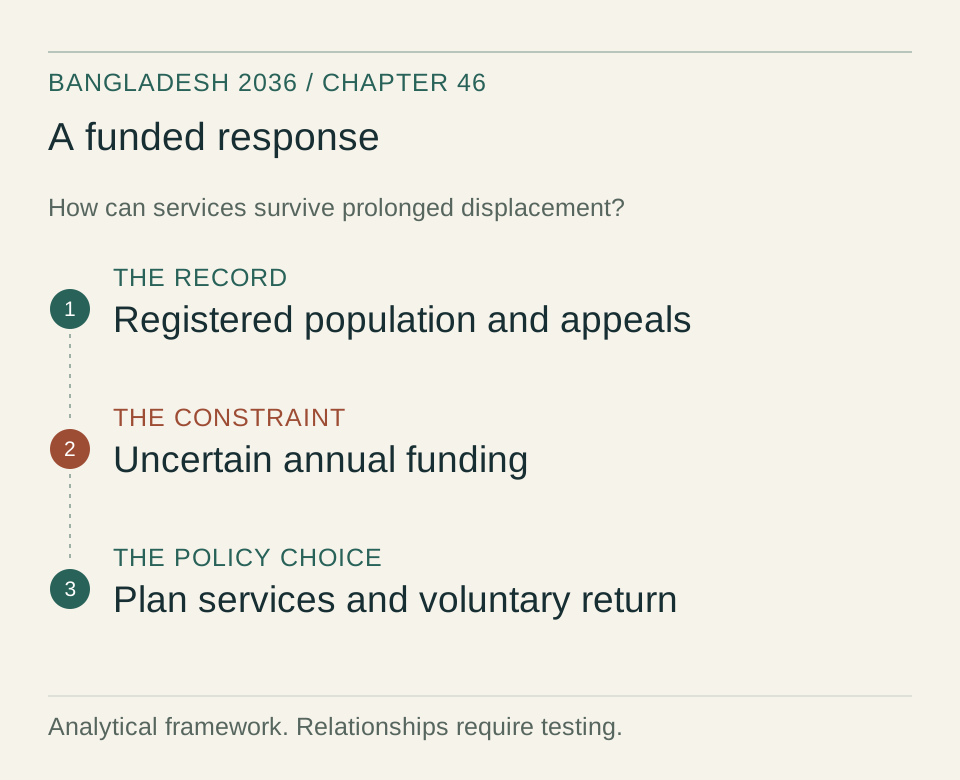
How displacement and aid affect the border region
The stock moves with Myanmar's war, not with Bangladesh's policy. The 2017 influx followed the Myanmar military's clearance operations; the 2019 dip followed joint verification, not return; the 2025 jump follows the Arakan Army's conquest of most of Rakhine state after the 2021 coup, a qualitative reading of the conflict record that no stored series in the source archive quantifies. Each phase left a different population behind: the 2017 arrivals filled about 30 camps in Ukhia and Teknaf, the consolidation years produced a registered caseload with a rising child share, and the post 2023 arrivals bring the war to the border at second hand. Policy in Dhaka changes where the population sits, on the mainland or on Bhasan Char, an island relocation whose caseload could not be confirmed from the cited reports, the RRRC and UNHCR operational reports being the resolving sources, but not whether it arrives.
The funding mechanism is an annual appeal competing in a global market for humanitarian dollars. The Joint Response Plan is a plan, not an entitlement: each year UN agencies and NGOs cost the response, donors pledge against competing crises, and the shortfall lands on food rations, fuel and services. The coverage slide from the 72 to 75 percent of the first cycles to 44 percent in 2026 to date [FTS 2026] is therefore a price signal, not an accounting detail: the World Food Programme's ration cuts that followed the 2023 shortfalls could not be confirmed here, WFP operational reporting being the resolving source, but the per person arithmetic above, 810 USD to 418 USD in six years, is the chapter's own measure of the squeeze. A cheaper camp is not a smaller camp; it is a camp with thinner services and a stronger incentive for onward movement.
The balance of payments barely feels the response, which is the point chapter 03's account misses without this chapter. Most Joint Response Plan money never touches the government's accounts or the reserves: it is spent by UN agencies and international NGOs on imported grain, fuel, transport and staff, entering the balance of payments as current transfers of NGOs rather than as budget support through the ERD pipeline. The scale comparison makes the point in one line: the response's best funded year, 692.0 million USD in 2019, was 2.3 percent of the remittances Bangladesh Bank recorded in FY25 alone, 30,328.80 million USD, and the 2025 receipts were 1.6 percent of them [FTS 2026] [BB Econ 2025].
Against the 26,603.7 million USD of BPM6 reserves at end-September 2025 [BB Econ 2025], the entire annual appeal is small relative to reserves. The costs that do hit the state are different in kind: land occupied by the camps in Ukhia and Teknaf, the Bhasan Char infrastructure, and the border force deployments whose budget lines could not be confirmed here.
The border economy is aid and security, not customs, and the trade series explains why. Rakhine state, the hinterland of the Bangladesh border, has been at war since 2018 and under insurgent administration across most of its townships since 2024, so the formal channel, Sittwe and Maungdaw to Teknaf, carries 67.2 million USD of imports [BACI 2024] against a banking channel that barely functions and a logistics corridor that the conflict has cut. The 2017 to 2018 import peak shows the border at its pre war working level, and that level was one third of one percent of Bangladesh's trade. Nothing in the border's economics, as distinct from its geopolitics, makes it a corridor worth the land routes chapter 23 prices for Chattogram; its value is prospective, in the Rakhine reconstruction and transit scenario chapter 45's geoeconomics discusses, and hypothetical until Myanmar settles.
The host community mechanism runs through prices and services rather than wages data. The response is Cox's Bazar's largest single economic programme: construction, trucking, translating and project employment paid out of the 619.2 to 692.0 million USD received annually from 2019 to 2023 [FTS 2026] may contribute to local demand. The census records 8.03 percent annual urban growth, but does not identify how much was caused by the response [BBS Census 2022]. The costs are the other side of the same shock: pressure on upazila water, health and education services from a registered caseload of 1,178,003 persons [UNHCR 2026], and a labour market effect on the low wage trades that no stored series separates from the tourism boom in the same district.
The divisional poverty rate of 15.8 percent in 2022 [BBS HIES 2022] says the host division absorbed the shock without measurable deterioration at the division level, which is the honest limit of what the stored data can claim; district and upazila level income effects could not be confirmed, the BBS household surveys being the resolving source.
Decisions on services, work and return
Three forces set the path to FY36 under the settings chapter 15's scenarios assume. First, the stock: with half the caseload under 18 and flight continuing out of a Rakhine that no observer expects to stabilise quickly, the registered population grows in every scenario this chapter can defend; the scenarios in chapter 15 assume a stock between 1.2 and 1.6 million by 2036, calculation from the cited figures on the UNHCR base, with the low end requiring returns to begin and the high end assuming a further major influx. Second, the funding: donor budgets that redefined priorities after 2022 give no visible reversion to the 70 percent coverage regime, so the planning base is coverage in the 40s; a 1.6 million person caseload at 418 USD a person implies roughly 670 million USD a year, a funding requirement that cannot yet be compared with a completed 2026 appeal cycle [FTS 2026].
Third, the border's geopolitics: whoever administers Rakhine, the Arakan Army in the current configuration, sits across from a Bangladeshi state that wants trade and returns, and both China's Kyaukphyu pipeline corridor and India's Kaladan project give outside powers standing interests in that coast, the geoeconomics chapter 45 carries.
Five decisions belong to Bangladesh, and none of them is repatriation timing, which Myanmar owns. The documentation decision: whether the camp population holds identity records that a future Myanmar recognises, on which every repatriation architecture since the 1990s has foundered; the UNHCR registration series is the stored base, the verification regime could not be confirmed here. The education decision: whether camp children sit the Myanmar curriculum and receive credentials, the pilot programmes not confirmed from the cited reports, UNICEF and UNHCR reporting the resolving sources, because a generation without credentials is a repatriation liability.
The movement and work decision: how much earning inside and outside the camps the state tolerates, which sets the camp's cost to donors and its pull on the local labour market. The consolidation decision: Bhasan Char versus the mainland camps, an island logistics model against a mainland services model, the caseload split not established. The border regime decision: fence, patrolling, trade channels and what official trade to permit with a Rakhine administered by an armed movement, a decision the 90.1 million USD formal flow says is currently priced at nothing [BACI 2024].
How to test the argument. Bangladesh’s response authorities and UN partners should separate funding received from service coverage and verified voluntary returns. If appeal coverage improves without restoring essential services, allocation and delivery need scrutiny; a falling registered population alone would not demonstrate successful return.
Risks and opportunities
Risks. First, a funding collapse: coverage already at 44 percent in 2026 to date [FTS 2026], a full appeal cycle below 40 percent would cut rations below the minimum the WFP specifies, sharpen camp instability and push onward movement by sea; monitor the coverage series itself and the ration pricing in the HDX WFP food price monitor. Second, a new mass influx: the 17.1 percent growth of 2025 [UNHCR 2026] is the warning shot; a Rakhine escalation that pushes another two to three hundred thousand people to the border inside a year would overwhelm a response already underfunded and force the state into a closure posture it has so far avoided, with the diplomatic cost that entails.
Third, security spillover: camp based armed groups, intra community violence and recruitment for the Myanmar war are the qualitative record, and no stored series counts incidents, so the budget is the watch line: a military expenditure share rising from 1.023 percent of GDP toward 1.5 percent [SIPRI 2024] would be the fiscal signature of the border turning from a humanitarian file into a security file, the diversion chapter 04's arithmetic would show.
Upside. First, a Rakhine settlement that makes return real: monitor the registered stock itself, verified safe voluntary return flows, distinguished from changes caused by registration or deduplication, and the repatriation attempts of 2018 and 2019, which processed verified lists measured in the hundreds and could not be confirmed here against RRRC records, mark how low the bar to beat is. Second, corridor economics: a stabilised Rakhine restores the pre war trade base at 240.2 million USD of two way flow and then multiplies it with transit and energy lines through chapter 45's Kaladan and Kyaukphyu projects, and monitor the bilateral series clearing 100 million USD in either direction [BACI 2024].
Third, a development pivot in the response: if donors shift from in kind survival to cash, education and skills, the camp's 51.3 percent child share becomes an asset with a return value instead of a cost with a ration, and monitor the education coverage programmes, not confirmed here, and the coverage share recovering above 70 percent [FTS 2026].
Displacement and funding indicators to follow
The benchmarks below are author-proposed monitoring points, not validated causal cutoffs or official forecasts.
- Registered Rohingya stock. Current value 1,178,003 persons at end-2025 [UNHCR 2026]. Proposed benchmark: annual growth above 10 percent may indicate a new influx regime; annual declines require reconciliation with births, deaths, arrivals, registration changes and verified voluntary returns.
- Joint Response Plan coverage. Current value 44 percent in 2026 to date [FTS 2026]. Proposed benchmark: a full appeal cycle below 40 percent would indicate the ration collapse and onward movement regime; recovery above 70 percent would indicate donor recommitment.
- Humanitarian aid to Bangladesh. Current value 751 million USD in 2024, current prices [OECD DAC 2025, measure: humanitarian aid, current prices]. Proposed benchmark: a year below 500 million USD means the response is shrinking faster than the stock, a warning of reduced humanitarian support.
- Two way Myanmar trade. Current value 90.1 million USD in 2024 [BACI 2024]. Proposed benchmark: clearing the 240.2 million USD two way peak of 2018 would indicate the corridor reopening; a fall below 50 million USD would indicate the border closing as an economy.
- Military expenditure share. Current value 1.023 percent of GDP in 2023 [SIPRI 2024]. Proposed benchmark: a sustained rise above 1.5 percent may indicate the border security buildout that crowds development spending at chapter 04's margin.
Sources
[UNHCR 2026] UN High Commissioner for Refugees registered refugee stock for Bangladesh via bdpolicy.db, series: unhcr_refugees_rohingya_bangladesh, unhcr_refugees_total_bangladesh, unhcr_refugees_female_bangladesh, unhcr_refugees_male_bangladesh, unhcr_refugees_children_bangladesh, annual stocks end-2001 to end-2025.
[FTS 2026] UN OCHA Financial Tracking Service, Rohingya Humanitarian Crisis Joint Response Plan via bdpolicy.db, series: fts_rohingya_jrp_requirements_usd, fts_rohingya_jrp_funding_usd, fts_rohingya_jrp_funded_pct, appeal years 2017 to 2026, the 2026 figures to date at drafting.
[OECD DAC 2025] OECD Development Assistance Committee DAC2a disbursements to Bangladesh via the aid/oecd_dac2a_bd parquet, measures: gross ODA and humanitarian aid, official donors aggregate, current prices only (the parquet also carries a constant-price series for the same measures; summing the two, as an earlier draft did, doubles the figure), 2014 to 2024.
[SIPRI 2024] Stockholm International Peace Research Institute military expenditure via the governance/sipri_milex_bd parquet, series: sipri_milex_bd, current USD and share of GDP, to 2023.
[BACI 2024] CEPII bilateral trade at HS6 via TradeWeave parquet, series: bd_bilateral for the Myanmar corridor, bd_hs6_trade for total exports.
[BBS Census 2022] Population and Housing Census 2022 district tables via the lake/demographics parquets, series: bbs_census_district_growth_dependency, bbs_census_district_literacy_rates, bbs_census_district_financial_inclusion, bbs_census_district_remittance_households.
[BBS HIES 2022] Household Income and Expenditure Survey 2022 divisional poverty via the lake/poverty parquet, series: bbs_hies_divisional_poverty, upper poverty line, 2016 and 2022 rounds.
[ERD 2024] Economic Relations Division aid pipeline series via bdpolicy.db, series: erd_foreign_aid_disbursement_usd_mn, erd_foreign_aid_commitment_usd_mn, FY20 to FY24.
[BB Econ 2025] Bangladesh Bank Monthly Economic Trends, October 2025, tables IB and XVIII: workers' remittances FY25 and foreign exchange reserves on the BPM6 basis at end-September 2025.