Chapter 38 of 60 in the Bangladesh 2036 research base. Contents of the series.
Insurance that pays, pensions that accumulate
Insurance and pensions should protect households across events they cannot finance from current income. The available record instead shows low coverage, claims still awaiting settlement and limited evidence on pension accumulation. Better disclosure, durable contributions and trustworthy claims handling matter more than the number of products launched.

Coverage, claims and invested savings
Insurance penetration, gross premium as a share of GDP, was 0.41 percent in calendar 2023, down from 0.44 percent in 2022, split 0.27 percent life and 0.13 percent non-life as printed in the authority's own premium and GDP table [IDRA 2024]. Premium per head tells the same story across currencies: density was 1,054.06 taka per person in 2023, up from 1,018.46 taka in 2022, but in United States dollars it fell from 10.91 to 9.76 because the taka depreciated faster than premiums grew [IDRA 2024]. The authority's comparison table, reprinting Swiss Re sigma data, puts India at 3.7 percent penetration and 95 dollars of premium per head, and Malaysia at 5.2 percent and 590 dollars, in the same 2023 reading [IDRA 2024].
Chapter 07 restates the headline premium total under the same tag: 18,226.77 crore BDT of gross premium in 2023, up 5.38 percent on 2022, split 12,273.49 crore life and 5,953.28 crore non-life [IDRA 2024]. Growth is decelerating from a low base: total premium grew 10.67 percent in 2022 and 5.38 percent in 2023, with non-life nearly flat at 0.85 percent [IDRA 2024].
Coverage is thin and shrinking at the top line. The authority’s summary reports 16.49 million insured people and a 4.26 percent coverage rate against a population of 173 million in 2023; those figures do not reconcile, since 16.49 divided by 173 is about 9.53 percent. Policy counts and unique insured people need to be distinguished before using the coverage rate [IDRA 2024]; the IMF Financial Access Survey counts 16.36 million policyholders in 2024, against a peak series reading of 17.01 million in 2014 [IMF FAS 2024]. Life policies in force fell from 7,702,433 at end 2022 to 7,374,276 at end 2023, a net loss of 328,157 policies calculated from the cited figures [IDRA 2024]. The flow explains the stock: the industry issued 1,520,582 new life policies in 2023 while 1,542,815 lapsed and 76,167 were surrendered, with 673,910 revived; lapses alone outnumbered new sales [IDRA 2024].
Claims settlement is central to whether policyholders can rely on their cover. Life insurers settled 72.43 percent of claims by value in 2023, 8,728.90 crore BDT of 12,051.01 crore claimed, an improvement on the 57.84 percent of 2021 but a decline from the 74.28 percent of 2022 [IDRA 2024]. Death claims, the product's core promise, settled at 75.55 percent of value in 2023, up from 59.96 percent in 2022, while maturity claims settled at 63.58 percent [IDRA 2024]. Non-life insurers settled 35.54 percent of claims by value in 2023, 1,142.46 crore BDT of 3,214.92 crore claimed, down from 43.29 percent in 2022 [IDRA 2024]. The aggregate ratio raises questions about pending claims and settlement delays. It does not establish that an individual claimant receives only a third of an accepted loss.
Structure explains behaviour. The industry has 82 insurers, 36 life companies of which Jiban Bima Corporation is state owned and 46 non-life companies of which Sadharan Bima Corporation is state owned, plus 146 licensed surveyors [IDRA 2024]. Distribution is a life agent army and a non-life afterthought: 539,896 life agents against 2,365 non-life agents, with 19,381 life and 20,092 non-life staff [IDRA 2024]. Sadharan Bima Corporation wrote 517.23 crore BDT of direct premium in 2023 and 1,718.16 crore BDT including reinsurance accepted from private insurers, ceding 812.92 crore BDT back out as the state's mandatory reinsurance window [IDRA 2024].
Excluding the corporation, the 45 private non-life insurers retained 54.27 percent of premiums in 2023: they keep 93.09 percent of motor business, which is compulsory and retail, but only 33.29 percent of miscellaneous lines, and 71.98 percent of marine cargo and hull, the branch that carries the country's export trade, goes heavily to foreign reinsurers [IDRA 2024]. Fire is the largest non-life line at 1,976.32 crore BDT of premium in 2023, followed by marine at 1,728.30 crore and miscellaneous at 798.29 crore [IDRA 2024]. Catastrophe cover for the cyclone and flood exposure chapters 11 and 29 document is inside the miscellaneous residue and is effectively absent as a retail market, a gap chapter 29 carries as its index insurance question.
The industry is simultaneously too small and the largest domestic institutional investor the country has after banks. Total industry assets reached 64,646.62 crore BDT at end 2023, life 47,055.29 crore and non-life 17,591.34 crore, with 49,635.48 crore BDT invested, 76.78 percent of assets [IDRA 2024]. That investment pool is 1.11 percent of GDP calculated from the cited figures against the 4,490,841.70 crore BDT calendar 2023 GDP the authority's table prints from BBS [IDRA 2024]. Where the money sits is the structural finding: of the life industry's 39,110.58 crore BDT of investments, 58.70 percent, 22,958.68 crore BDT, is in government securities, the 30 percent floor the life investment rules of 2019 make a magnet rather than a ceiling; 15.96 percent is fixed deposits with listed banks; 8.06 percent is land and buildings, a category the authority's own report calls unprofitable and morally hazardous; and the risk capital total is a sliver, 4.91 percent shares, 2.21 percent debentures, 1.43 percent mutual funds [IDRA 2024].
Investment income was 2,820.69 crore BDT, a 7.21 percent yield, with the government securities book yielding 8.47 percent [IDRA 2024]. The IMF survey's balance sheet view agrees across vintages: insurance technical reserves reached 40,459.46 crore BDT at end 2024 on this chapter's conversion of the series from 3,187.30 crore BDT at end 2004, a 12.69 fold nominal expansion in two decades that still amounts to 3.77 times the 10,729 crore BDT of mutual fund assets chapter 07 cites [IMF FAS 2024] [BSEC 2024].
Pensions face a different coverage and funding problem. For government employees the state runs pay as you go schemes that chapter 07 notes created no funded pool, and for the elderly poor it pays allowances: the old age allowance reached 5.70 million people at 500 taka a month in FY2021-22, a book chapter 34 audits and this chapter does not restate [DSS 2022]. Contributory coverage, the pillar that funds ageing, reached 1.19 percent of the population in 2022 and 0.21 percent in the poorest quintile [WB ASPIRE 2022]. The universal pension scheme, enacted in 2022 with voluntary subscription opened in FY24, is the shell chapters 34 and 36 defer to this chapter: its registration and contribution series are not published in any source available to this chapter, uptake could not be confirmed, with the Finance Division's pension authority the resolving source, and the first published enrolment count is itself the chapter's leading indicator.
What is on the record is the payroll entry mechanism: Bangladesh Bank instructed all conventional banks except state owned and specialised banks to bring their employees and officials under the universal pension scheme in February 2024 [BB AR 2024]. The contribution base the scheme must recruit from is the 38.57 percent wage employment share of 2024 inside the 84.0 percent informal workforce chapters 08 and 35 carry [WB WDI 2026] [ILO 2025]. Private provident and gratuity funds exist as a legal option concentrated in formal firms, but no aggregate series on contributions or coverage is held in the source archive, so the private sector coverage share could not be confirmed, with the Ministry of Labour and Employment and the Finance Division the resolving sources.
The savings certificate book completes the triad, and it is the household asset the other two institutions lose to. National savings certificates pay administered rates that chapter 05 places between the deposit rate and the old lending cap, and chapter 04 names the certificates one of the three channels that close the state's financing gap. Neither the outstanding stock, nor net sales, nor the current rate schedule is published in any source available to this chapter; each could not be confirmed, with the National Savings Directorate and the Finance Division debt bulletin the resolving sources, a gap the FY26 budget in brief, a cover page stub in the local copy, does not fill.
What the national accounts do record is the pool from which all three institutions compete: gross national savings were 29.95 percent of GDP in FY23 [BBS NA 2024]. The question this chapter poses is not whether Bangladesh saves, it is where the saving lands, and the measurable answer is bank deposits migrating down and out through the distress chapter 06 documents, certificates at administered rates, land, gold and cash.
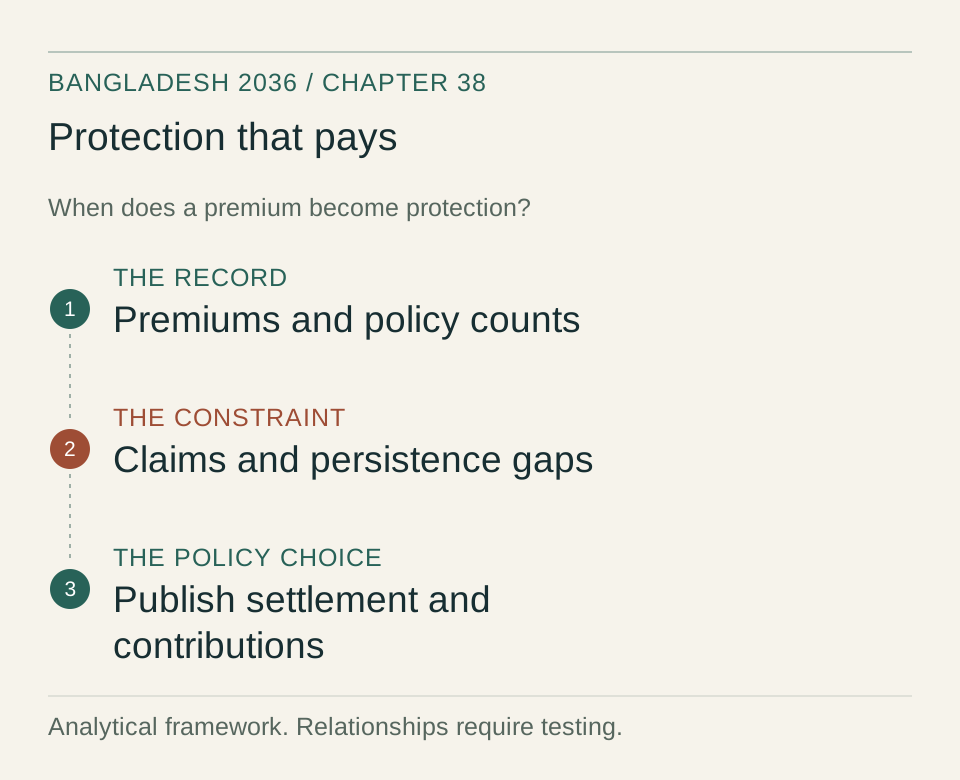
Why premiums do not guarantee protection
The life insurance industry is built to sell first-year premium, not to keep it. Of the 3,190.95 crore BDT of first-year life premium written in 2022 excluding group and health business, only 1,716.27 crore BDT, 53.79 percent, returned as renewal premium in 2023; 46.21 percent of the year's new money never paid a second premium [IDRA 2024]. The authority's report names the cause: agents chasing first-year commission targets, weak after sales service and neglect of existing policyholders, with first-year commission largely consumed by acquisition cost [IDRA 2024]. The economics follow: an industry whose renewal income cannot carry its fixed costs cannot pay for actuarial capacity, product development or claims service, and the authority's own manpower response, two actuarial scholarship students sent to City University of London in 2022-23, one in 2023-24 and one full with two partial awards in 2024-25, jointly financed by the authority and the two state insurers, measures the scarcity it is correcting [IDRA 2024].
Claims behaviour completes the loop: lapses strip the pool of the persistent premiums that fund death benefits, death claims settle at 75.55 percent of value, prospective buyers observe the settlement record, and the policy count falls for a third consecutive year.
Non-life is a tariff protected, reinsurance dependent wholesale business. Compulsory motor retains 93 percent locally, but the marine and engineering risks that carry trade and construction are ceded abroad, leaving the 45 private insurers with 54.27 percent overall retention, while the state corporation's window takes accepted reinsurance out of the country again [IDRA 2024]. Settlement at 35.54 percent of claimed value has two reinforcing sources: policyholder side, documentation and dispute practices that inflate or obscure claims, and insurer side, premium rates the authority acknowledges required its own tariff review, with collectible premium insufficient to pay honest claims in the branches that underprice.
The macro consequence is that a non-life industry growing at 0.85 percent tracks the formal fixed capital stock rather than the economy's risk; the building, deposit and passenger lines the authority lists as unlaunched are the products that would carry the urban property and transport economy chapters 14 and 24 describe.
The pension mechanism is an informality trap with a state footprint at both ends. At the collecting end, contributions must attach to wages, and only 38.57 percent of employment is wage employment [WB WDI 2026]; a voluntary scheme competing against a 500 taka allowance that requires no contribution, and against savings certificates paying administered rates, recruits mainly where employers can be instructed, which is what the February 2024 bank employee circular did [BB AR 2024]. At the paying end, the state has pre-committed its own future revenue to pay as you go promises rather than funding them, so the fiscal machinery that should want a funded domestic bond market is itself the largest unfunded claimant on it.
The savings certificate mechanism closes the circle: an administered rate above the deposit rate pulls exactly the household balances that would otherwise fund insurers, pension funds and corporate bonds into direct lending to the state, so the long-term savings system's largest competitor is its own sovereign, and the rate decision that chapter 05 identifies, whether certificates follow the market down as inflation eases, is also this chapter's central price.
Decisions on pensions and insurance delivery
The denominator moves regardless of policy. The old age dependency ratio stood at 10.15 dependants per 100 working age persons in 2025 and chapter 36's arithmetic puts each additional point at about 1.14 million dependants; chapter 15's baseline scenario assumes the ratio reaches 12.6 by 2036 with social insurance coverage still under 2 percent, while its reform scenario assumes the pension scheme and formalisation push coverage into double digits [WB WDI 2026] [WB ASPIRE 2022]. Fertility falling to 1.92 births per woman by 2036, projected on the UN WPP 2024 medium variant [UN WPP 2024], closes the window chapter 36 dates while the elderly stock, 11.28 million in 2024 [WB WDI 2026], compounds at the growth rate chapter 08 records. The pension decisions therefore cannot wait past the window, a conclusion chapters 36 and 34 reach from the allowance side and this chapter reaches from the contribution side.
Four decisions carry the decade, with the responsible institutions identified. The pension accumulation decision belongs to the Finance Division and its pension authority: whether the universal pension scheme publishes its enrolment and contribution accounts, extends the payroll entry mechanism from bank employees to the garment and formal services payrolls, and licenses employer group vehicles, the group defined contribution product the authority approved for insurers in November 2023 is the instrument [IDRA 2024] [BB AR 2024]. The insurance conduct decision belongs to the authority reconstituted under a new chairman from September 2024 and new members from December 2024: whether enforcement and disclosure turn the claims settlement ratios into a published, company by company discipline that households can shop on, and whether the bancassurance channel opened by the 2023 guidelines, eight bank agreements approved by the time of the report, moves from pilot to volume [IDRA 2024].
The rate decision belongs to the Finance Division with Bangladesh Bank: whether savings certificate rates follow the market after the lending cap's removal, the decision chapter 05 frames, which determines whether the certificate book keeps setting a floor under every other long-term yield in the economy. The capital decision belongs jointly to the authority, the securities commission and the central bank: whether the 40,459.46 crore BDT of technical reserves [IMF FAS 2024] and the future pension pool are allowed into the corporate bond and infrastructure paper that chapter 07's second decision would create, replacing the current allocation in which the life industry holds 58.70 percent of its investments in government securities [IDRA 2024].
Chapter 07's reform scenario assumes funded pools exist at scale by the early 2030s; this chapter adds the test of whether they are invested in anything but the sovereign.
The distribution rail for all four decisions already exists. Chapter 07 counts 88.89 million active mobile money accounts and 822,726 agent outlets [IMF FAS 2024]; the authority's regulatory sandbox had approved seven insurtech start ups by 2024 [IDRA 2024]. Micro insurance sold over the rails at a taka a day, credit life attached to the microfinance book chapter 07 and chapter 39 carry, and crop cover attached to the digital agriculture record, are products that require no agent army, only settlement credibility. The insurance industry's own agent count, 539,896 life agents [IDRA 2024], is a second rail that formalisation would reprice rather than replace.
How to test the argument. The insurance regulator should publish claim cohorts, settlement delays and reasons for rejection, while the pension authority reports sustained contributions. If distribution expands without better persistence or settlement, more sales channels cannot be treated as evidence that household protection improved.
Risks and opportunities
Risks. First, the persistent policy lapses locks in: if second-year persistency stays near its 53.79 percent reading while nominal premium grows below inflation, the life industry shrinks in real terms and in coverage, and monitor the in-force policy count, 7,374,276 at end 2023 and falling [IDRA 2024]. Second, the claims trust floor breaks: non-life settlement fell from 43.29 to 35.54 percent of value between 2022 and 2023 [IDRA 2024], and a further slide, or a high profile insolvency, would confirm to households that insurance is a transfer to the seller, taking bancassurance and insurtech distribution down with it; monitor the annual settlement ratio and the authority's company level disclosure.
Third, the pension shell stays a shell: if enrolment counts remain unpublished past FY27, the checkpoint this chapter targets for the first public accounts, the assumption that the scheme is recruiting cannot be distinguished from the assumption that it is empty, and the allowance book of chapter 34 becomes the only old age pillar as the ratio passes 13 in the late 2030s on chapter 36's arithmetic; monitor the first published contribution stock, and its absence.
Upside. First, formalisation converts payroll into coverage without a single new product: a job under contract can support pension contributions and insurance, provided enrolment, affordability and enforcement are in place, which is why the wage employment share, 38.57 percent in 2024 [WB WDI 2026], is this chapter's most valuable single series. Second, the funded pool becomes the domestic bid: pension assets plus technical reserves compounding at even the current 7.21 percent investment yield [IDRA 2024] would give the corporate bond market chapter 07 wants its anchor buyer, and give infrastructure, the 230,000 crore BDT NEC-approved FY26 development programme chapter 04 documents, a domestic long-term creditor instead of bank loans and foreign aid.
Third, the settlement dividend: published, enforced claim settlement discipline is the cheapest trust technology the sector has, because the 35.54 percent non-life ratio [IDRA 2024] can move toward 70 percent on processing reform alone, and every point of it raises the product's value to the 88.89 million active account holders the rails already serve [IMF FAS 2024].
Insurance and pension indicators to follow
The benchmarks below are author-proposed monitoring points, not validated causal cutoffs or official forecasts.
- Insurance penetration. Current value 0.41 percent of GDP in calendar 2023 [IDRA 2024]. Proposed benchmark: a rise above 0.6 percent by 2030, the horizon this chapter targets, would indicate the distribution and formalisation channels working; a fall below 0.35 percent may indicate the industry fading into a treasury captive.
- Life policies in force. Current value 7,374,276 at end 2023, down 328,157 on the year calculated from the cited figures [IDRA 2024]. Proposed benchmark: a recovery above 8 million would indicate the persistency and claims regime turned; a third consecutive annual fall may indicate the persistent policy lapses.
- Life and non-life claim settlement by value. Current values 72.43 percent life and 35.54 percent non-life in 2023 [IDRA 2024]. Proposed benchmark: life above 85 percent with company level publication may indicate the trust rebuild; non-life below 30 percent may indicate the distrust regime that would poison the bancassurance channel at birth.
- Universal pension enrolment and contribution stock. Current value not established; no series in the source archive, the Finance Division's pension authority the resolving source. Proposed benchmark: a published enrolment above one million with a contribution stock reported in the Finance Division accounts is the funded pool's birth certificate; continued absence of any published figure past FY27, the checkpoint this chapter targets, is the shell regime confirmed.
- Life industry investment in government securities. Current value 58.70 percent of life investment, 22,958.68 crore BDT, in 2023 [IDRA 2024]. Proposed benchmark: a sustained fall below 45 percent with rising debenture and infrastructure holdings would indicate the long-term capital regime chapter 07's reform scenario assumes; a rise above 65 percent may indicate the industry as a captive buyer of the deficit.
Sources
[IDRA 2024] Insurance Development and Regulatory Authority, Annual Report 2023-24 via ocr_text/idra_deep: gross premium, penetration and density tables with GDP as printed from BBS, policy and claims tables, investment composition, agent and branch counts, bancassurance and insurtech approvals, actuarial scholarships, commission tenures, and the Swiss Re sigma comparison table the report reprints.
[IMF FAS 2024] IMF Financial Access Survey via bdpolicy.db lake, series: imf_fas_policy_holders_insurance_corporations_number, imf_fas_policies_insurance_corporations_number, imf_fas_technical_reserves_insurance_corporations_liabilities_domestic_currency, imf_fas_technical_reserves_nonlife_insurance_nonlife_insurance_corporations_liabilities_domestic_currency, imf_fas_mobile_money_active_accounts, imf_fas_mobile_money_agent_outlets.
[BB AR 2024] Bangladesh Bank Annual Report 2023-24 via ocr_text/bb/annual_report, BRPD instruction of 8 February 2024 bringing bank employees under the universal pension scheme.
[WB ASPIRE 2022] World Bank Atlas of Social Protection Indicators of Resilience and Equity, Bangladesh 2022 wave via bdpolicy.db parquets, series: per_si_allsi.cov_pop_tot, per_si_allsi.cov_q1_tot.
[DSS 2022] Department of Social Services annual report FY2021-22 via ocr_text/mosw, old age allowance beneficiaries and budget, carried in full by chapter 34.
[WB WDI 2026] World Bank World Development Indicators snapshot via bdpolicy.db, series: SL.EMP.WORK.ZS, SP.POP.DPND.OL, SP.POP.65UP.TO.
[ILO 2025] ILO modelled estimates via bdpolicy.db, series: ilo_emp_nifl_sex_age_rt_a.
[BBS NA 2024] Bangladesh Bureau of Statistics national accounts via bdpolicy.db, series: bbs_national_savings_gdp_ratio_pct.
[BSEC 2024] Bangladesh Securities and Exchange Commission Annual Report 2023-24 via ocr_text/bsec, mutual fund assets, per chapter 07.
[UN WPP 2024] UN World Population Prospects 2024 medium variant, fertility projection, per chapters 15 and 36.