Chapter 36 of 60 in the Bangladesh 2036 research base. Contents of the series.
Jobs now, support in later life
Bangladesh faces two linked tasks: helping young people enter decent work and preparing support for a growing older population. Demography shapes the scale of both, but neither pension coverage nor employment follows automatically from the age structure. A useful timetable needs age-specific projections, comparable labour statistics and explicit financing choices.
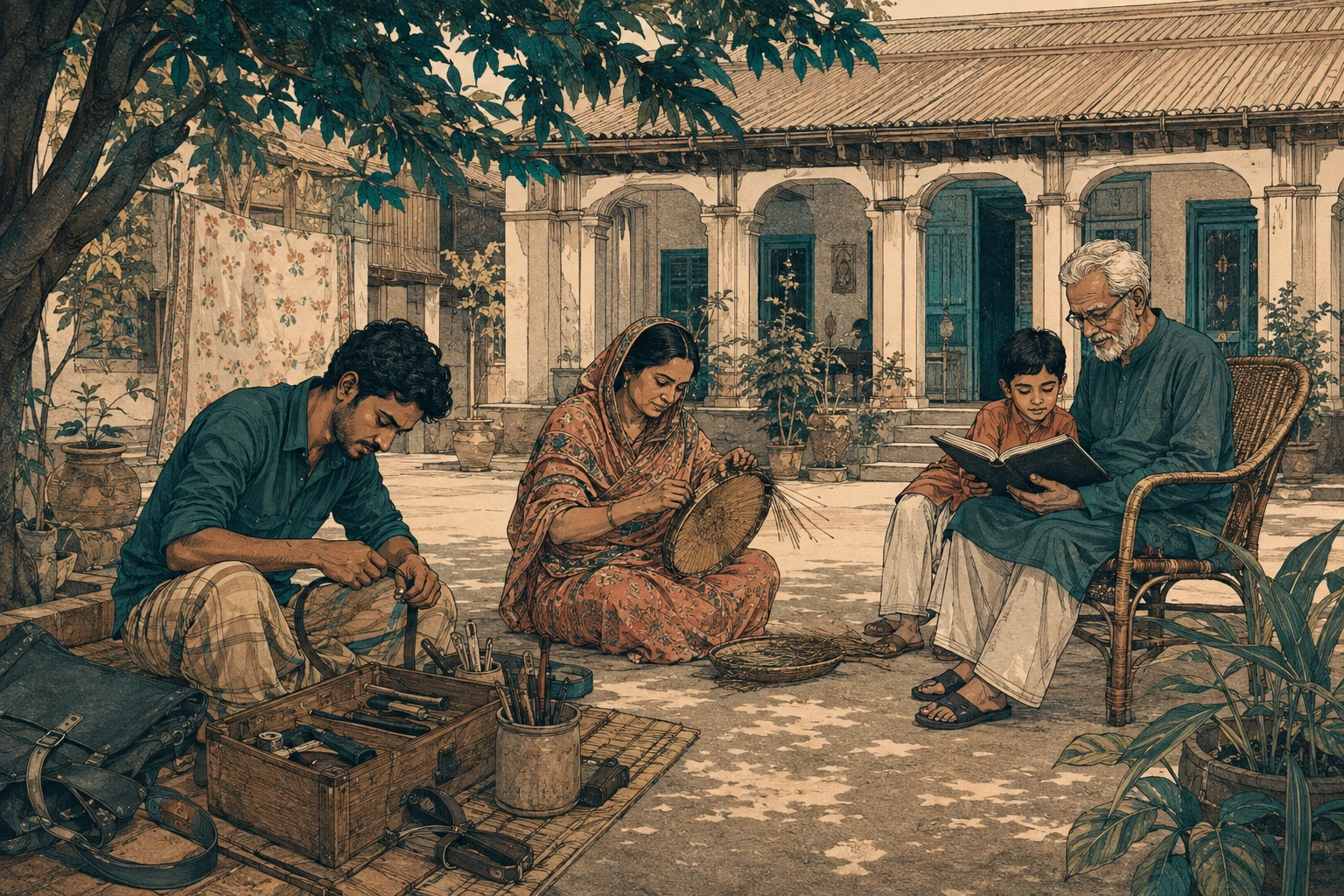
Youth employment and population ageing
The youth record is a first job market that never opened and is now closing. Employment of persons aged 15 to 24 stood at 10.54 million in 2016, rose to 13.70 million in 2022 and 13.84 million in 2023, then fell to 12.29 million in 2024 [ILO 2025]; that is 1.41 million youth jobs lost across the political transition and flood year, more than the total net employment fall of 1.39 million chapter 08 measures over the same two years [ILO 2025], from a cohort that is one fifth of the population.
The census age table puts the 15 to 24 population at 32.73 million persons, 19.28 percent of the total, on this chapter's sum of the post enumeration check adjusted bands [BBS Census 2022, PEC adjusted Table 5, derived sums]. The unemployment queue is the male half of the story: youth unemployment was 9.63 percent in 2024, 14.13 percent for young men against 5.02 percent for young women [ILO 2025]. Young women do not queue, they exit, the mechanism chapter 08 and chapter 35 trace, and the exit is visible in the not in employment, education or training share.
The NEET record is a decade of improvement giving way. The total youth NEET share fell from 30.99 percent of the youth population in 2005 to 14.96 percent in 2022 and 14.34 percent in 2023, then rose to 15.43 percent in 2024 and 15.60 percent in 2025 [WB WDI 2026]. The female share carried the whole history: 55.51 percent in 2005, 19.04 percent at the 2022 trough, 20.10 percent in 2025, against a male share of 10.95 percent in 2025 [WB WDI 2026]. Female youth idleness is back above the 20 percent line chapter 08 flags as the regime boundary.
The census instrument reads the same problem at a higher level: the unweighted mean of the 64 district youth NEET rates is 35.44 percent, well above the survey reading, the definitional gap chapter 08 documents; the pattern is nationwide, not a single-district artefact, with 62 of 64 districts above 30 percent, Dhaka lowest at 25.44 percent and Lakshmipur highest at 42.16 percent [BBS Census 2022, census district youth NEET table]. Even the best district reading for young women is severe: NEET among women aged 20 to 24 was 47.23 percent in Gazipur, the lowest district reading in the table, and 80.87 percent in Lakshmipur, the highest [BBS Census 2022, census district youth NEET table].
The first job wait itself, the months between leaving education and the first work, is not measured in any series available to this chapter, the BBS quarterly labour force bulletins being the resolving source, so the wait is not established and rides on the NEET and youth employment readings. What the jobs are like when they arrive is measured: 95.0 percent of employed youth were informal in 2024 [ILO 2025].
The window record is a working age share still rising, with the turn not yet dated. The working age population aged 15 to 64 grew from 93.97 million persons in 2010 to 113.71 million in 2024 [WB WDI 2026], adding 19.74 million people, with annual growth slowing from 1.63 percent across 2010 to 2015 to 1.23 percent across 2019 to 2024 calculated from the cited figures on the series. The working age share reached 65.51 percent of the population in 2024 and 65.69 percent in 2025, still rising [WB WDI 2026]; the date of its peak cannot be computed from the tables available to this chapter because the UN age detail of the projections is not stored here, so the peak date is not established; the same gap chapter 08 carries.
The dependency ratios frame the window's remaining length. The total ratio fell from 61.97 dependants per 100 working age persons in 2010 to 52.24 in 2025 [WB WDI 2026]; the young ratio did almost all the falling, 55.15 to 42.09 [WB WDI 2026]; the old ratio did all the rising, 6.82 to 10.15 [WB WDI 2026]. The census counts the elderly base directly: 10.05 million persons aged 65 and over in 2022, 5.92 percent of the population, on this chapter's sums of the adjusted census age bands [BBS Census 2022, PEC adjusted Table 5, derived sums], and the World Bank series puts the 2024 stock at 11.28 million, up from 6.41 million in 2010, growth of 4.12 percent a year calculated from the cited figures [WB WDI 2026].
Of those elderly, 2.90 million were still counted as employed in 2024 [ILO 2025], work as pension substitute, the single clearest sign the support system does not reach its beneficiaries.
The ageing support record is the weakest pillar of the welfare state chapter 34 audits. The old age allowance, the universal tier for the poor, carried 57.01 lakh beneficiaries and a budget of 3,444.54 crore BDT in FY2021-22, at 500 taka a month [DSS 2022], an amount whose purchasing power the inflation record chapter 05 and chapter 34 document has since eroded by a quarter. Contributory coverage, the pillar that could actually fund ageing, was 1.19 percent of the population in 2022 and 0.21 percent in the poorest quintile [WB ASPIRE 2022], and the adequacy of what the state does pay out was 1.62 percent of beneficiary household welfare [WB ASPIRE 2022].
The universal pension scheme's registration and contribution series are not available to this chapter, uptake could not be confirmed, with the Finance Division the resolving source, and chapter 38 carries the scheme; chapter 34 carries the allowance book. This chapter carries the arithmetic those accounts imply: at a 10.15 old age ratio and 113.71 million working age persons, each additional point of the ratio is about 1.14 million additional dependants, this chapter's product of the two figures.
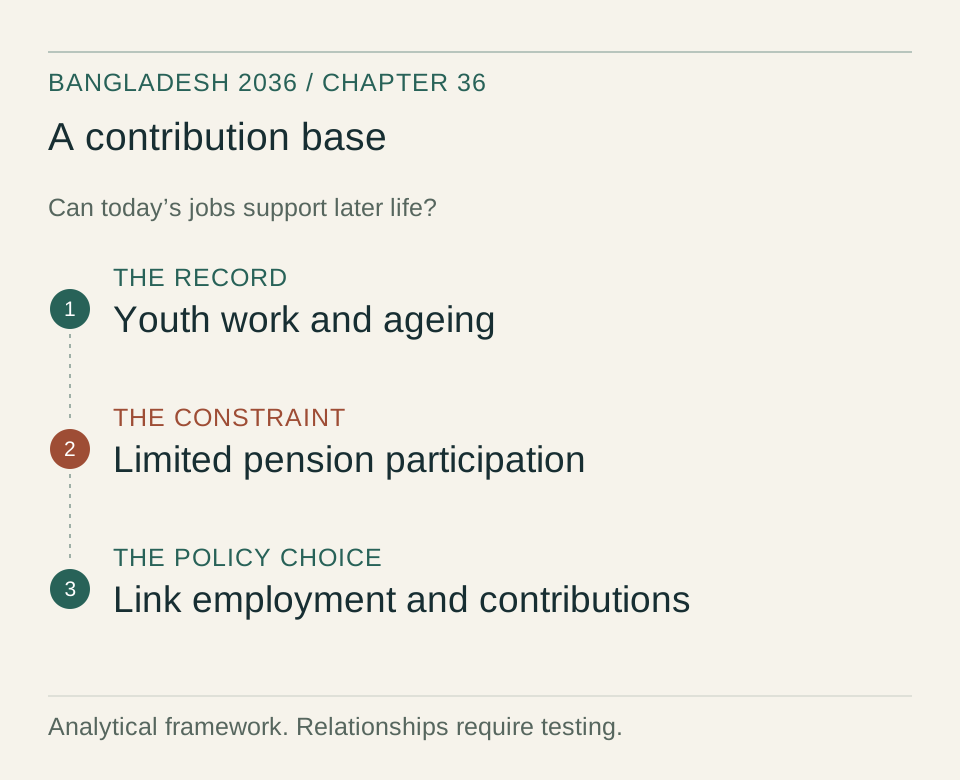
From school to work, and work to retirement
The school to work transition clears through exit, not queueing. The NEET fall of 2005 to 2022 rode the education expansion chapter 09 documents, the garment hiring wave chapter 08 describes and better measurement; the 2024 reversal rode the factory disruption and floods that chapter 08 dates. When hiring stumbles, young women leave the measured labour force and young men stay in the queue, which is why the 2024 queue is 9.1 points wide between young men and young women [ILO 2025]. The clearing house for everyone who does not queue and does not emigrate is informality, at 95.0 percent of employed youth [ILO 2025], which is why a 9.63 percent youth unemployment rate can coexist with a census district-mean idleness reading of 35.44 percent [BBS Census 2022, census district youth NEET table]: unemployment, NEET status and informal employment describe different groups.
Informally employed young people are employed and therefore are not NEET.
The migration valve prices the youth surplus daily. Recorded departures peaked at 1,305,453 workers in calendar 2023 [BMET 2023], fell to 1,015,675 in FY25 [BB Econ 2025, Table XVIII], and the flow is a youth market: half the 2023 flow was less skilled [BMET 2023], the skill band that recruits directly out of the school to work transition. The stock of 7.40 million Bangladeshis abroad at the last UN tabulation [UN DESA 2020] against a net migration rate of minus 2.73 per 1,000 population in 2024 [UN WPP 2024, estimates] makes external labour the country's largest youth employment programme, and its yield, 30.33 billion USD of remittances in FY2024-25 [BB Econ 2025, Table XVIII], is the largest transfer the households of the idle youth receive.
Chapter 21 owns the corridors and the formalisation step; the point for this chapter is narrower: every year the domestic first job market does not open, the emigration decision is made for another cohort, and the FY25 fall of 15.2 percent in departures [BB Econ 2025, Table XVIII] shows the valve tightening on its own.
Ageing is arriving through mortality decline, not cohort size. Life expectancy at 65 was 13.89 years in 2010 and 17.20 years in the 2024 estimates, and the UN WPP 2024 medium variant projects 18.49 years by 2036 and 20.10 years by 2050 [UN WPP 2024, estimates and medium variant]. The people turning 65 in the 2030s were born in the late 1960s and 1970s, not unusually large cohorts; what grows the elderly stock is that they survive, 4.12 percent a year on the 2010 to 2024 record [WB WDI 2026].
Fertility is the other half: 2.38 births per woman in 2010, 2.14 in 2024 [WB WDI 2026], and the UN WPP 2024 medium variant projects 2.09 in 2026, 1.92 by 2036 and 1.81 by 2050 [UN WPP 2024, medium variant]. The births series converts fertility into the youth arithmetic: 3,469 thousand births in 2024 against 2,976 thousand projected for 2036 on the medium variant, birth cohorts about 14 percent smaller; the 2024 cohort reaches age 15 in 2039 and the 2036 cohort in 2051 [UN WPP 2024, medium variant]. The window closes from both directions at once, fewer entrants and longer lived elders.
The support system prices ageing in allowances, and allowances do not compound. A 500 taka monthly transfer [DSS 2022] is a flow that starts and stops with the budget line, has no contribution history, no survivor protection and no relation to wages, and it is financed from the same revenue base chapter 04 measures at the bottom of the world tables. A contributory pension is a claim on the payroll, and the payroll is the 38.57 percent wage employment share [WB WDI 2026] inside an 84.0 percent informal workforce [ILO 2025].
The mechanism that decides how ageing feels in the 2036 economy the scenarios describe is therefore the formalisation mechanism chapter 08 lists, not the welfare mechanism chapter 34 audits: if hiring moves onto contracts, contribution coverage still depends on pension rules, enrolment and enforcement; if it does not, the allowance book becomes the only pillar, and its arithmetic at an old age ratio heading past 12 is a fiscal event chapter 04 must absorb.
Demographic assumptions and policy choices
The projections that bind are the UN's. The UN WPP 2024 medium variant projects a population of 177.82 million in 2026, 186.07 million in 2030 and 196.74 million in 2036, with growth easing from 1.19 to 0.80 percent a year across that window, and projects readings of 214.71 million people, a median age of 35.55 years and 0.49 percent annual growth by 2050 [UN WPP 2024, medium variant]. The median age rises from 26.30 years in 2026 to 30.02 in 2036 on the same projected path [UN WPP 2024, medium variant]. What the stored tables do not carry is the age structure of those projections, so the working age share and dependency ratios of the UN path could not be confirmed from the cited reports, and this chapter supplies its own arithmetic, stated so chapter 15 can adopt or amend it.
The arithmetic has three lines. First, the old age ratio: extending the 2010 to 2025 WDI trend of 0.22 points a year assumes a reading of about 12.6 by 2036, a crossing of 13 near 2038 and, if the linear extension were held to mid century, about 15.7 by 2050, a 2050 figure this chapter states as direction only, because the linear extension is conservative when life expectancy at 65 is itself projected to rise by three years on the UN WPP 2024 medium variant [UN WPP 2024]. Second, the total ratio: holding the 2019 to 2025 component slopes constant, the young ratio falling 0.56 points a year and the old ratio rising 0.24, calculation from the cited figures assumes the total dependency ratio passes 50 around 2032 and reads about 48.7 by 2036; beyond that the young ratio's decline must flatten as fertility settles near 1.8, and the 2050 total is not established pending the UN age projections.
Third, the support ratio: 9.9 persons of working age per person aged 65 and over in 2025 falls to about 7.9 by 2036 on the same old age arithmetic, this chapter's division of 100 by the projected ratio. These linear extensions still show total dependency falling through 2036. They cannot date its turning point or the close of a demographic window; that requires age-specific population projections.
Five decision points sit inside that decade. First, the youth transition: the NEET reversal of 2023 to 2025 is three readings, not yet a trend, but the census and survey give different readings that must be reconciled by age coverage, definitions and weighting, and the first decision is measurement, the quarterly labour force series reconciled against the census so the first job wait and the NEET stock become a monthly managed number rather than a five year surprise. Second, formalisation: chapter 08's target of 8 to 11 million net new jobs to 2036 is also a pension decision, because contracts can support contributions where pension enrolment and collection are established; monitor the wage employment share, 38.57 percent in 2024 [WB WDI 2026].
Third, the pension instrument: the universal pension scheme chapter 38 tracks must recruit where the payroll exists, and the design choice chapter 34 frames, tying enrolment to payroll registration and contract hiring, is the mechanism that makes coverage compound. Fourth, the youth outlet: whether the skill mix of the departure flow upgrades toward the skilled and professional 29.0 percent of the 2023 flow, this chapter's sum of the two categories [BMET 2023], and toward higher wage corridors is chapter 21's and chapter 32's account; for this chapter it decides whether emigration remains a poverty exit or becomes a career path.
Fifth, the female margin: the NEET reversal is a female event, and the recovery of female participation chapter 35 prices is the largest single lever on both the youth idleness stock and the contribution base. Chapter 15's scenarios carry these decisions: its baseline assumes the old age ratio reaches 12.6 by 2036 with social insurance coverage still under 2 percent, its reform scenario assumes the pension scheme and formalisation push coverage into double digits and the NEET share below 15, its stall scenario assumes the allowance book carries a 13 point old age ratio priced at 2022 taka.
How to test the argument. The Finance Division should measure paid pension contributions separately from registrations and employment status. If wage employment rises without wider sustained contributions, the assumed link from formalisation to retirement protection has failed and affordability or scheme design needs revision.
Risks and opportunities
Risks. First, a youth idleness regime: the female NEET share is already above 20 percent in 2025 [WB WDI 2026], and if the total share follows while the census district mean sits at 35.44 percent [BBS Census 2022, census district youth NEET table], the political economy that produced the 2024 transition acquires a permanent recruitment base; monitor the NEET series and the male female youth unemployment spread of 9.1 points [ILO 2025]. Second, the valve closes while the window is still open: departures of 1,015,675 in FY25 [BB Econ 2025, Table XVIII] sit 1.6 percent above the 1.0 million line, and a Gulf or Malaysia corridor shock at the scale chapter 21 documents would strip the largest youth employment programme and the remittance cushion together; monitor the monthly BMET clearances and the Bangladesh Bank remittance series.
Third, ageing without contributions: if the old age ratio crosses 13 while social insurance coverage stays near its 1.19 percent of 2022 [WB ASPIRE 2022], the state meets ageing entirely through the allowance book and the family, and the 500 taka transfer [DSS 2022] becomes the floor under an elderly stock that calculation from the cited figures projects past 15 million by the early 2030s; monitor the pension registration series and the old age ratio.
Upside. First, the formalisation dividend: a wage employment share rising from 38.57 percent toward the mid forties, chapter 08's reform assumption, creates a possible contribution base, but pension coverage requires enrolment and actual payments, and every point of it compounds for three decades against the rising ratio; monitor the wage share in the quarterly labour force series. Second, the migration quality dividend: a skilled and professional share above the 29.0 percent of 2023 [BMET 2023] raises the value of every departure and diversifies the corridors, converting the youth outlet from a pressure valve into a skills system chapter 32 can build on; monitor the BMET skill table against the destination table.
Third, the concentration dividend: fertility falling to 1.92 births per woman by 2036, projected on the UN WPP 2024 medium variant [UN WPP 2024], concentrates household and public investment per child, the mechanism chapter 09 prices, and smaller entry cohorts after the late 2030s make the first job market easier to clear just as the pressure eases; monitor the births series and the learning outcomes chapter 09 tracks.
Jobs and ageing indicators to follow
The benchmarks below are author-proposed monitoring points, not validated causal cutoffs or official forecasts.
- Youth NEET share, ages 15 to 24. Current value 15.60 percent in 2025 on the survey definition, with the female share at 20.10 percent and the census district mean at 35.44 percent on its own definition [WB WDI 2026] [BBS Census 2022, census district youth NEET table]. Proposed benchmark: a sustained total reading above 20 percent may indicate the idleness regime; a reconciled quarterly series holding below 15 percent clears it.
- Youth employment, ages 15 to 24. Current value 12.29 million persons in 2024, down from the 13.84 million reading of 2023 and the 13.70 million of 2022 [ILO 2025]. Proposed benchmark: a fall below 12 million while entry cohorts run near 3.5 million a year may indicate a youthless recovery; recovery above the 2022 peak would indicate reabsorption has begun.
- Old age dependency ratio. Current value 10.15 dependants per 100 working age persons in 2025 [WB WDI 2026]. Proposed benchmark: crossing 13, which this chapter's linear arithmetic assumes near 2038, makes contributory pension coverage a first order employment policy; each point of the ratio adds about 1.14 million dependants on the 2024 working age base.
- Total dependency ratio. Current value 52.24 in 2025, still falling [WB WDI 2026]. Proposed benchmark: the illustrative slope calculation passes downward through 50 around 2032. It does not identify a later turn upward; age-specific projections are needed to date that change.
- Overseas departures. Current value 1,015,675 workers in FY25, down 15.2 percent from the FY24 peak [BB Econ 2025, Table XVIII], on a calendar series that peaked at 1,305,453 in 2023 [BMET 2023]. Proposed benchmark: a flow below 1.0 million closes the youth valve; a new peak above 1.4 million with the skilled share above 30 percent may indicate the quality upgrade regime chapter 21 assumes.
Sources
[WB WDI 2026] World Bank World Development Indicators, series: SL.UEM.NEET.ME.ZS, SL.UEM.NEET.FE.ME.ZS, SL.UEM.NEET.MA.ME.ZS, SP.POP.1564.TO, SP.POP.1564.TO.ZS, SP.POP.DPND, SP.POP.DPND.YG, SP.POP.DPND.OL, SP.POP.65UP.TO, SP.DYN.TFRT.IN, SL.EMP.WORK.ZS; the 2025 vintage of the five SP.POP series verified against the live World Bank API (data.worldbank.org), the local indicators/wb_full_bd parquet holding these series only through 2024.
[ILO 2025] ILOSTAT modelled estimates for Bangladesh via the bdpolicy lake, series: ilo_emp_temp_sex_age_nb_a for youth and elderly employment, ilo_une_deap_sex_age_rt_a for youth unemployment by sex, ilo_emp_nifl_sex_age_rt_a for youth informality and workforce informality.
[UN WPP 2024] UN World Population Prospects 2024 via the demography/un_wpp2024_bd parquet, Estimates and Medium variant sheets: population, median age, fertility, births, life expectancy at 65, net migration rate.
[BBS Census 2022] Bangladesh Bureau of Statistics, Population and Housing Census 2022: post enumeration check adjusted population by age group (Table 5), the 15 to 24 years NEET district table, and the district growth and dependency ratio table, via the census2022_thematic OCR text and the bbs_census dataset.
[DSS 2022] Department of Social Services annual report 2021-22 via ocr_text/mosw: old age allowance beneficiary count, allocation and monthly benefit rate.
[WB ASPIRE 2022] World Bank Atlas of Social Protection Indicators via the social_protection/wb_aspire_bd_full parquet, series: per_si_allsi.cov_pop_tot, per_si_allsi.cov_q1_tot, per_sa_allsa.adq_pop_tot.
[BMET 2023] Bureau of Manpower, Employment and Training overseas employment tables via the bdpolicy lake, series: bmet_overseas_employment_total, bmet_overseas_employment_skilled, bmet_overseas_employment_less_skilled.
[BB Econ 2025] Bangladesh Bank Monthly Economic Trends (October 2025 issue), Table XVIII, number of persons left for abroad on employment and total workers' remittances by fiscal year, sourced by the bank from BMET and the Statistics Department, via the bb/remittances lake (economic_trends_october_2025.pdf).
[UN DESA 2020] UN DESA International Migrant Stock 2020 tabulation, Bangladesh origin stock, via the bdpolicy lake.