Renewable growth needs projects that can operate
Renewables supplied 2.14 percent of Bangladesh's electricity generation in 2025 [Ember 2025]. Solar output rose to 1.56 terawatt hours, but coal generation also expanded to 22.24 terawatt hours [Ember 2025]. Renewable additions have therefore not yet reversed the wider shift toward imported fossil fuels. Land access, grid connections, finance and enforceable purchasing arrangements will determine whether the new policy framework delivers operating projects.
Generation and the new policy framework
The generation record is the measured base. Solar generated 1.56 terawatt hour in 2025, up from 0.46 in 2020, 0.87 in 2022 and 1.07 in 2023 [Ember 2025], the only renewable line with growth; wind is zero in the available evidence, 0.00 terawatt hour in 2025 after 0.01 in 2019 to 2021 [Ember 2025], and Ember's capacity record carries no wind at all through 2024, 0.00 gigawatt [Ember 2025], despite the wind farms commissioned at Cox's Bazar and Patuakhali whose individual capacities and outputs could not be confirmed here; the SREDA and Power Division plant registers would resolve them.
Hydro from Kaptai contributed 0.65 terawatt hour in 2025 [Ember 2025], below the 1.28 terawatt hour of 2005 and the 0.59 of 2015, a silted and seasonal estate, not a growth asset. Against the growth line sits the counter-movement: coal generation of 22.24 terawatt hour in 2025, from 10.69 in 2023 and 3.15 in 2020, on a coal fleet whose capacity grew from 0.52 gigawatt in 2019 to 6.04 gigawatt in 2024 [Ember 2025], burning 4.55 million tonne of coal in 2023 against 1.24 million tonne in 2020 [BPDB 2023]. Gas held 66.48 of the 103.40 terawatt hour generated in 2025 [Ember 2025], and net imports covered 14.66 terawatt hour of the 118.06 terawatt hour of demand [Ember 2025], the dependency chapters 25 and 26 discuss.
The share line is the summary statistic. Renewables supplied 2.14 percent of generation in 2025 [Ember 2025], the highest reading since 2011, when the share was 2.22 percent, after bottoming at 1.26 percent in 2009 and sitting at 1.46 percent in 2020 and 1.89 percent in 2024 [Ember 2025]. The share is low because the denominator grew: demand rose 5.1 percent a year between 2020 and 2025, from 92.13 to 118.06 terawatt hour [Ember 2025], and the system met the growth with coal and imported electricity rather than renewables. Solar capacity reached 0.85 gigawatt at end 2024, from 0.34 gigawatt in 2020, 0.52 in 2022 and 0.75 in 2023, within a renewable fleet of 1.13 gigawatt that includes Kaptai's 0.23 gigawatt [Ember 2025].
On chapter arithmetic the 2025 solar output of 1.56 terawatt hour against the 0.85 gigawatt fleet implies a capacity factor near 21 percent, consistent with dense monsoon cloud and rooftop scale, and it means the same fleet doubling requires either more panels on the grid or better hours from the ones installed.
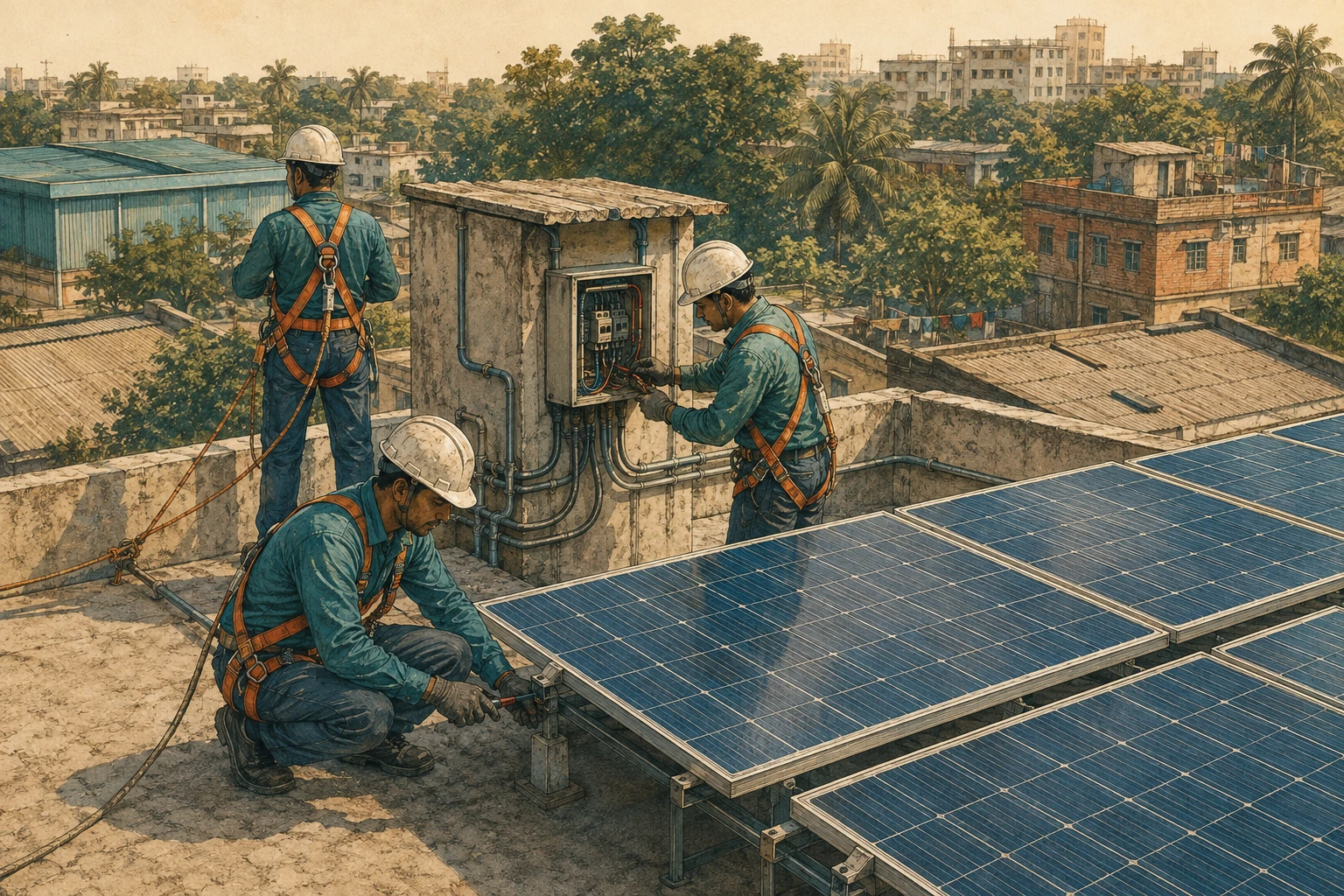
The distributed layer is the quietest and fastest line. The rural electrification board's solar portfolio reached 80.22 megawatt in FY23, from 30.77 in FY21 and 42.87 in FY22 [BPDB 2023], and the census found 2.82 percent of households relying on solar as their electricity source in 2022 [BBS Census 2022], the off-grid legacy of a home system programme whose scale SREDA recorded at about 4.1 million systems, benefiting more than one crore (over 10 million) people in remote areas, under IDCOL in its 2016-17 annual report [SREDA 2017]. The grid-connected rooftop segment that net metering administers is the line the export buyers price directly, and its installed base could not be confirmed from the cited sources; the SREDA and BERC registration data would resolve it.
The wider energy account brackets the power story: renewable energy still supplied 25.0 percent of total final energy consumption in 2021 [WB WDI 2026], but that line is dominated by traditional biomass, the cooking fuel share that is falling, while access to clean cooking stood at 28.4 percent in 2023 [WB WDI 2026], so the modern renewable transition and the cooking transition are two different gaps measured in one household.
The policy architecture was rebuilt in the decade's first year. The Renewable Energy Policy 2008 had set a 10 percent renewable share of generation by 2020, a target SREDA's 2016-17 annual report restated when the country's renewable capacity stood at about 446 megawatt, with about 316 megawatt under implementation and about 528 megawatt planned [SREDA 2017]; the actual 2020 outcome was 1.46 percent [Ember 2025]. The Renewable Energy Policy 2025 repeals the 2008 text and sets the power sector target at 20 percent of power demand up to 2030 and 30 percent up to 2040, directs SREDA to publish a time-bound implementation roadmap, and instructs that a Renewable Purchase Obligation and Renewable Energy Certificates be introduced at generation, distribution and consumer levels [RE Policy 2025].
The older integrated plan chapter 10 cites as stale carried renewables at up to 40 percent of generation by 2041 [Power Division 2023], and the Mujib Climate Prosperity Plan carries its own renewable and mitigation targets whose current numeric versions could not be confirmed from the cited sources; the Environment Ministry documents would resolve them. The carbon market question the chapter examines is now answered in the policy text itself: a carbon trading platform will be considered, SREDA will keep the inventory of projects that trade, carbon revenue may be income tax exempt, and participation runs through Power Division approval [RE Policy 2025]; the actual Article 6 authorisation and registry infrastructure could not be confirmed beyond that framework; the UNFCCC focal point documents would resolve it.
The economics are the chapter's lever. Solar's global price collapse meets Bangladesh's land constraint and grid absorption limit at a domestic cost the available evidence does not publish; utility-scale tariff awards could not be confirmed here; the BERC procurement records would resolve them. What is measurable is the counterfactual's price. The 22.24 terawatt hour of coal generation burns imported coal [Ember 2025], the LNG exposure is chapter 26's import bill, and both are dollar indexed on a balance of payments the taka's slide repriced: USD/BDT moved from 85.8 at end December 2021 to 122.9 by May 2025 [BIS 2026]. Every solar megawatt hour is domestic currency energy; every coal and LNG megawatt hour is an import invoice, and the exchange rate path converts that accounting identity into the fiscal arithmetic chapters 04 and 25 carry.
Land, grid connections and finance
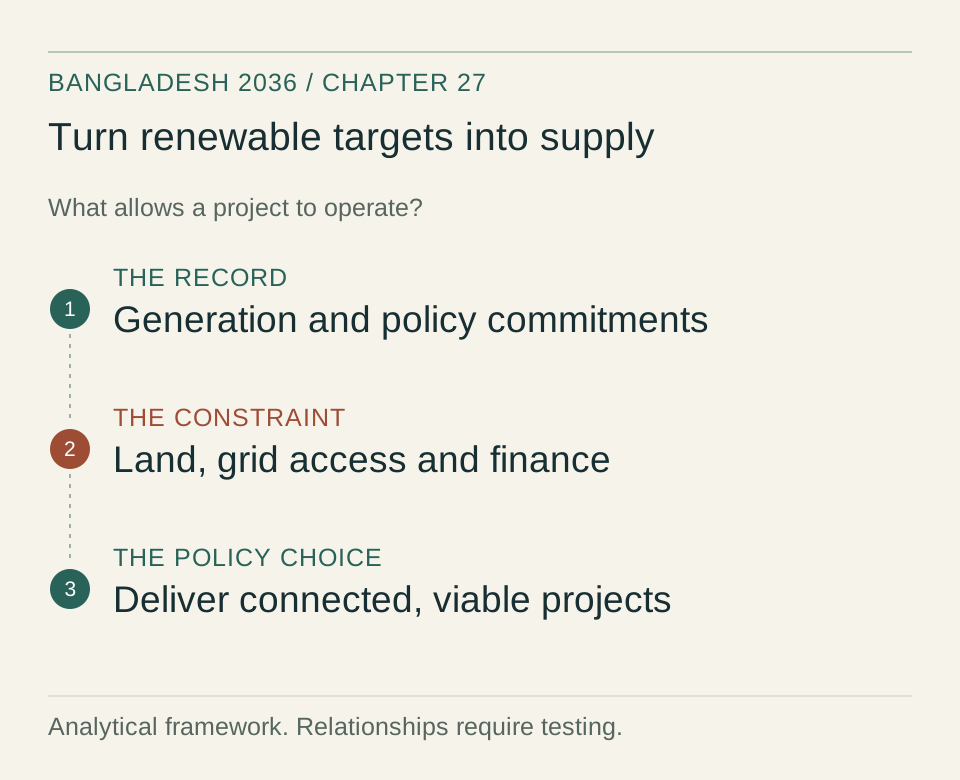
The mechanism that kept renewables near 2 percent while the world scaled is a triple lock. The first lock is land: utility solar needs contiguous land near transmission, farmland is protected by the cropping arithmetic chapter 14 measures, and the alternatives the 2025 policy now names, agri-voltaics, floating solar and dual use water surfaces [RE Policy 2025], await the permitting clarity that is not established here. The second lock is the grid: the transmission system chapter 10 describes was built for large central plants, and absorbing variable output requires the forecasting, scheduling and deviation settlement codes the policy directs developers to comply with and BERC to determine [RE Policy 2025]; the system operator's day-ahead practice for renewables could not be confirmed from the cited sources; the Power Grid Company and BERC documents would resolve it.
The policy grants renewable plants priority dispatch, "must run except in unavoidable situation" [RE Policy 2025], which addresses the merit order symptom, not the causes. The third lock is the mandate-price mismatch: renewables compete against gas at administered prices and coal at contracted terms, chapters 25 and 26's pricing, so the merit order never selects solar until fossil prices are honest, and the pricing reform chapter 26 frames as the fuel security measure is the same measure the transition requires.
The rooftop mechanism runs through the buyers, not the state. The decarbonisation demands chapter 17 documents are a foreign enforcement mechanism with a commercial price: factories with rooftop solar and certificate cover keep the premium orders, and the national emissions record gives the buyers their arithmetic, fossil carbon dioxide rising from 95.45 million tonne in 2020 to 113.43 million tonne in 2023, the last year in the available series [GCP 2024, co2] while the grid's renewable share sat near 2 percent [Ember 2025]. The 2025 policy gives the demand a domestic instrument: the Renewable Energy Certificate is defined as a tradable certificate representing the environmental attributes of one megawatt hour, the Renewable Purchase Obligation binds utilities and selected consumers to a renewable share of purchases, and peer-to-peer trading of rooftop output is promoted [RE Policy 2025].
The rooftop economics improve with every gas price step chapter 26 delivers, because captive gas is the rooftop array's competing supply, and the factory roofs chapter 17's cluster geography implies are the land bank the utility-scale lock cannot find. The 80.22 megawatt on the rural electrification board's books [BPDB 2023] and the 2.82 percent household solar share [BBS Census 2022] are the distributed base the net-metering scaling would join.
The target machine is its own mechanism, and its record explains why this chapter counts commissioned output rather than announced capacity. The 2008 policy's 10 percent target for 2020 produced 1.46 percent [Ember 2025]; the SREDA 2016-17 pipeline of about 446 megawatt installed, 316 under implementation and 528 planned [SREDA 2017] sat beside a renewables share that was 1.55 percent in 2022 and 1.71 percent in 2023 [Ember 2025]. Announced capacity is not delivered capacity, and the gap between the two is the transition's actual state variable. The 2025 policy's answer is procedural: the SREDA roadmap is required to be time-bound, the obligations are to be set as regulatory mandates on named entities, and the policy is to be reviewed every three to five years [RE Policy 2025].
Whether the roadmap names annual megawatt and gigawatt hour milestones whose non-delivery is visible is the design test the document itself sets.
The finance mechanism is the missing market the policy tries to buy. The cited material does not quantify renewable investment or the financing gap. Bangladesh Bank's green refinance data and SREDA's investment records would help distinguish credit availability, foreign-exchange costs and project bankability before selecting a financing instrument. The policy's response is a tax package: full corporate income tax exemption for ten years and partial exemption for the next five, three years at 50 percent and two at 25 percent, for projects commissioned inside the window the incentive targets, 1 July 2025 to 30 June 2030, plus import duty and VAT exemptions on renewable equipment [RE Policy 2025].
A tax holiday priced against a grid whose fossil margin is administered and whose dispatch is not yet reformed is an incentive for projects that already clear, not for the ones that do not; the mechanism that moves the marginal project is the purchase obligation and the certificate market, which is why the two instruments stand or fall together.
Decisions that convert targets into supply
Four forces carry the share from 2.14 percent [Ember 2025] toward the marks in play. First, the buyer compliance clock: the export sector's decarbonisation demands scale through the decade chapter 17 discusses, and the certificate and obligation architecture of the 2025 policy is the state's answer to a demand that was otherwise going to be met by factory level imports of panels and claims. Second, the coal exit question: the 22.24 terawatt hour of 2025 [Ember 2025] meets plant age and financing horizons mid-century, and the decade decides whether the fleet runs to forty years or is repriced early, the contract question chapter 25 examines.
Third, the grid reform: wheeling, banking, forecasting settlement and the distribution of rooftop surpluses are the regulations that turn consumers into generators, and the policy's direction that BERC determine wheeling and open access charges [RE Policy 2025] puts the question on the regulator's desk with a deadline the roadmap implies. Fourth, the regional wire: cross-border renewable trade is promoted in the policy's regional cooperation section [RE Policy 2025], the divisional work plan chapter 10 cites targets 9,000 megawatt of cross border import capacity by 2041 [Power Division 2023], and Nepali hydro is the firm, seasonal renewable whose deliveries through the Indian grid would decarbonise the evening peak solar cannot reach; the volume of the first deliveries could not be confirmed from the cited sources; the Power Division import data would resolve it.
No cited projection targeting the 2036 renewable share exists in the cited sources; the named authors whose work would resolve the question are the SREDA roadmap the policy requires, the IRENA country assessments and the World Bank renewable energy reviews. The decision points sit in sequence: the roadmap's publication with annual milestones, the RPO and REC mechanism's notification, the utility-scale land and permitting package, the fossil price honesty of chapters 25 and 26, and the cross-border trade agreement. The chapter 15 reform scenario assumes the share passes 5 percent by 2030; the policy targets 20 percent of demand in the same horizon [RE Policy 2025]; the distance between those two numbers is the distance between the system's demonstrated behaviour and the statute's ambition, and the SREDA roadmap is the document that will say which one the state is governing toward.
Risks and opportunities
Risks. First, the mandate-without-market trap, the 2008 precedent repeated: targets met on paper through announcements whose capacities never commission, as the 10 percent target for 2020 became 1.46 percent [Ember 2025], and the indicator to monitor is commissioned capacity against the roadmap's milestones, the series SREDA's inventory obligation creates. Second, the coal lock-in deepening: coal generation growing with demand through the 22 terawatt hour level of 2025 [Ember 2025] would widen the buyer decarbonisation gap chapter 17 discusses until the premium orders move, and the indicators to monitor are the coal generation and burn series against chapter 26's 8 million tonne burn threshold [BPDB 2023].
Third, the fiscal fear: renewables financed through explicit subsidy inside a state that collects 7.64 percent of GDP in tax revenue [WB WDI 2026] would repeat the fossil subsidy cycle chapters 04 and 26 document, and the indicator to monitor is the budget's renewable line against the tax holiday's revenue forgone, which could not be confirmed here; the Finance Division statements would resolve it.
Upside. First, the rooftop wave: the factory roofs, the net-metering reform and the buyer premium together are a self-financing transition segment, because the alternative for the factory is imported fuel at the exchange rate, and the indicator to monitor is the net-metered capacity, not established here, that SREDA and BERC registration would publish. Second, the floating and dual-use option: the delta's water surfaces and the agri-voltaic designs the policy names [RE Policy 2025] are the land answer that avoids the farmland conflict chapter 14 measures, and the indicator to monitor is the permitting framework's publication and the first floating megawatt commissioned.
Third, the regional import leverage: Nepali hydro is firm against the evening peak, the wire infrastructure is chapter 25's import record already carrying 10,425 million kilowatt hour in FY23 [BPDB 2023], and the indicator to monitor is the cross-border renewable contract the two governments sign.
Testing the policy case
SREDA, the Power Division and the system operator should report commissioned output, curtailment and connection delays. More announced capacity without generation would identify a delivery problem. Renewable growth without lower fossil exposure would require examination of demand growth, dispatch and the wider generation mix.
What to watch
The thresholds below are author-proposed monitoring markers, not official targets or estimated policy effects. Interpret them alongside the source dates and definitions.
- Renewables share of generation. Latest cited value 2.14 percent in 2025, the highest since 2011 (2.22 percent) [Ember 2025]. Threshold: passing 5 percent by 2030, the mark the chapter 15 reform scenario assumes, validates the scaling regime; a reading still below 3 percent in 2028, the closure chapter 10 sets, locks the fuel import path; the 20 percent of demand the policy targets by 2030 is the statutory ambition the roadmap must reconcile.
- Solar generation. Latest cited value 1.56 terawatt hour in 2025, up 27.87 percent on the year [Ember 2025]. Threshold: a sustained doubling to the level the SREDA roadmap targets around 2028 marks the utility and rooftop scaling regime; a stall marks the land and grid lock binding.
- Coal generation. Latest cited value 22.24 terawatt hour in 2025, from 3.15 in 2020 [Ember 2025]. Threshold: a plateau below 25 terawatt hour marks the lock-in managed; growth past 30 marks the transition failing its decade and the buyer gap widening.
- Distributed solar capacity. Latest cited value 80.22 megawatt on the rural electrification board's books in FY23, from 30.77 in FY21 [BPDB 2023]. Threshold: growth past 300 megawatt marks the distributed regime; the net-metered total, not established here, is the companion number to publish and the buyer segment's true base.
- Clean cooking access. Latest cited value 28.4 percent of the population in 2023 [WB WDI 2026]. Threshold: movement off 28.4 percent at the survey's pace is the cheapest transition increment, chapter 11's adaptation argument and chapter 30's air argument in one indicator, and it is the renewable line the household, not the grid, decides.
Sources used
[Ember 2025] Ember yearly electricity data via the climate/ember_yearly_bd parquet, series: ember_yearly_bd, solar, wind, hydro, coal, gas and renewables share series, capacity and generation, calendar years.
[BPDB 2023] Bangladesh Power Development Board series via bdpolicy.db, series: breb_solar_electricity_mw, bpdb_fuel_coal_m_ton, bpdb_power_import_mkwh.
[BBS Census 2022] Bangladesh Bureau of Statistics Population and Housing Census 2022 via bdpolicy.db, series: census2022_solar_electricity_access_pct.
[SREDA 2017] Sustainable and Renewable Energy Development Authority annual report 2016-17 via ocr_text/sreda, renewable capacity of about 446 megawatt with 316 under implementation and 528 planned, IDCOL solar home systems about 4.1 million, Renewable Energy Policy 2008 target restated.
[RE Policy 2025] The Renewable Energy Policy 2025, Power Division gazette notification of 2 June 2025 via ocr_text/national_policies/renewable_energy_policy_2025.txt, targets of 20 percent of power demand up to 2030 and 30 percent up to 2040, RPO and REC, tax incentives, carbon markets, grid integration, regional cooperation.
[Power Division 2023] Power Division annual report FY2022-23 work plan targets, cited from chapter 10.
[WB WDI 2026] World Bank World Development Indicators via bdpolicy.db, series: EG.CFT.ACCS.ZS, GC.TAX.TOTL.GD.ZS, EG.FEC.RNEW.ZS.
[BIS 2026] Bank for International Settlements USD/BDT series via bdpolicy.db, series: bis_usd_bdt_monthly_eop.
[GCP 2024] Global Carbon Project Global Carbon Budget country series via bdpolicy parquet, series: co2.
[Not confirmed, chapter 27] Wind farm capacities and outputs (SREDA and Power Division plant registers), net-metering installed base (SREDA and BERC registration data), utility-scale tariff awards (BERC procurement records), agri-voltaic and floating solar permitting clarity (SREDA and Power Division), system operator day-ahead dispatch practice for renewables (Power Grid Company and BERC), Mujib Climate Prosperity Plan numeric targets (Environment Ministry), Nepali hydro first delivery volumes (Power Division import data), renewable investment totals (Bangladesh Bank and SREDA), Article 6 participation status (UNFCCC focal point), the budget renewable line and tax expenditure (Finance Division); each named where cited.