Services growth needs skills and reliable settlement
Bangladesh exported 7.47 billion USD of services and imported 12.29 billion USD in calendar 2024, producing a deficit of about 4.81 billion USD on the IMF's underlying figures [IMF BOP 2024]. The deficit adds to the external financing requirement. Freight accounts for a large part of service imports, while recorded ICT exports remain below one billion dollars. Payment arrangements and professional skills could support services growth, but unverified freelancer counts cannot substitute for measured export receipts.

The services account and ICT exports
The services account at BPM6 resolution is the measured core. Service exports were 6.38 billion USD in calendar 2023 against imports of 11.01 billion [IMF BOP 2023, item 120]; by FY24 the totals were 7.47 and 12.29 billion [IMF BOP 2024]. The calendar 2023 decomposition shows what the account is made of. Transport services: 0.77 billion USD of credits against 6.73 billion of debits [IMF BOP 2023, item 121], down from 8.28 billion of debits in FY22, the freight bill moving with the import surge and compression chapter 03 records, the shipping deficit: the country's own fleet carries almost none of its trade, the flag carrier question chapter 57 develops, and every garment container chapter 17 ships pays a foreign carrier.
Travel: 0.45 billion against 1.68 billion [IMF BOP 2023, item 122], outbound spending of the upper middle class exceeding inbound tourism nearly four times. The other services block: 5.15 billion of credits against 2.60 billion of debits, a surplus of 2.55 billion USD [IMF BOP 2023, item 123], the only surplus block in the account.
That surplus block is not the freelancing story. Its calendar 2023 composition resolves at sub-item level in the available evidence: construction services 733.76 million USD of credits against 412.73 million of debits, other business services 1,158.08 million of credits of which technical and trade related services carry 833.70 million and professional and management consulting 306.13 million, government goods and services 1,879.08 million of credits, financial services 182.68 million of credits against 874.55 million of debits, and intellectual property charges of 2.37 million of credits against 46.49 million of debits [IMF BOP 2023, items 123c, 123e, 123f, 123h, 123h2, 123h3, 123j].
Two facts follow. Bangladesh already exports services at scale where they are organised: the construction lines are the contracting form of the migrant labour flows chapter 21 measures. And the consulting and technical lines show that income reaching the country through corporate channels is captured while sole trader income is not, which is why the account's ICT line and the platform economy's size move on different definitions of who exports.
The ICT line is the smallest measured piece of the story and the one with the loudest claims. The World Bank series, which follows Bangladesh's July to June fiscal year, shows 527.79 million USD in FY17, 405.08 million in the pandemic year FY20, 721.19 million in FY22, 638.21 million in FY23, 715.03 million in FY24 and 740.89 million in FY25, the highest print in the series, which is 8.79 percent of service exports on the World Bank denominator, down from 10.04 percent in FY23 [WB WDI 2026]. The denominator is contested: the World Bank carries FY25 service exports of 8,424.86 million USD [WB WDI 2026], while Bangladesh Bank's revised FY25 table prints 6,790.8 million USD of services receipts with 738.0 million from telecom, computer and information services [BB Econ 2026, Services and income account, FY25R], a share of 10.87 percent; the two totals differ by 24.1 percent and the national table is the one the IMF will eventually carry.
Growth from the FY17 base runs near 4.3 percent a year on chapter arithmetic, the plateau chapter 13 diagnoses, and the line's share of service exports moves sideways while the claims around the sector compound. The three stored records agree on the ICT line itself: the World Bank figure for FY23 is 638.21 million USD against the balance of payments item 123g credit of 636.69 million [IMF BOP 2023, item 123g], and the FY25 World Bank and Bangladesh Bank prints sit 2.9 million USD apart, so the measurement gap this chapter chases is not between the official series but between all of them and the platform claims.
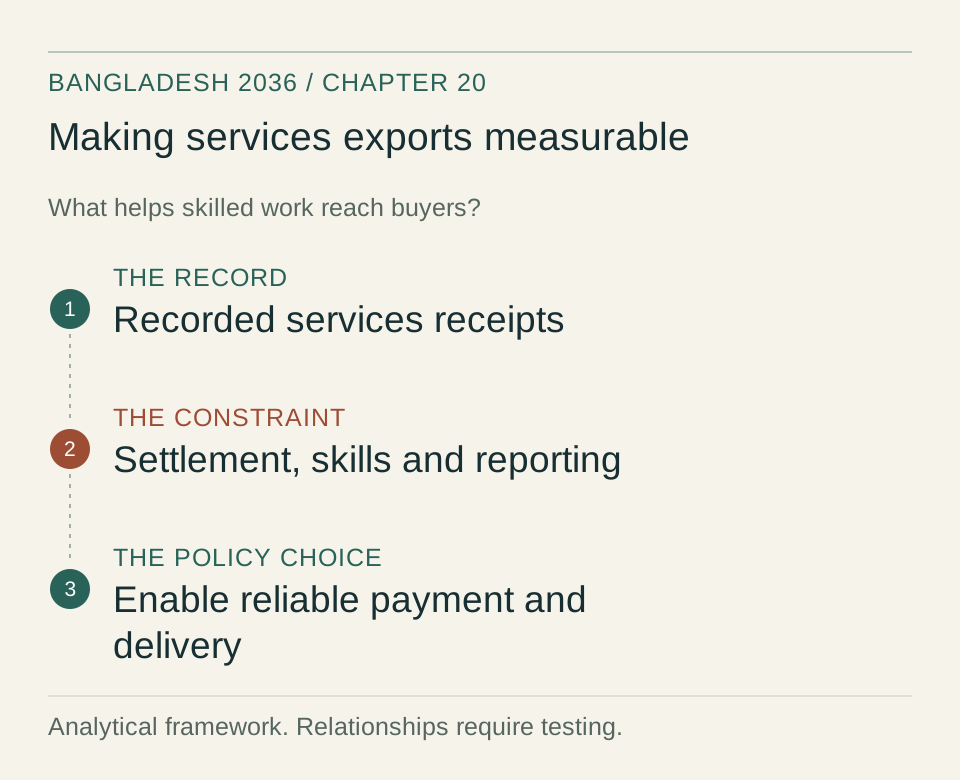
Freelancer claims and the measurement gap
The secondary compilation's freelancer counts and income estimates could not be traced to a sufficiently documented primary series [ICT Division 2020]. They are excluded from the measured baseline. The compilation cannot support a reliable earnings-per-worker calculation.
The compilation attributes headcounts to registrations and income to an undocumented government estimate. The balance of payments cannot independently validate those claims or identify a freelancer population. Comparison with garment exports requires a documented services category and a consistent measure of employment, rather than the compilation's claims. The gender angle is chapter 35's: freelancing is one of the few tradable activities accessible without the migration, factory gate or street presence other markets require, and no cited series measures its female share.
Connectivity and the skills pipeline
The rails and pipes the sector runs on are built. National internet bandwidth capacity reached 5,805.05 Gbps at end-FY23, up from 2,710.36 Gbps at end-FY21, with usage of 4,865.44 Gbps [BTRC 2023], more than doubling in two years. Internet use crossed half the population at 53.42 percent in 2024, against fixed broadband of 8.09 per 100 people [WB WDI 2026], the mobile-only cap chapter 13 diagnoses. Mobile money counts 88.89 million active accounts and 238.68 million registered accounts served by 822,726 agent outlets, with transactions worth 34.73 percent of GDP in 2024 [IMF FAS 2024].
The monetisation of the infrastructure as recorded service exports is near zero: BSCCL booked 2.54 crore BDT of submarine cable bandwidth export revenue in FY23, up from 1.99 crore BDT in FY22 [BSCPLC 2023], a rounding error against the merchandise account. The skills pipeline is the thin part: the UNESCO ICT skills series, whose Bangladesh indicator is the share of individuals who used a basic arithmetic formula in a spreadsheet, records 13.7 percent in 2023, down from 14.2 percent in 2021, and the 15 to 24 cohort fell from 34.6 to 23.1 percent over the same two years, young women at 21.2 percent against young men at 25.2 [UNESCO UIS 2023, ICTSKILLARSP].
The outflow chapter 33 measures drains exactly the mid career cohort the export firms hire.
Settlement, capability and formal reporting
Gate one is settlement. Platform income arrives through informal value transfer, personal cards and hundi adjacent rails because the formal inbound channel is built for family remittances, not for micro invoices from foreign platforms; the hundi premium chapter 03 and chapter 21 measure applied to service income too until the float repriced it in May 2024 at 117.7 BDT per USD [BIS 2026]. The float's formalisation dividend, remittances up 26.8 percent in FY25 [BB Econ 2025, cited from chapter 03], is the natural experiment: the same mechanism would move freelancing income into the record if the rails allowed it. The regulatory state of the cross-border settlement leg for platform payouts could not be confirmed from the cited sources, the Bangladesh Bank payment systems documents being the resolving source.
Gate two is the capability ladder. Recorded exports concentrate in low end outsourcing and data entry, the segment generative AI compresses first, chapter 13's risk verbatim, while the higher value lines of software products and global capability centres require the English plus skills pipeline and the fixed broadband stock of 8.09 per 100 [WB WDI 2026] constrains the bandwidth half. The UNESCO youth spreadsheet skills fall from 34.6 to 23.1 percent between 2021 and 2023 [UNESCO UIS 2023] points the supply side the wrong way while demand for those skills peaks.
Gate three is informality. Freelancers are unregistered by construction: no trade credit, no export certification, no tax record that would let them scale into firms, the informality trap chapter 22 measures at economy level. The sector's tax exemptions on ICT service income carried an annual cost that could not be confirmed here, the NBR documents being the resolving source; what a decade of exemptions and the incubators chapter 18 records never produced was a registration regime light enough to use or a settlement channel priced for micro transactions. The push pull asymmetry is why the sector's story is scale without record: the workers came, the rails did not.
Decisions that support services exports
Four forces decide the FY27 to FY36 window the chapter 15 scenarios assume. First, formalisation of platform income: the float plus the rails could move the claimed 1,000 million USD [ICT Division 2020] toward the recorded account, and the indicator to monitor is the ICT export line's convergence with platform estimates. Second, the AI shock: the outsourcing segment the country competes in is the segment generative AI compresses first, and the response is the ladder's upper rungs. Third, the transport deficit's partial conversion: container fleet ownership and regional shipping services would cut the freight bill, 6.73 billion USD in calendar 2023 [IMF BOP 2023, item 121] and 7,773.7 million USD in FY25 on Bangladesh Bank's revised table [BB Econ 2026, Services and income account, FY25R], at the margin, the mechanism chapter 57 and chapter 23 develop.
Fourth, the travel turn: if visa and aviation constraints ease, the travel line, 0.45 billion USD in calendar 2023 [IMF BOP 2023, item 122] and 454.3 million USD in FY25 [BB Econ 2026, Services and income account, FY25R], has the largest proportional headroom in the account, the monetisation chapter 56 measures.
No cited services projection targeting 2036 exists in the cited data and any figure would not be established; the World Bank's services trade work and the ICT Division's updated strategy are the authors that could support a forecast. The decision points are the cross-border payment rail decision chapter 37 examines, the bandwidth and power reliability decisions chapters 13 and 10 own, and the freelancer registration decision: whether a light touch export licence converts informality into record.
Risks and opportunities
Risks. First, AI compression: the recorded 740.89 million USD line and the informal income behind it both sit in the exposure band, and the indicator to monitor is the ICT export line against the global outsourcing price index. Second, the measurement regime: if the compilation claims are believed and the balance of payments record dismissed, policy optimises for a number nobody can bank; the indicator to monitor is the gap between the two series, which widened in 2024 when the claimed headcount jumped 43 percent and claimed income rose 5.3 percent. Third, the transport bill compounding: freight charges scale with trade volume, so the 6.73 billion USD of FY23 already reached 7,773.7 million USD in FY25 [BB Econ 2026, Services and income account, FY25R] and grows with chapter 17's exports unless fleet and efficiency intervene, and the indicator to monitor is the transport deficit's share of total trade.
Upside. First, the remittance formalisation template: the 26.8 percent FY25 jump chapter 03 records [BB Econ 2025] proves the float plus rails mechanism, and applying it to service income is the cheapest export policy available. Second, the global capability centre wave: firms diversifying delivery locations price exactly the young, English speaking, low cost workforce the demographic window chapter 08 provides. Third, the organised services proof: construction services credits of 733.76 million USD in calendar 2023 [IMF BOP 2023, item 123c] show regional demand for Bangladeshi labour services is bankable when organised, and organising it is an institutional task, not a market discovery.
Testing the policy case
Bangladesh Bank and the ICT Division should evaluate settlement changes against independently recorded receipts and the costs exporters face. More registrations without additional reported earnings would weaken a registration-led growth claim. A consistent classification of ICT and other professional services is essential before comparing freelancer claims with export accounts.
What to watch
The thresholds below are author-proposed monitoring markers, not official targets or estimated policy effects. Interpret them alongside the source dates and definitions.
- ICT and information services exports. Latest cited value 740.89 million USD in FY25, 8.79 percent of service exports on the World Bank denominator [WB WDI 2026]; 738.0 million USD, 10.87 percent, on Bangladesh Bank's revised FY25 table [BB Econ 2026, Services and income account, FY25R]. Threshold: sustained prints above 1 billion USD mark the export sector's existence, chapter 13's mark; a fall below 600 million would be consistent with the plateau and AI compression.
- Total service exports. Latest cited value 7.47 billion USD in calendar 2024 [IMF BOP 2024] and 6,790.8 million USD in FY25 on Bangladesh Bank's revised table [BB Econ 2026, Services and income account, FY25R]. Threshold: growth above 10 percent a year marks the services turn; stagnation near 7 billion marks the merchandise-only regime holding.
- Transport services balance. Latest cited value 0.77 billion USD of credits against 6.73 billion of debits in calendar 2023 [IMF BOP 2023, item 121]; 1,490.0 million USD against 7,773.7 million in FY25 [BB Econ 2026, Services and income account, FY25R]. Threshold: the deficit's share of total trade falling marks the fleet and efficiency turn; growth with trade marks the bill compounding.
- Freelancer count against recorded income. The freelancer count and income claims are not verified [ICT Division 2020]. Recorded ICT exports were 740.89 million USD in FY25 [WB WDI 2026], a category that should not be equated with freelancing alone. Threshold: convergence of the two series marks the formalisation regime; divergence marks the measurement regime failing.
- Travel services balance. Latest cited value 0.45 billion USD of credits against 1.68 billion of debits in calendar 2023 [IMF BOP 2023, item 122]; 454.3 million USD against 1,660.6 million in FY25 on the Bangladesh Bank fiscal year, which is a different basis from the calendar figures above and not a like for like comparison [BB Econ 2026, Services and income account, FY25R]. Threshold: travel exports passing 1 billion USD marks the tourism monetisation turn chapter 56 targets.
Sources used
[WB WDI 2026] World Bank World Development Indicators via hdx/wb_combined.csv, series: BX.GSR.CCIS.CD, BX.GSR.CCIS.ZS, BX.GSR.NFSV.CD, IT.NET.USER.ZS, IT.NET.BBND.P2; years follow the July to June fiscal year.
[BB Econ 2026] Bangladesh Bank, Services and income account, monthly table, column 2024-25R (July to June), million USD,
[IMF BOP 2024] IMF Balance of Payments, BPM6 presentation, via the curated IMF pull trade/bd_imf_bop.parquet, services credit, debit and balance, calendar 2024. This pull is calendar year and must not be joined to Bangladesh Bank fiscal year tables.
[IMF BOP 2023] IMF Balance of Payments, BPM6 presentation, via the trade/bd_bop_flows parquet, items 120, 121, 122, 123 and sub-items 123a to 123j, credits and debits, calendar 2023. This pull is calendar year: its 2019 travel receipt of 388.427 million USD matches the World Bank calendar 2019 figure of 388 million. An earlier version of this chapter labelled every row here as a fiscal year.
[ICT Division 2020] ICT Division registration counts and government income estimate as carried by the BDFacts sector compilation in bdpolicy.db, series: bdfacts_freelancers_total_count, bdfacts_freelancing_income_usd_million, annual 2018 to 2024; no upstream document available, not confirmed.
[IMF FAS 2024] IMF Financial Access Survey via bdpolicy.db, series: imf_fas_mobile_money_active_accounts, imf_fas_mobile_money_registered_accounts, imf_fas_mobile_money_agent_outlets, imf_fas_mobile_money_tx_pct_gdp, 2024.
[BTRC 2023] Bangladesh Telecommunication Regulatory Commission via bdpolicy.db, series: btrc_bandwidth_capacity_gbps, btrc_bandwidth_usage_gbps, end-FY21 to end-FY23.
[BSCPLC 2023] Bangladesh Submarine Cable Company Limited via the MoF SOE evaluation tables in bdpolicy.db, series: bscplc_iplc_export_m_bdt, FY22 and FY23.
[UNESCO UIS 2023] UNESCO UIS ICT skills series via the UNESCO SDG pull hdx/extra/unesco-data-for-bangladesh__sdg_data_bgd.parquet, series: ICTSKILLARSP, ICTSKILLARSP.AG15T24, ICTSKILLARSP.AG15T24.F, ICTSKILLARSP.AG15T24.M, 2021 and 2023.
[BB Econ 2025] Bangladesh Bank Monthly Economic Trends, remittances, cited from chapter 03.
[BIS 2026] Bank for International Settlements USD/BDT series via bdpolicy.db, series: bis_usd_bdt_monthly_eop.
[BACI 2024] CEPII bilateral trade at HS6 via TradeWeave parquet, series: bd_hs6_trade, cited from chapter 17.