Executive Summary. Forty years of satellite imagery establish one falsifiable claim: Bangladesh's monsoon flood extent shows no downward trend (it oscillates between 1,219 km2 and 3,826 km2 with no clear direction), while the seasonal swing from dry to flooded ground reached its dataset maximum of 3,094 km2 in 2015. Behind that volatility, river erosion is accelerating in the northeast and southeast, and wetlands that once buffered peak flows have lost up to 86% of their area. The Surma River now erodes land at 734 hectares per year, faster than any resettlement program can keep pace with, and the eight rivers with measurable erosion together consume roughly 909 hectares per year. In May 2026, rivers in Netrokona and Moulvibazar were already above danger levels before the main monsoon arrived. The BNP government (in office from February 17, 2026) must treat wetland restoration, bank revetment on the Surma-Sangu corridor, and volatility-calibrated early warning as its first-term climate priorities.
In July 2020, satellite sensors orbiting 700 kilometers above Bangladesh captured something that no ground survey could: the entire country, from the Teesta basin to the Meghna estuary, in a single frame. What they recorded was water. An extraordinary amount of water. Over 2,600 square kilometers of land lay submerged under monsoon floodwater, a sprawling inland sea visible from space.
That image was not an anomaly. It was just one frame in a 40-year movie that tells a story of a country locked in an intensifying struggle with water, a struggle it is losing.
This is that story, told entirely through satellite data.
The monsoon footprint shows no downward trend
Every year, Bangladesh transforms. The dry season reveals cropland, roads, settlements. Then the monsoon arrives and water reclaims territory that humans thought was theirs. Satellites have been measuring this transformation since 1990.
The claim is precise and testable: over 30 years of observation, monsoon flood extent has not trended down. It has swung. In 1990, monsoon floodwater covered 3,826 km2 of land surface. The 2010 monsoon reached 3,459 km2, and 2015 reached 3,622 km2. The mild years are just as real: 1995 at 2,038 km2 and 2005 at 1,219 km2. The 2020 monsoon, at 2,616 km2, was moderate by this record, and 2000, at 3,287 km2, sat near the top. A trend line through these seven observations is flat: the wet years are not getting drier, and the country has had no decade of relief.
The averages hide where the danger is actually growing. The signal is in the seasonal swing, the difference between dry-season water and monsoon-season water in the same year. That swing widened to 3,094 km2 in 2015, the largest in the dataset, up from 2,650 km2 in 1990. Over three thousand square kilometers of land transitioned from dry ground to standing water in a matter of weeks. A widening swing is harder to plan around than a high average: it means the gap between what a community prepares for and what arrives is itself growing.
The 2020 monsoon, at 2,616 km2, was moderate by historical standards. That should not be reassuring. A "moderate" monsoon in Bangladesh still drowns an area larger than Luxembourg's 2,586 km2.
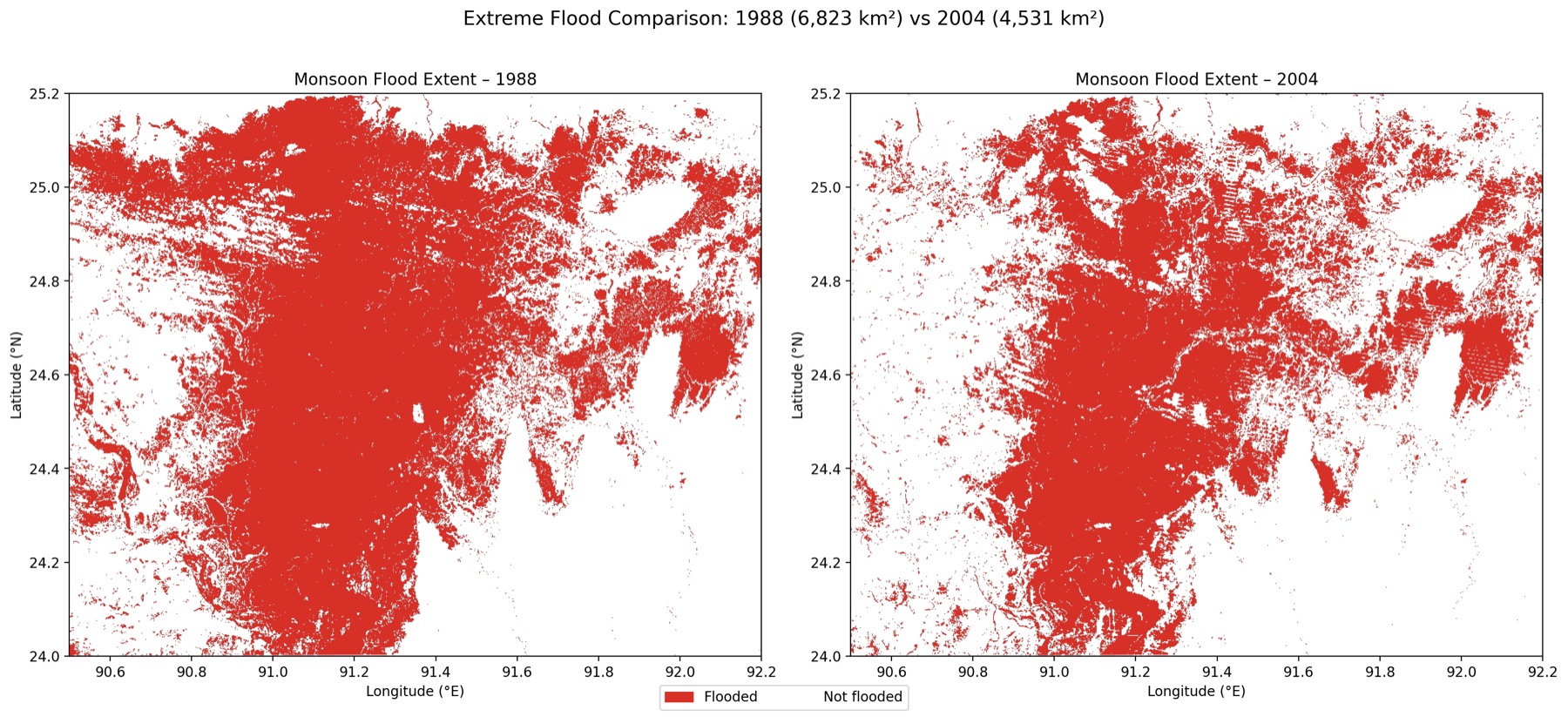
What makes this data alarming is not any single year. It is the combination of a flat trend in extent and a rising swing. The gap between the mildest year (1995, 2,038 km2) and the severest (1990, 3,826 km2) is a near-doubling, and the dry-to-wet swing within a single year now exceeds it. Communities cannot plan around that level of uncertainty. The thesis to falsify is not "floods are getting bigger every year"; it is "floods are not getting smaller, and their year-to-year variability is widening." The satellite record supports both halves.
The rivers are eating the land
Flooding is temporary. River erosion is permanent.
When a river erodes its bank, that land does not come back. Homes, farms, schools, mosques, everything on it falls into the current and is carried away. Satellite-based channel migration analysis across 16 major rivers reveals the scale of this destruction.
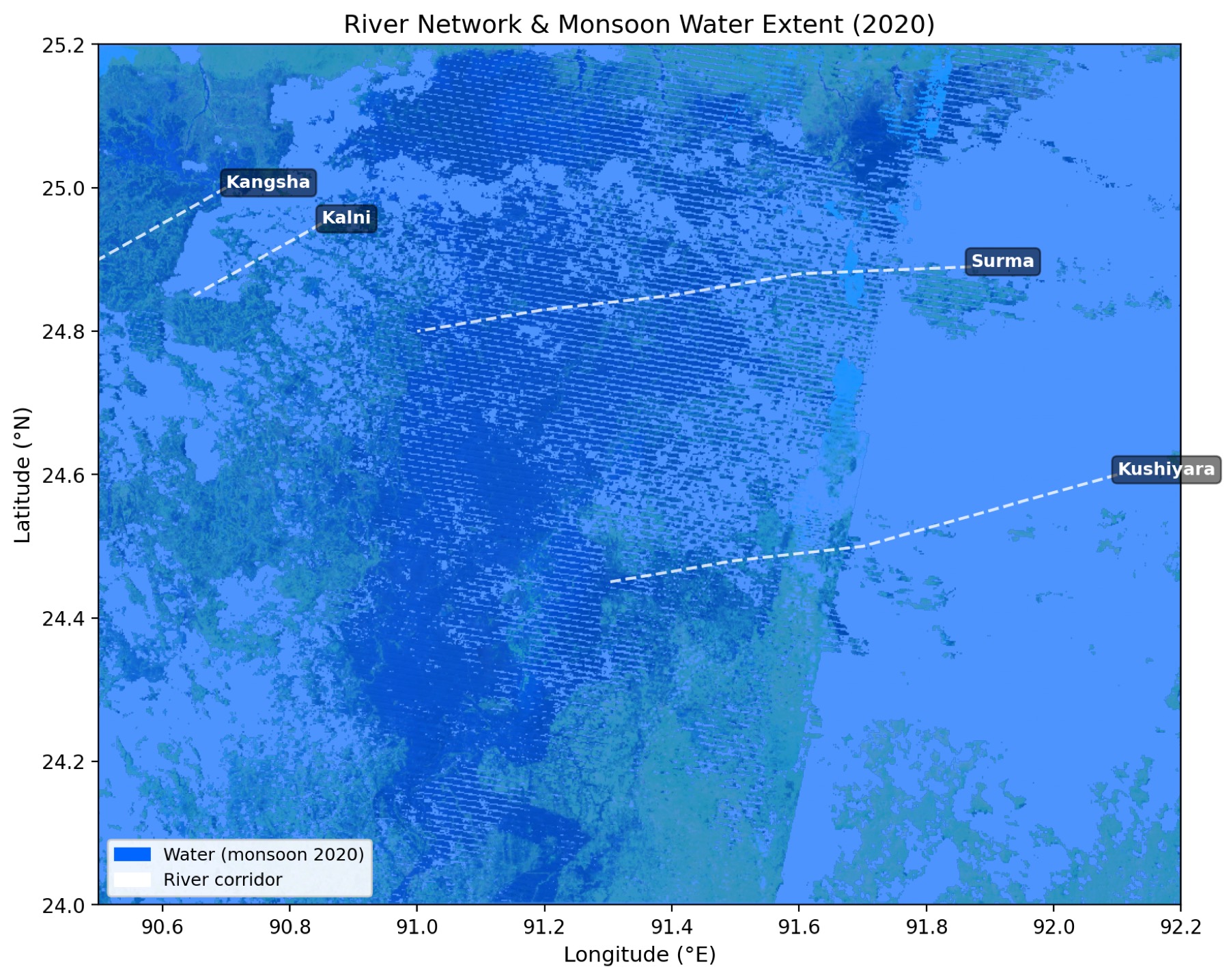
The Surma River in Sylhet is the most aggressive eroder in the satellite record. Between 1995 and 2005, it was consuming 486 hectares per year. That rate accelerated to 680 ha/yr in 2005-2015, and then to 734 ha/yr in the most recent decade. That is not stabilizing. That is a river accelerating its consumption of the landscape.
The Sangu River in the Chittagong Hill Tracts tells a similar story: from 14 ha/yr in 1995-2005 to 96 ha/yr in 2015-2025, a nearly seven-fold increase. The Karnaphuli, which flows through Chattogram city, has also picked up pace, reaching 18 ha/yr in the latest period after a lull in 2005-2015.
Not every river is getting worse. The Arial Khan has slowed from 79 to 28 ha/yr. The Dharla dropped from 25 to 4 ha/yr. But these improvements are dwarfed by the acceleration elsewhere.
Add the numbers up across the eight rivers with measurable erosion in the most recent decade (2015-2025), and the total, before rounding each river's rate, is 909 hectares per year, of which the Surma alone accounts for 734. The other seven (Sangu 96, Arial Khan 28, Karnaphuli 18, Kangsha 14, Kalni 13, Dharla 4, Matamuhuri 1) make up the balance. Each hectare lost represents families displaced, livelihoods destroyed, and tax base eroded.
The wetlands are vanishing
Bangladesh's haors, beels, and floodplains are the country's natural shock absorbers. During monsoon, they expand to hold excess water. During dry season, they contract, exposing fertile land and sustaining fisheries. They are, in ecological terms, the kidneys of the delta.
The satellites show those kidneys failing.
Chalan Beel, once the largest beel in Bangladesh at nearly 77 km2 in 1993, had collapsed to barely 11 km2 by 2023. That is an 86% decline in three decades. The causes are well-documented: encroachment for rice cultivation, siltation from upstream deforestation, and unplanned road embankments that fragment the wetland.
The Meghna Floodplain has shrunk from 186 km2 in 1990 to 58 km2 in 2023, a 69% loss. Hail Haor dropped from 18 km2 to under 3 km2. Even the larger haors show wild inter-annual swings that suggest degraded capacity: Hakaluki Haor measured 197 km2 in 1990 but collapsed to near-zero in 1999 and 2020, likely due to dry-season drainage for agriculture, before recovering.
Tanguar Haor, a Ramsar wetland site under international protection, has been more resilient, fluctuating between 62 and 284 km2 without a collapse to near-zero. But variability for a protected site is the bare minimum. The unprotected wetlands are the ones being destroyed, and they are the ones that millions of rural Bangladeshis depend on for fish, water, and flood buffering.
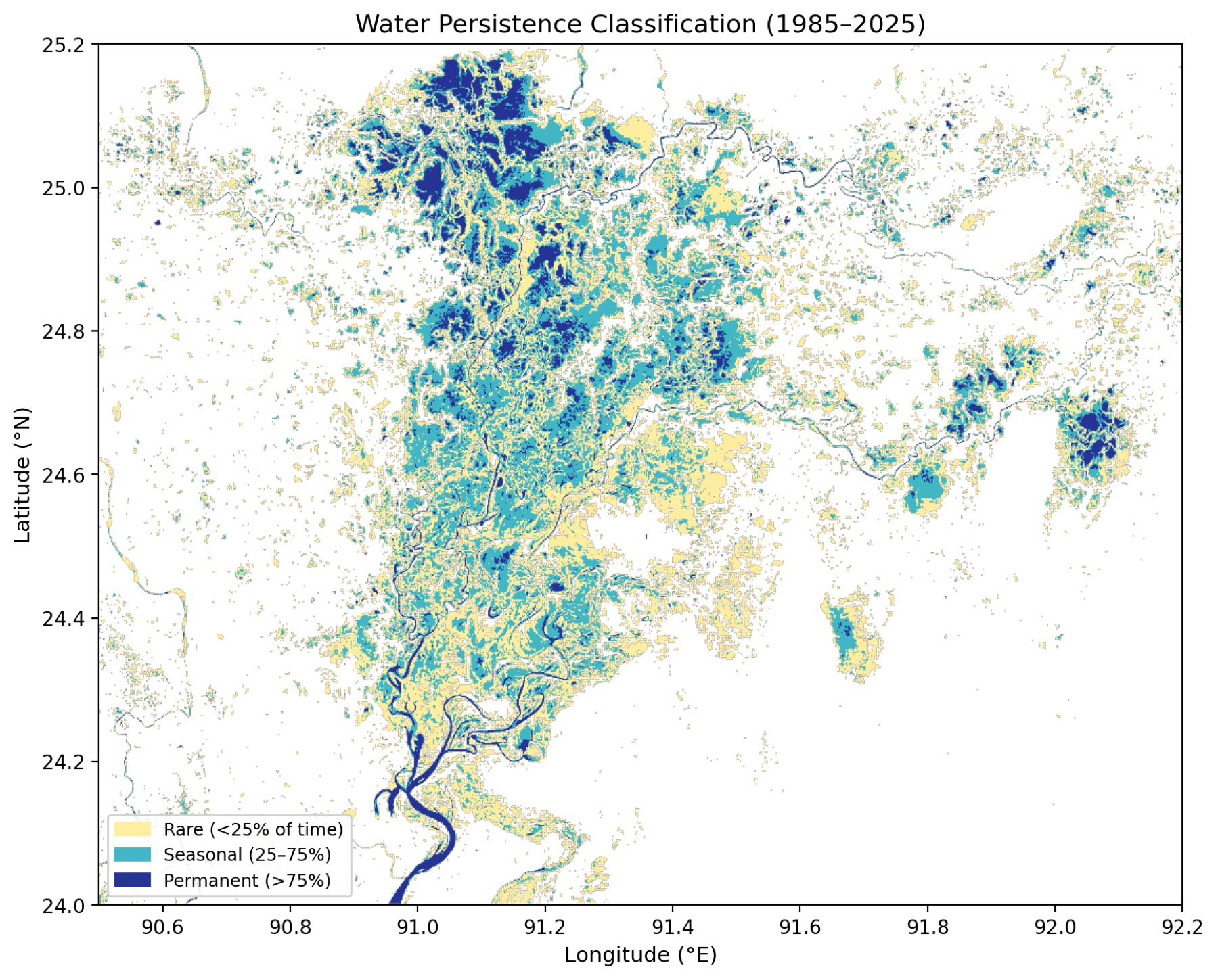
The arithmetic of wetland loss is simple and devastating: every square kilometer of haor that disappears is a square kilometer of floodwater that has to go somewhere else. It goes into villages.
The rain is getting wilder
The satellite and ground-station rainfall record spanning 1985 to 2023 reveals not a simple increase in total precipitation, but something more dangerous: increasing volatility.
Mean annual rainfall across Bangladesh ranged from 2,130 mm (1989, a relatively dry year) to 3,148 mm (2017, the wettest in the record). That is roughly a 1.5-to-one ratio between the driest and wettest years. For a country whose agriculture, infrastructure, and settlement patterns were designed around a relatively narrow rainfall band, this volatility is a crisis in itself.
The 2017 spike is worth pausing on. At 3,148 mm mean rainfall, with a spatial maximum of 7,419 mm, that year was an outlier by any measure. It coincided with the devastating northeast haor flash floods in Sylhet, Sunamganj, and the northern districts, which affected roughly 4.7 million people across six districts (FAO GIEWS, 2017).
The monsoon share of rainfall shows a similar pattern of unpredictability. Monsoon precipitation has oscillated between 1,293 mm (1992) and 1,931 mm (2004), with no clear directional trend but substantial year-to-year swings. In 2022, monsoon rainfall dropped to 1,355 mm, only to rebound to 1,864 mm in 2024.
Meanwhile, land surface temperature data from MODIS satellites shows the thermal backdrop against which all of this is playing out. Daytime land surface temperatures have remained stubbornly high, averaging 26.6 to 27.8 degrees Celsius across the country. Night-time temperatures show a slight upward drift over the 2000-2024 period, from 20.6 degrees in 2000 to above 20.9 degrees in 2024, with a low of 19.4 degrees in 2012. Warmer nights mean more atmospheric moisture capacity, which means more intense rainfall events when they do occur.
What the satellites cannot see
The satellite record is powerful but incomplete. It measures area, not depth. It captures extent, not velocity. It shows where water was, not how many people it displaced.
But the data it does provide leads to one conclusion: Bangladesh's water crisis is not a future threat. It has been unfolding for four decades, visible from orbit, measured in square kilometers and hectares, and it is getting worse in several critical dimensions simultaneously.
The monsoon flood footprint is not shrinking, and its seasonal swing is widening. River erosion is accelerating in the northeast and southeast. Wetlands that once buffered the worst impacts are being destroyed. And rainfall is becoming more volatile at exactly the moment when the country's natural and built infrastructure is least able to absorb shocks.
What policy must do
The satellite evidence points to three urgent, owner-assigned priorities.
First, protect the remaining wetlands. Owner: Ministry of Environment, Forest and Climate Change. Chalan Beel's collapse from 77 km2 to 11 km2 is not a natural process. It is the result of policy failures: unregulated encroachment, infrastructure that fragments ecosystems, and agricultural incentives that reward draining wetlands for rice. Extend Ramsar-grade legal protection and enforcement, which Tanguar Haor already receives, to the ten largest unprotected haors within the first term. Success signal: zero net dry-season area loss in those ten wetlands measured against the 2023 Landsat baseline by 2030.
Second, invest in erosion-resistant riverbank infrastructure along the Surma and Sangu corridors. Owner: Bangladesh Water Development Board. These rivers are accelerating. At 734 ha/yr, the Surma is consuming land faster than any resettlement program can relocate people, and the eight measurable rivers together lose 909 ha/yr. This requires hard engineering: revetments, geobags, strategic dredging, plus land-use rules that stop allowing settlement on actively eroding banks. Success signal: the Surma's measured erosion rate falls below its 2005-2015 level of 680 ha/yr within five years.
Third, redesign flood preparedness around volatility, not averages. Owner: Department of Disaster Management. The difference between a 2,038 km2 monsoon (1995) and a 3,826 km2 monsoon (1990) is the difference between manageable and catastrophic, and the dry-to-wet swing now exceeds even that gap. Current preparedness plans tend to be calibrated to recent experience. Calibrate early warning, evacuation capacity, and crop insurance to the worst case in the satellite record (the 3,826 km2 extent and the 3,094 km2 swing), not the average. Success signal: pre-positioned evacuation and shelter capacity rated for the 3,826 km2 scenario in all flood-prone districts before the 2027 monsoon.
The strongest counterargument is that the flat trend in flood extent means the system is coping, not failing. The data answers it: a flat extent trend paired with a widening seasonal swing and accelerating erosion is not stability, it is a system absorbing larger shocks with fewer natural buffers. What would change this conclusion is a sustained decline in extent together with a narrowing swing across two or more decades. The record shows neither.
Bangladesh did not choose its geography. It sits at the bottom of the Ganges-Brahmaputra-Meghna basin, which drains roughly 1.7 million square kilometers across five countries before reaching the delta (International Rivers; FAO Aquastat). But geography is not destiny. The Netherlands sits below sea level and thrives. The difference is policy.
The satellites have been watching for 40 years. The evidence is clear. The question is whether anyone is acting on it.
The Satellite Bangladesh series. Part 1: Bangladesh is Drowning (this part). Part 2: Bangladesh is Glowing. Part 3: Bangladesh is Greening (and Browning). Part 4: Bangladesh is Eroding. Part 5: Bangladesh is Dividing. Part 6: Bangladesh is Trading.
Sources
- Landsat flood mapping: USGS/NASA Landsat 5/7/8/9 surface water classification (NDWI/MNDWI/AWEI with Otsu thresholding), 1990-2020, processed by BDPolicyLab on Google Earth Engine. Flood-extent series:
bd_gis/outputs/flood_time_series.csv. https://earthengine.google.com - River erosion data: BDPolicyLab Landsat-derived channel migration analysis across 16 major rivers, 1995-2025. Per-river erosion-rate series, e.g.
bd_gis/outputs/rivers/surma_erosion_rates.csvandbd_gis/outputs/rivers/sangu_erosion_rates.csv. USGS/NASA source imagery. - Wetland area timeseries: BDPolicyLab Landsat dry-season composites (Nov-Feb), per-wetland series, e.g.
bd_gis/outputs/haors/chalan_beel_area_timeseries.csvandbd_gis/outputs/haors/meghna_floodplain_area_timeseries.csv. USGS/NASA source imagery. - Extreme flood, river corridor, and water persistence maps: BDPolicyLab bd_gis pipeline, Landsat 5/7/8/9 and Sentinel-2 water classification (NDWI/MNDWI/AWEI, Otsu thresholding), Sylhet haor wetlands study area, 1985-2025.
bd_gis/outputs/report_maps/. Validated against JRC Global Surface Water v1.4 (Pekel et al. 2016, doi:10.1038/nature20584), Pearson r = 0.717. https://global-surface-water.appspot.com - CHIRPS precipitation: Climate Hazards Group InfraRed Precipitation with Station data, 5.5 km resolution, 1985-2023. https://www.chc.ucsb.edu/data/chirps
- MODIS LST: NASA Terra/Aqua MOD11A2, 1 km resolution, 2000-2024. https://lpdaac.usgs.gov/products/mod11a2v006/
- 2017 northeast flood impact: FAO GIEWS Update, "Bangladesh: Severe floods in 2017 affected large numbers of people," 2017 (approximately 4.7 million people across six districts). https://reliefweb.int/report/bangladesh/giews-update-bangladesh-severe-floods-2017-affected-large-numbers-people-and
- GBM basin drainage area: International Rivers and FAO Aquastat, Ganges-Brahmaputra-Meghna basin (approximately 1.7 million km2 across five countries). https://www.internationalrivers.org/where-we-work/asia/ganges-brahmaputra-meghna/
- May 2026 pre-monsoon flooding: The Daily Star, "Water levels in four rivers above danger level, flood risk in five districts," May 2026. https://www.thedailystar.net/news/environment/climate-crisis/natural-disaster/news/water-levels-four-rivers-above-danger-level-flood-risk-five-districts-4163701
- Flood frequency statistics: IFRC Bangladesh Floods overview. https://www.ifrc.org/urgence/bangladesh-floods
- Administrative boundaries: geoBoundaries ADM2, William and Mary geoLab. https://www.geoboundaries.org
- Satellite processing: Google Earth Engine. https://earthengine.google.com